Puzzle Feeders a Border Collie Cannot Solve Twice
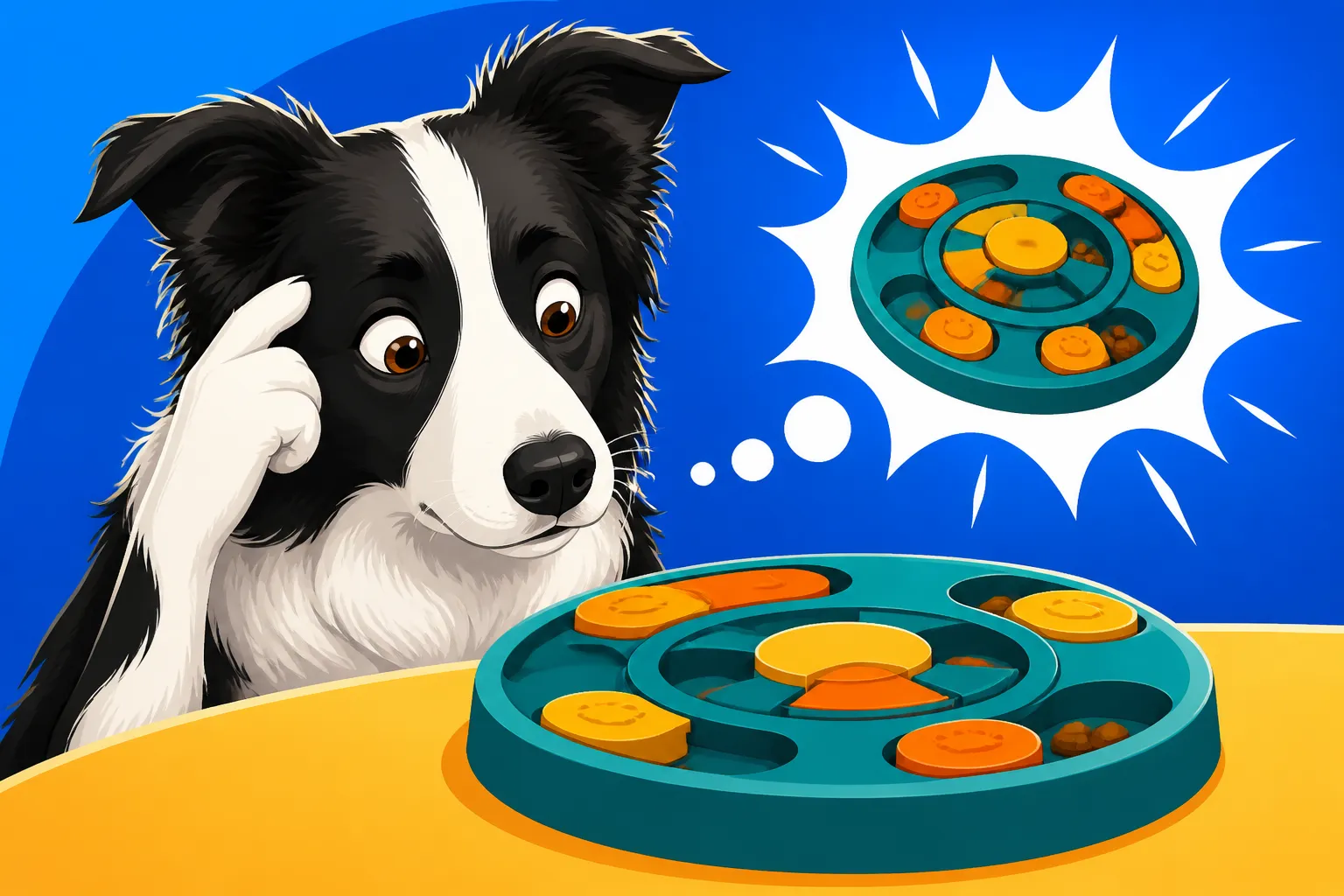
If you're a Border Collie owner, you know the struggle: you bring home a shiny new puzzle feeder, full of hope, only for your brilliant canine companion to solve it in about 37 seconds flat. You feel a mix of pride and exasperation, left wondering if there's any puzzle out there that can actually challenge their incredible minds for more than five minutes. This guide is here to tackle that very frustration, exploring how to select and utilize puzzle feeders that truly engage your Border Collie, preventing them from becoming "one-and-done" toys.
The Frustration of the "One-and-Done" Puzzle Feeder
It’s a familiar scene for many of us with Border Collies. You unbox a new puzzle feeder, excited by its clever design and promises of mental stimulation. Your dog sniffs it, perhaps gives it a tentative paw, then BAM! In a blur of nose-nudges, paw-swipes, and focused "eye," they’ve emptied every compartment. The treats are gone, the puzzle is solved, and your Border Collie looks up at you with an expectant gaze that clearly says, "Is that all you've got?" This isn't just a minor annoyance; it can be genuinely frustrating when you've invested time and money in tools meant to enrich their lives, only for them to be utterly conquered almost instantly.
The core issue isn't that the puzzle feeders are necessarily bad; it's that Border Collies operate on a whole different level of cognitive ability. Their natural drive to problem-solve, combined with their incredible learning speed, means they can often outthink or outmaneuver toys designed for a more average canine intellect. We’re dealing with a breed bred for intricate, independent thinking in complex working environments, so a simple slide-and-reveal mechanism might feel like kindergarten math to them.
This rapid problem-solving can leave owners feeling defeated, especially when the goal is to provide sustained mental engagement throughout the day or during times when you can't actively train them. It can feel like an endless quest for the next big thing, always chasing that elusive challenge that will truly satisfy their insatiable brains.
Why Border Collies Master Puzzles So Quickly
Let's face it, Border Collies aren't just "smart"; they're often described as canine Einsteins. This isn't just anecdotal fluff; their intelligence is consistently ranked among the highest of all dog breeds, and it's backed by centuries of selective breeding for problem-solving in dynamic, unpredictable environments like a sheep pasture. They're designed to analyze, strategize, and execute complex commands, often at a distance and with minimal input. They need to read livestock, terrain, and their handler's subtle cues all at once.
This inherent intelligence translates directly to how they approach puzzle feeders. They don't just randomly bat at things; they observe, they learn cause-and-effect remarkably fast, and they remember what worked before. A Border Collie can often deduce the underlying mechanism of a puzzle after only one or two successful solves, making subsequent attempts less about problem-solving and more about executing a learned sequence. This is why many owners find that a puzzle feeder that was engaging on day one becomes a mere treat dispenser by day three. Their ability to quickly identify patterns and manipulate objects is extraordinary. How Few Repetitions a Border Collie Needs to master a new task is truly astonishing, and puzzle feeders are no exception.
Furthermore, Border Collies thrive on mental work. For them, solving a puzzle isn't just about getting a treat; it's about the satisfaction of the intellectual challenge itself. It taps into their drive to "figure things out" and control their environment, much like herding gives them purpose. If the puzzle is too simple, that inherent need for mental engagement isn't met, leading to boredom and, potentially, the search for other things to "solve" around your house, which might not be as desirable as a puzzle feeder.
The Cost of Under-Challenging Your Genius Dog
Beyond the immediate frustration of a quickly solved toy, there's a real, tangible cost to consistently under-challenging a Border Collie. When their formidable minds aren't adequately stimulated, they don't just sit around and mope; they invent their own jobs. And often, those self-appointed tasks aren't ones we appreciate. We're talking about behaviors like obsessive shadow chasing, fence running, destructive chewing, excessive barking, or even developing complex behavioral patterns to get attention. These aren't signs of a "bad" dog, but rather a brilliant dog that's desperately trying to fulfill its genetic imperative to work.
The expense of dealing with these behaviors can quickly add up. Imagine the cost of replacing furniture chewed to splinters, repairing fences damaged by tireless patrolling, or paying for extensive behavioral training. These are the hidden costs of not meeting your Border Collie's mental needs. A well-designed, challenging puzzle feeder, or a rotation of them, can be a surprisingly cost-effective way to prevent these issues by channeling their mental energy into appropriate outlets. The Annual Border Collie Budget Nobody Plans For often includes these unexpected behavioral costs.
Moreover, a bored Border Collie can become anxious or stressed, leading to health issues down the line. Chronic stress can impact their immune system, digestion, and overall well-being. Investing in mental enrichment isn't just about preventing bad habits; it's about nurturing a happy, well-adjusted dog. Just as A Month of Food for a Working Border Collie is essential for their physical health, consistent mental engagement is crucial for their psychological health.
Understanding Different Tiers of Puzzle Complexity
When we talk about puzzle feeders, it’s not a one-size-fits-all situation, especially when you have a Border Collie. Think of them like levels in a video game: you wouldn't give a seasoned gamer a tutorial-level challenge and expect them to be entertained for long. For our Border Collies, we need to understand the different tiers of complexity available and how to identify what level of challenge your dog genuinely needs. This isn't just about buying the most expensive puzzle; it's about choosing one that matches their cognitive abilities and then using it in a way that maximizes its potential for engagement.
Many owners fall into the trap of buying what looks interesting, only to find their dog solves it instantly. Instead, let's categorize them to give us a better framework for selection. We need to move beyond simple "treat dispensing toys" and look for true "problem-solving apparatuses" when it comes to our super-smart companions.
Entry-Level Puzzles for Beginners (or "Warm-Ups")
Entry-level puzzles are typically straightforward devices where the dog needs to perform a single, obvious action to release treats. These might involve knocking something over, pushing a single slider, or lifting a simple lid. For many dog breeds, these are fantastic and provide plenty of mental stimulation. However, for a Border Collie, these are often warm-up exercises, if that. They are excellent for introducing the concept of a puzzle feeder to a young puppy, or for a dog that might be new to this type of enrichment. For example, a simple KONG Wobbler, where food tumbles out as the dog nudges it around, or a flat board with a few sliding panels, fits into this category.
While your adult Border Collie might breeze through these, they still have a place. They can be great for quick mental breaks, for spreading out a meal when you have limited time, or for a dog recovering from an injury who can't engage in more strenuous activities but still needs their brain stimulated. You can also use them to hold part of a meal (perhaps using a high-quality kibble from brands like Chewy or your fresh food delivery like Ollie, ensuring they're still getting good nutrition). Think of these as the mental equivalent of a quick stretch before a big run—they get the brain activated but won't sustain true engagement. They're also good for dogs who are just starting to learn that foraging for food can be a rewarding activity.
It's also worth noting that what constitutes "entry-level" for a Border Collie might be "intermediate" for another breed. Don't feel discouraged if your Border Collie masters these with shocking speed. It's a testament to their intelligence, not a failure on your part or the puzzle's. The key is to recognize their rapid learning and move them up the ladder swiftly.
Intermediate Challenges: Introducing Multiple Steps
Intermediate puzzles raise the bar by requiring two or more sequential actions, or a combination of different movements, to access the reward. These might involve lifting a peg then sliding a door, or rotating a wheel and then pulling a drawer. The dog can't just perform one action; they need to understand that one action enables the next. This introduces a level of strategic thinking that begins to tap into a Border Collie's cognitive strengths. These puzzles usually have more compartments, varying mechanisms, and require a bit more dexterity and persistence.
Examples might include puzzles where the dog has to remove a block, then slide a piece to reveal food, or a device with multiple drawers that must be pulled out in a specific order or with different types of manipulation. These puzzles start to leverage the Border Collie's ability to create a mental map of a problem and execute a plan. They encourage sustained engagement because the solution isn't immediately obvious after the first step. For many Border Collies, these puzzles will offer a decent challenge for the first few sessions, providing that sweet spot of frustration and eventual success that is so mentally satisfying. Puzzle Feeders That Hold a Border Collie in this category are starting to get interesting for our clever canines.
When introducing an intermediate puzzle, you might need to guide your Border Collie through the first few steps initially, just to help them understand the mechanics. Show them how one action leads to the next, and let them figure out the rest. This coaching phase is crucial; it teaches them how to learn these more complex challenges. Remember, the goal isn't for them to be utterly stumped forever, but for the process of discovery and execution to be mentally stimulating and take more than a few seconds.
Advanced Puzzles: Layers, Latches, and Sequential Thinking
Now we're talking about the big leagues for Border Collies. Advanced puzzles are designed to truly test their problem-solving prowess, often incorporating multiple layers of interaction, complex latches, gravity-fed components, or requiring a specific sequence of actions to unlock treats. These are the puzzles that might make you scratch your head for a moment when you first unbox them. They demand not just strength or basic manipulation, but genuine cognitive effort, memory, and sometimes even abstract thought.
Imagine a puzzle where your dog has to spin a carousel, which then reveals a string to pull, which in turn opens a drawer, and only then can they slide a panel to get the treat. Or puzzles with various types of levers, buttons, and sliding mechanisms that each require a different approach to open. Some even have components that can be rearranged or combined in different ways, adding an element of novelty with each use. These puzzles are designed to challenge The Border Collie That Learns Faster Than You Teach, giving them a truly engaging mental workout.
When looking for advanced puzzles, seek out designs that explicitly state they are for "expert" or "advanced" dogs. Brands known for durable, high-quality dog products, which you might find on platforms like Chewy, often have a good selection in this category. These can often be more expensive, but the investment is worth it for the sustained mental stimulation they provide. Always prioritize durability and safety, especially with complex mechanisms, to ensure there are no small pieces that could break off and be ingested.
Strategies for Making Puzzles Last Longer (or "Unsolvable Twice")
The reality is, even the most advanced puzzle feeder won't stay "unsolvable" forever for a Border Collie. Their incredible intelligence means they will eventually figure out any fixed mechanism. The key, then, isn't to find a puzzle they can't solve, but to implement strategies that extend the challenge, keep them guessing, and prevent the puzzle from becoming rote. We want to maximize the "thinking time" and minimize the "solving time" in subsequent uses. This involves a combination of puzzle selection, manipulation, and owner creativity.
It's about creating a dynamic environment where the puzzle isn't a static object but a continuously evolving challenge. This approach helps maintain that crucial mental engagement that our Border Collies crave and need. Without it, even the cleverest puzzle will eventually gather dust as your dog moves on to more "interesting" (and potentially destructive) pursuits.
Combining Puzzle Elements for a Super-Challenge
One of the most effective ways to elevate the difficulty of a puzzle feeder is to combine elements or add extra steps within the puzzle itself. For example, instead of just putting plain kibble in the compartments, try making the treats harder to extract. You could use larger, more irregularly shaped treats that don't slide out easily, or even moist, sticky treats that require more licking and maneuvering to get out. Some owners smear peanut butter or pureed pumpkin into crevices, forcing the dog to spend more time working it out.
You can also combine different puzzles! Imagine placing a smaller, simpler puzzle inside a compartment of a larger, more complex puzzle. Your Border Collie would first have to solve the outer puzzle to even access the inner one, then solve that one to get the reward. This creates a multi-layered challenge that takes significantly longer to decipher. Or, use a treat-dispensing ball as a "key" that needs to be rolled to a certain spot before a drawer can be opened. The possibilities are truly endless, limited only by your imagination and the types of puzzles you have. This strategy taps into the Border Collie's ability for Mental Work That Tires a Border Collie Faster by adding cognitive load.
Another simple but effective trick is to add obstacles. Place a soft toy or a knotted rag into a compartment alongside the treats. Your dog will have to pull out the obstacle first before they can access the food underneath. Just make sure any added elements are safe for your dog to chew on and won't present a choking hazard. This forces them to engage with the puzzle in a different way, adding a tactile and manipulative challenge to the cognitive one.
Rotating Puzzles and Introducing Novelty
Even the most brilliant Border Collie will memorize a puzzle's solution after repeated uses. The trick here is to prevent them from hitting that "muscle memory" stage too quickly. One of the simplest yet most effective strategies is to implement a strict rotation schedule for your puzzle feeders. Instead of letting your dog play with the same puzzle every day, have a selection of 3-5 different puzzles and only bring one out every few days. This way, by the time a particular puzzle reappears, the exact sequence of steps might not be as fresh in their memory, requiring them to "re-solve" it to some extent.
Think of it like us trying to remember a locker combination we haven't used in months – we might need a moment to recall it. For a Border Collie, this slight mental reset can be enough to increase the engagement time. You might even want to categorize your puzzles by difficulty and only rotate within a certain tier, or use a "warm-up" puzzle before introducing a more complex one in the same session. The Border Collie That Stays Sound Into Its Teens often benefits from varied mental stimulation throughout its life, keeping their minds sharp.
Introducing novelty doesn't just mean rotating different puzzles; it can also mean changing how you use the same puzzle. Alter the types of treats you put inside, use it in a different room, or even present it in a slightly modified orientation. These subtle changes can sometimes be enough to disrupt their learned sequence and encourage fresh problem-solving. This keeps their mind active and prevents the boredom that sets in when a task becomes too predictable.
DIY Solutions for the Truly Bored Border Collie
Sometimes, even the commercial advanced puzzles don't cut it, or your Border Collie breezes through them faster than your budget can keep up. This is where DIY solutions become your best friend. With a little creativity and some household items, you can create incredibly challenging and unique puzzles that your Border Collie absolutely cannot solve twice in the exact same way. These are often the most satisfying for both owner and dog because they are truly custom-tailored to your dog's specific skills and drives.
One classic DIY is the "snuffle mat" on steroids. Instead of just fabric strips, use different textures, hide treats under small, lightweight plastic cups, or tuck them into empty toilet paper rolls that are then hidden within the mat. The goal is to create multiple layers of scent work and manipulation. Another great idea is the "box labyrinth." Take several cardboard boxes of varying sizes. Cut holes in them, stack them, link them with small tunnels, and hide treats deep inside. Your Border Collie will have to navigate a complex, ever-changing maze. Just remember safety: no sharp edges, no toxic materials, and supervise your dog, especially if they are a strong chewer.
For a true challenge, consider creating an "environmental enrichment zone." Hide treats in various places around a secured room or yard, under different objects (like an overturned bucket, under a towel, behind a log). Your Border Collie then has to engage their scent work skills and their problem-solving to figure out how to access each hidden treat. This isn't a single puzzle, but a whole series of mini-challenges, constantly changing with each setup. You can even incorporate items from places like Healthy Paws for ideas on durable, non-toxic materials for DIY projects, focusing on safety.
Choosing the Right Puzzle Feeder for Your Individual Border Collie
Picking a puzzle feeder for a Border Collie isn't like buying a bag of kibble; it's a strategic decision that depends on your dog's unique personality, skill level, and even their physical capabilities. What works for one Border Collie might be too easy or too frustrating for another. Understanding these nuances is crucial to making an investment that actually pays off in terms of mental enrichment. There's nothing more disheartening than spending money on something your dog ignores or demolishes in seconds.
The goal is to find that sweet spot: challenging enough to require effort and thought, but not so impossible that it leads to frustration and giving up. This is a delicate balance, and it often involves a bit of trial and error. But by considering a few key factors, you can significantly increase your chances of finding a puzzle feeder that truly engages your brilliant companion.
Assessing Your Dog's Current Skill Level
Before you dive into the world of advanced puzzles, take a moment to honestly assess your Border Collie's current problem-solving skills. Have they easily conquered every "beginner" puzzle you've thrown their way? Do they pick up new tricks and commands with incredible speed? Do they exhibit signs of boredom if not mentally challenged regularly? If so, they’re likely ready for intermediate or advanced puzzles. If they're new to puzzles, or perhaps a bit more cautious, starting with an intermediate puzzle might still be appropriate, but be prepared to guide them more.
Consider their history with toys and games. Does your Border Collie prefer to figure things out independently, or do they look to you for guidance? Some Border Collies are relentless in their pursuit of a solution, while others might get frustrated and give up if a task is too difficult too quickly. Observing their engagement with simpler toys or even how they approach training exercises can give you clues. A dog that quickly learns How Many Words a Border Collie Can Learn might be ripe for multi-step puzzles, while one that takes a bit longer might benefit from a more incremental approach.
It's also important to remember that a Border Collie's skill level can evolve. A young, inexperienced puppy might start at true beginner puzzles, but quickly accelerate to advanced ones within months. An older dog might appreciate a slightly less physically demanding puzzle, even if their mind is still sharp. Regularly reassess their engagement and adjust the difficulty accordingly.
Durability and Safety Considerations
For a breed as active and intelligent as the Border Collie, durability and safety are paramount when choosing a puzzle feeder. Border Collies have strong jaws and often use their paws and noses with considerable force. A flimsy plastic puzzle might last all of five minutes before it's chewed into unrecognizable pieces, posing a choking hazard and rendering your investment useless. Always look for puzzles made from robust, high-quality materials like tough, non-toxic plastics, solid wood, or durable composites. Read reviews specifically from owners of strong chewers or highly intelligent breeds to get a real sense of a product's longevity.
Beyond the material, consider the design. Are there small, detachable parts that could easily come loose and be ingested? Are the mechanisms prone to breaking or trapping paws or noses? Does the puzzle have sharp edges or corners? These are all critical safety questions. A puzzle feeder should engage their mind, not put their health at risk. When buying online from retailers like Chewy, scrutinize product photos and descriptions for potential weak points. If you have concerns about potential vet costs due to accidental ingestion or injury, pet insurance from providers like Healthy Paws can provide peace of mind, though preventing the issue is always best.
Always supervise your Border Collie, especially with a new puzzle. Even the most well-designed puzzle can present an unforeseen issue with a determined dog. Supervision allows you to intervene if they get overly frustrated, start to chew inappropriately, or if a piece breaks. Once you're confident they understand how to use it safely, you can often leave them to it, but a watchful eye during initial sessions is always a good idea.
Where to Find High-Quality, Challenging Puzzles
Finding truly high-quality, challenging puzzle feeders for Border Collies often requires looking beyond the basic offerings at your local big-box pet store. While those stores might have some entry-level options, the more advanced, multi-step puzzles tend to be found at specialty pet boutiques, online retailers, or direct from manufacturers known for pet enrichment products. Online platforms like Chewy offer an extensive selection, often with detailed descriptions and customer reviews that can help you gauge complexity and durability.
Look for brands that specialize in "brain games" or "interactive feeding" rather than just "slow feeders." Some European brands are particularly well-regarded for their innovative and robust puzzle designs. Don't be afraid to read detailed blogs and forums from other Border Collie owners; they are often the best source for recommendations on what truly holds up to the intelligence and drive of the breed. Brands that also offer high-quality food, like Ollie, sometimes collaborate with puzzle manufacturers or offer recommendations for how to best use their food with various feeders.
Finally, consider the investment. Advanced, durable puzzle feeders will generally cost more than simpler ones. However, view this as an investment in your Border Collie's mental well-being and your own peace of mind. A single, truly challenging puzzle that lasts for years and prevents destructive behavior is far more valuable than a dozen cheap ones that are quickly conquered and discarded. Always check for a reputable return policy in case a puzzle simply doesn't meet your Border Collie's high standards.
Disclaimer
This article is for general informational purposes only and does not constitute professional advice. Laws, prices and regulations vary by location and change over time. Consult a qualified professional for guidance on your specific situation.