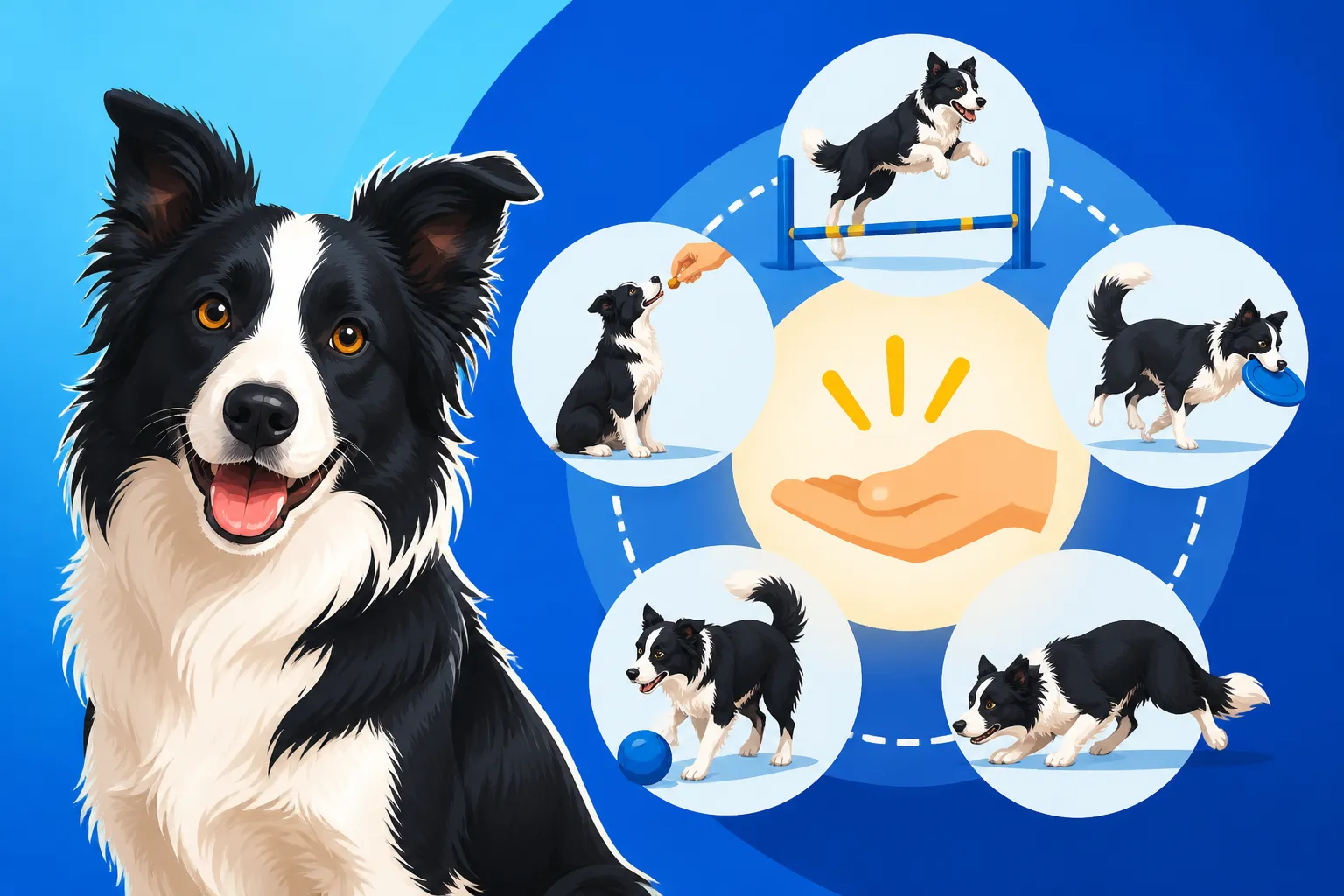
How Few Repetitions a Border Collie Needs
Oh, the Border Collie brain! It's a marvel, isn't it? Many new Border Collie owners find themselves in a unique predicament: their brilliant, eager-to-please pup seems to pick up on things in a flash, sometimes too fast. You might show them something once, maybe twice, and poof – they've got it. This incredible learning speed can be both a blessing and, if you're not careful, a bit of a curse, as they’re just as quick to learn something you didn't mean to teach. This guide is all about understanding just how few repetitions a Border Collie truly needs to grasp a new concept, and how to harness that incredible intelligence for good, rather than accidentally solidifying a habit you'll later regret.
The Border Collie's Reputation for Rapid Learning
If you've spent any time around Border Collies, or even just read about them, you know they come with a well-earned reputation for being incredibly intelligent. This isn't just hype; it's deeply ingrained in their very being, bred over centuries to perform complex tasks with minimal instruction.
Why Border Collies Are Different: Instinct and Intelligence
Think about the work they were originally designed for: herding sheep. This isn't just chasing animals around a field; it requires immense focus, strategic thinking, problem-solving, and the ability to read subtle cues from both the sheep and the handler. Their brains are hardwired for pattern recognition, anticipating movement, and making rapid associations. When you see that intense "Border Collie stare," that's not just them looking at something; it's their entire being locked onto a task, analyzing, planning, and focusing with incredible intensity. This drive to work, to process information, and to please their handler is what makes them such phenomenal learners. It's why they consistently rank so high on intelligence scales, and why many refer to them as the smartest breed. Why the Border Collie Is Called the Smartest Breed isn't just a title; it's a fundamental aspect of their genetic makeup. They thrive on mental stimulation, and learning new things is a huge part of that.
The Double-Edged Sword: Learning Good and Bad Habits
Here's where that lightning-fast learning can become a challenge. A Border Collie doesn't differentiate between what you want them to learn and what they accidentally get rewarded for. If you accidentally reinforce a jump on a guest with a startled "no" and then attention, they've learned that jumping gets attention. If they figure out that barking at the mail carrier makes the mail carrier go away (even though that was their job anyway), they've just had a powerful lesson in making the mail carrier disappear. These behaviors aren't born of malice or stupidity; they're the result of a brilliant mind quickly making associations, often after just one or two instances. You might even find yourself saying, "My Border Collie learns faster than I teach!" The Border Collie That Learns Faster Than You Teach is a sentiment many owners can relate to, highlighting the need for vigilance in your interactions. Every interaction is a potential learning opportunity for them, whether you intend it or not.
Understanding the "Few Repetitions" Principle
So, when we talk about "how few repetitions," what does that actually mean in practical terms for a Border Collie? It's often far less than you might imagine for other breeds.
The Power of Single-Trial Learning (or close to it)
For many dog breeds, training a new command might involve dozens, if not hundreds, of repetitions before they consistently perform the behavior. With a Border Collie, particularly a highly motivated one, that number can plummet dramatically. We're often talking about a handful of repetitions, and sometimes, if the reinforcement is powerful enough, it can feel like a single-trial learning event. They have these "aha!" moments where a concept just clicks into place.
For example, I once taught my young Border Collie to retrieve a specific toy by name. After just a few paired associations of "Go get the red ball!" and rewarding her when she brought it, she consistently picked out the red ball from a pile of other toys. It wasn't endless drills; it was clear communication, high motivation (she loves her balls!), and consistent reward. This rapid acquisition is why some Border Collies can learn an astonishing number of words and commands. How Many Words a Border Collie Can Learn is a testament to this inherent ability, with some individuals demonstrating vocabularies comparable to a human toddler. This isn't just memorization; it's understanding concepts and applying them.
Factors Influencing Learning Speed
While Border Collies are generally quick studies, several factors can influence just how few repetitions they need:
- Motivation: This is huge. What does your Border Collie truly value? Is it a high-value treat, a favorite squeaky toy, a quick game of fetch, or access to their beloved stock? The higher the motivation, the fewer repetitions required to solidify a behavior. If the reward isn't exciting, they might perform the behavior, but they might not truly learn it with the same intensity.
- Clarity: Is your cue clear and consistent? Are your hand signals unambiguous? Is the timing of your reward impeccable? Any confusion or inconsistency on your part will slow down the learning process, even for a Border Collie. They thrive on clear, predictable communication.
- Distractions: Starting new training in a quiet, low-distraction environment is crucial. Once the behavior is understood, then you can gradually introduce distractions. Don't expect a one-repetition success in your living room to translate to perfect execution at a busy park without further proofing.
- Generalization: A Border Collie might learn "sit" perfectly in the kitchen, but not initially understand that "sit" means the same thing in the backyard or at the vet's office. Learning isn't always immediately generalized. They need practice in a variety of environments for a command to become truly reliable everywhere. This is where those few initial repetitions multiply as you prove the behavior across different contexts.
Practical Application: Maximizing Efficient Training
Knowing that your Border Collie is a rapid learner means your training approach needs to be thoughtful and proactive.
Start Strong: The Importance of Foundation and Proofing
Because Border Collies pick things up so quickly, laying a strong foundation from day one is paramount. Positive reinforcement training works wonders, as it clearly communicates what you do want them to do. Using short, frequent training sessions keeps them engaged and prevents boredom. Don't be fooled by their quick grasp of a new concept in a controlled setting. While they might understand "come" after just a few tries in the hallway, that's not the same as a rock-solid recall when a squirrel darts across their path. That's where "proofing" comes in.
Proofing means practicing a command in increasingly challenging environments, gradually adding distractions, distance, and duration. A great example is teaching an emergency recall. You might spend weeks or months proofing this with varying levels of distraction, using a long line to ensure success, even when their instinct tells them to ignore you. Many owners find value in structured puppy and obedience programs, like those offered by BAXTER & Bella. Their online courses provide a systematic approach to building these foundations, ensuring you're setting your Border Collie up for success from the start. Tools found on Amazon, like long lines, various treat pouches, and clickers, can also be invaluable for effective proofing. If you're looking to teach a command like Teaching a Border Collie to Stay on Its Bed, you'll start simple and slowly add in distractions like movement, other people, or even opening the fridge, always rewarding for success.
Preventing Unwanted Behaviors: The Art of Management
Since Border Collies can learn undesirable habits just as quickly as desirable ones, proactive management is perhaps even more critical than with less intelligent breeds. The goal is to prevent them from rehearsing unwanted behaviors even once, if possible.
- Crate Training: A crate can be a lifesaver for managing a young Border Collie, preventing destructive chewing, house-soiling, and generally keeping them safe when you can't actively supervise.
- Secure Fencing: If your Border Collie has an opportunity to chase cars, squirrels, or the neighbor's cat even a few times, that behavior can become strongly self-reinforcing. Secure fencing is non-negotiable for most. This is part of understanding Why a Border Collie Cannot Stop on Its Own once they've locked onto something.
- Leash Management: In public spaces, even if your Border Collie has a decent recall, always err on the side of caution. A single successful "self-reinforcement" of chasing a jogger or a bike could be all it takes to engrain that behavior.
- Enrichment: A bored Border Collie is an inventive Border Collie, and their inventions often involve behaviors you won't appreciate. Provide plenty of appropriate mental and physical enrichment. Puzzle toys (readily available on Amazon) are excellent for channeling their intelligence, as is scent work or trick training. Engaging their minds prevents them from finding their own, less desirable, forms of "work." For ideas, consider exploring What Mental Work That Tires a Border Collie Faster.
The Role of Training Programs and Resources
Don't feel like you have to navigate the Border Collie brain alone! Structured training programs, whether in-person or online, are incredibly helpful. Organizations like BAXTER & Bella offer comprehensive online puppy and dog training programs that break down complex behaviors into small, achievable steps. This approach ensures that you're consistently setting your Border Collie up to succeed, minimizing errors and maximizing successful repetitions. This guided learning environment helps you understand how to communicate effectively with such an intelligent dog, making the most of their quick learning ability. It's especially useful for those who might be Retraining a Rescued Border Collie With No Rules or bad habits.
Common Misconceptions and Troubleshooting
Despite their intelligence, owners often run into issues and mistakenly attribute them to "stubbornness" or a sudden lack of intelligence.
"My Border Collie is Stubborn" – Re-evaluating the Problem
It's a common complaint: "My Border Collie knows 'come,' but sometimes they just won't do it! They're so stubborn." More often than not, this isn't true stubbornness. For a Border Collie, it's usually one of three things:
- Lack of Motivation: Whatever they are currently doing (sniffing an interesting scent, watching a bird, staring intently at something) is more rewarding than coming to you. Their priorities are just different in that moment. You need to elevate your reward.
- Conflicting Reinforcement: They've been inadvertently rewarded for not complying in the past. Perhaps you called them, they ignored you, and then you gave up, letting them continue their activity. That taught them that ignoring you sometimes works.
- Lack of Generalization: They genuinely haven't learned the command in that specific context with those specific distractions.
Instead of labeling them stubborn, step back and re-evaluate the environment, your reward system, and your training history. For a dog that can hold a stare with such intensity, like The Border Collie That Will Not Break Its Stare, breaking that focus requires something truly compelling.
The Myth of "Once is Enough"
While it feels like Border Collies learn things in one go, relying on a single successful repetition is a gamble. Acquiring a behavior and mastering it under all conditions are two very different things. Think of it like a human learning a new language. You might learn a new word in one lesson, but you wouldn't be considered fluent after that. You need consistent practice to integrate it into your vocabulary and use it reliably in various situations.
For your Border Collie, those first few repetitions might create understanding, but consistent, brief practice sessions solidify that understanding into reliable, fluent behavior. You're building muscle memory and strengthening the neural pathways that lead to that desired response. This is especially true for crucial commands like recall or a reliable "stay" at a distance. Getting a Border Collie to Stop at Two Hundred Yards is not a skill learned in a single session, no matter how bright your dog is. Regular, positive reinforcement reinforces the reliability, making the behavior a strong habit rather than a fleeting understanding.
Remember, a Border Collie's rapid learning isn't just about their intelligence; it's about their intense desire to engage and work. Harness that, and you'll have a canine partner capable of truly incredible things.
Here's a quick look at the contrasting learning curves for Border Collies versus other breeds:
| Aspect | Border Collie (Typical) | Other Breeds (General) |
|---|---|---|
| Initial Acquisition | Very few repetitions (often 1-5 for basic cues) | Moderate to many repetitions (often 10-100+) |
| Understanding | Quick conceptual grasp; often an "aha!" moment | Gradual understanding, often requires more shaping |
| Motivation Impact | Extremely high: highly motivated = extremely fast learning | Moderate: motivation helps, but repetition is still key |
| Distraction Level | Can be easily distracted initially, but learns quickly to focus with proofing | Can be easily distracted; generalization takes more effort |
| Problem Solving | Eager to figure things out; can solve new puzzles quickly | May rely more on handler guidance or trial-and-error |
| Unwanted Habits | Pick up bad habits very quickly, making management critical | May pick up bad habits, but often more slowly or less intensely |
Disclaimer
This article is for general informational purposes only and does not constitute professional advice. Laws, prices and regulations vary by location and change over time. Consult a qualified professional for guidance on your specific situation.