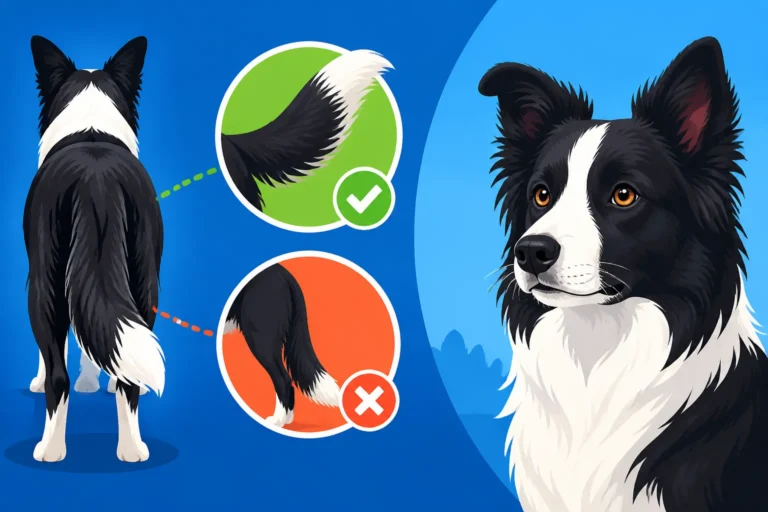
Whether Obedience Rankings Measure a Border Collie’s Mind
An obedience ranking can make it sound as though a Border Collie’s intelligence has been measured from every angle. It hasn’t. These rankings mostly reflect how readily dogs learn and respond to familiar commands, not the full range of a dog’s problem-solving, social awareness, instincts, or individual personality. This guide explains what the rankings show—and what they leave out.
What obedience rankings actually measure
Learning and responding to familiar cues
The best-known breed intelligence rankings draw heavily on how quickly dogs learn commands and how reliably they respond when asked. That can be useful information: a dog that picks up a cue quickly may need fewer repetitions during basic training than a dog that takes longer to connect the word, action, and reward.
But learning speed is only part of the picture. A Border Collie may understand “down” after a few practice sessions and still struggle to hold that position beside a squirrel, a running child, or a flock of sheep. Knowing a cue and choosing to follow it in a distracting situation are different skills. Reliability depends on practice, motivation, context, and the dog’s emotional state—not simply on a breed’s position in a ranking.
The rankings also tend to describe average patterns, not individual dogs. One Border Collie may be unusually quick to learn verbal cues; another may learn better through movement, toys, or shaping. A dog’s breeding, early experiences, health, and relationship with its handler all help shape what training looks like day to day.
What the popular ranking leaves out
Stanley Coren’s well-known ranking of working and obedience intelligence placed the Border Collie at the top. That result is often repeated as proof that the breed is “the smartest.” A more careful reading is that Border Collies performed exceptionally well on measures related to learning and obeying commands in the ranking’s framework. It does not establish that one breed has the most capable mind in every situation.
A ranking built around obedience naturally favors dogs whose typical strengths fit the task. It is less equipped to measure independent decision-making, scent work, persistence, social sensitivity, or the ability to adapt to changing conditions. A dog bred to make decisions at a distance from a handler may not look “obedient” in the same way as a dog selected for close cooperation, even if both are highly capable.
It also cannot capture a dog’s quality of life or the realities of living with that dog. A fast learner may learn unwanted routines just as quickly as useful ones. A Border Collie that figures out how to open a cupboard or demand another round of fetch is showing learning ability, but that does not automatically mean the behavior is convenient—or that the dog needs more intense training.
The difference between intelligence and obedience
A quick learner is not a remote-controlled dog
Border Collies are often attentive to people and responsive to small changes in movement, voice, or routine. That can make training feel wonderfully fluent: a handler gives a cue, the dog recognizes the pattern, and the behavior follows. Yet responsiveness should not be confused with an automatic willingness to comply in every setting.
Imagine a young dog who can come when called in the kitchen but races toward a moving bike on a quiet path. The dog may know the recall cue perfectly in one context and not yet have the skill—or self-control—to respond around a powerful distraction. That is a training and management challenge, not evidence that the dog suddenly became unintelligent.
Border Collies can also make decisions based on what has worked before. If a dog learns that barking brings a ball back, barking may become part of the routine. If staring at a person causes that person to move, the dog may repeat the behavior. This kind of pattern learning can be impressive, but it means owners need to be deliberate about what they reward and what routines they establish. For more on how intelligence and learning style intersect, see What Border Collie Intelligence Actually Measures.
Instinct can compete with a trained cue
A Border Collie’s herding heritage influences how some dogs respond to movement. A running child, a bicycle, or a group of people changing direction can attract intense attention, even if the dog has learned polite household behaviors. That instinct does not mean every Border Collie will herd people, but it helps explain why a familiar cue may be harder to follow in a high-arousal moment.
The same dog can appear brilliantly cooperative during a quiet training session and frustratingly distracted at the park. This contrast is common because cues are learned in context. A “stay” practiced in the living room does not automatically transfer to a busy sidewalk. Training needs gradual practice in different places, with distractions introduced at a level the dog can handle.
Breed tendencies are not destiny, either. Individual Border Collies vary in energy, confidence, sensitivity, and interest in different activities. A dog that is highly motivated by a ball may work eagerly for play; another may respond better to food, praise, or access to sniffing. If you are deciding whether the breed fits your household, What a Border Collie Takes Out of Your Week offers a useful perspective on the commitment beyond training sessions.
How to use rankings without overreading them
Treat a ranking as a starting point
A breed ranking can offer a broad clue about what training might feel like, but it is not a promise about a particular puppy or adult dog. It cannot tell you whether a dog will enjoy visitors, settle comfortably while you work, cope with city noise, or stay focused around livestock. Those qualities depend on a mix of temperament, socialization, experience, health, and the home environment.
When considering an individual dog, ask about the behaviors that matter in your real life. Can the dog relax indoors? How does it respond to unfamiliar people? Has it practiced being alone? Does it fixate on moving objects? What kind of activities help it settle afterward? Those answers are more useful for household planning than a general claim that the breed ranks first in intelligence.
If you are meeting a puppy, watch how it recovers after something surprising, how it engages with people, and whether it can pause between bursts of activity. A single visit cannot predict everything, but thoughtful questions and observations can provide a more grounded picture than a breed label alone. A breeder’s or rescue’s knowledge of the individual dog matters; What a Border Collie Breeder's Contract Usually Requires can help you think about the practical information and responsibilities that may be discussed when bringing a dog home.
Look for behavior in context
Instead of asking whether your Border Collie is “smart,” identify the exact behavior you want to understand. Is the dog slow to respond to a cue, unable to settle after exercise, or too focused on movement to disengage? Each concern calls for a different approach. Repeating a command louder may not help if the environment is too distracting or the dog has not learned what the cue means in that setting.
A simple training log can reveal patterns. Note where you practiced, what distractions were present, what reward you used, and how the dog responded. If your dog succeeds in the yard but not near a school pickup, the next step may be to practice farther from the activity—not to conclude the dog is being stubborn. Small, successful steps help build the behavior under gradually harder conditions.
For home enrichment, match activities to your dog rather than assuming that every clever dog needs complicated gadgets. Short scent games, simple food searches, trick training, or calm toy-based activities can provide useful variety. If you compare puzzle feeders or training supplies through retailers such as Chewy, focus on the dog’s size, chewing style, and ability to use the item safely. A puzzle that is too easy may be finished in seconds; one that is too frustrating can leave a dog barking or pawing at it rather than thinking calmly.
Helping a Border Collie learn well
Build skills in manageable steps
Teach a new behavior in a quiet place where your dog can pay attention. Reward the smallest correct action at first. For example, when teaching a mat settle, reward the dog for looking at the mat, then stepping onto it, then lying down, and eventually remaining there while you move around. Raising the difficulty gradually gives the dog a fair chance to understand what earns reinforcement.
Once the behavior is reliable in one setting, practice it in another. Move from the living room to the yard, then to a quiet outdoor area, and later to a busier location if your dog is coping well. Change only one challenge at a time when possible. If you add a new place, more distance, and a major distraction all at once, it can be difficult to tell what made the exercise too hard.
Keep sessions short enough that the dog can remain engaged. A few focused repetitions can be more productive than continuing until both dog and person are frustrated. Border Collies may learn patterns quickly, but that does not mean they benefit from endless repetition. They also need opportunities to rest, sniff, and simply be dogs. Ideas such as Mental Work That Tires a Border Collie Faster can help you think beyond longer and longer walks.
Reward calm choices as well as flashy tricks
It is easy to celebrate the impressive behaviors: a fast recall, a perfect spin, or a new trick learned in a handful of sessions. But calm behavior deserves attention too. Rewarding a dog for choosing to lie down, waiting quietly, or turning away from movement can help build skills that matter in everyday life.
This is particularly important for dogs that become highly excited by play. If every energetic moment leads to a ball being thrown, the dog may learn to demand more action rather than practice settling. Add planned pauses to games, use a clear cue to begin and end play, and reinforce calm behavior between turns. If ball play is becoming difficult to interrupt, Weaning a Border Collie Off Endless Fetch explores ways to make the routine more balanced.
You can find food rewards, toys, and enrichment items through retailers such as Chewy, but the item itself does not replace a training plan. A handful of the dog’s usual food may be enough for a simple exercise; another dog may work harder for a toy or a chance to sniff. Watch how your dog responds and adjust the reward to the task. For equipment-based games, supervise use and remove items that become damaged or unsafe.
| What a ranking may suggest | What it cannot tell you | A practical way to use the information |
|---|---|---|
| A breed tends to learn familiar cues readily | Whether an individual dog will respond around every distraction | Teach cues gradually in different settings |
| A breed often works closely with people | Whether a particular dog will settle easily at home | Observe the individual dog’s rest and recovery habits |
| A breed may be responsive to training | Whether the dog will enjoy every sport or activity | Offer varied activities and notice what the dog finds rewarding |
| A dog learns patterns quickly | Whether those patterns will be convenient | Reinforce the behaviors you want to see repeated |
Obedience rankings can be interesting, but they are not a complete measure of a Border Collie’s mind. They describe a narrow set of abilities and broad breed tendencies, while everyday behavior depends on the individual dog and the situation. Use rankings as background, then focus on what your own dog is showing you: what it finds rewarding, where it struggles, and what helps it feel settled and successful.
Disclaimer
This article is for general informational purposes only and does not constitute professional advice. Laws, prices and regulations vary by location and change over time. Consult a qualified professional for guidance on your specific situation.