Why a Mostly White Border Collie Cannot Be Shown
It can be incredibly confusing for new Border Collie owners, or those simply admiring the breed, to learn that a dog with too much white on its coat might be disqualified from the show ring. You might look at your beautiful, spirited, white-footed pup and wonder what on earth could be wrong with it. This guide aims to clear up that confusion, explaining why a Border Collie that is "mostly white" is typically not permitted in conformation showing, delving into the historical context, breed standards, and the nuances that define acceptable coat patterns.
The Evolution of the Border Collie Standard and Color
To understand why excessive white is a disqualification in the show ring, we first need to appreciate the rich history of the Border Collie. These dogs were developed on the Anglo-Scottish border, where shepherds valued working ability above all else. Their coats, colors, and markings were secondary to their instinct, intelligence, and stamina. A dog that could gather sheep efficiently and reliably was prized, regardless of its appearance. However, over time, certain preferences and practical considerations naturally emerged.
Early working Border Collies displayed a wide range of colors and patterns, reflecting their diverse genetic heritage. While black and white became the most iconic and recognizable pattern, primarily because it often made the dog easier to spot against various landscapes and sheep, it wasn't the only one. However, the tradition of certain markings, particularly a balanced distribution of color, started to become ingrained as part of the breed's identity, distinguishing it from other types of collies. When official breed clubs and registries began to form, they sought to formalize these characteristics into written standards. These standards aimed to preserve the breed's essential qualities, both functional and aesthetic, ensuring a consistent type for future generations. For example, The International Sheep Dog Society, Founded 1906 focused purely on working ability, while later kennel clubs adopted more specific physical descriptions.
The initial emphasis on functionality meant that a dog's coat pattern or color was rarely a barrier to its working career. A dog with a splash of white, or even a good deal of it, could still be an exceptional sheepdog. But as the breed moved into the realm of conformation showing, where judging is based purely on adherence to a written standard of appearance, these aesthetic considerations became paramount. The "look" of the dog became just as important as, if not more important than, its inherent ability to herd, leading to a divergence in what was considered desirable between working lines and show lines—a fascinating dynamic explored further in The Working and Show Split in Border Collies.
Understanding the "Mostly White" Clause in Conformation
When we talk about a "mostly white" Border Collie being ineligible for the show ring, we're referring specifically to the breed standards set by organizations like the American Kennel Club (AKC) or The Kennel Club (KC) in the UK. These organizations provide detailed descriptions of the ideal Border Collie, covering everything from gait and temperament to coat type and color. It's not that white is inherently bad; it's about the proportion of white.
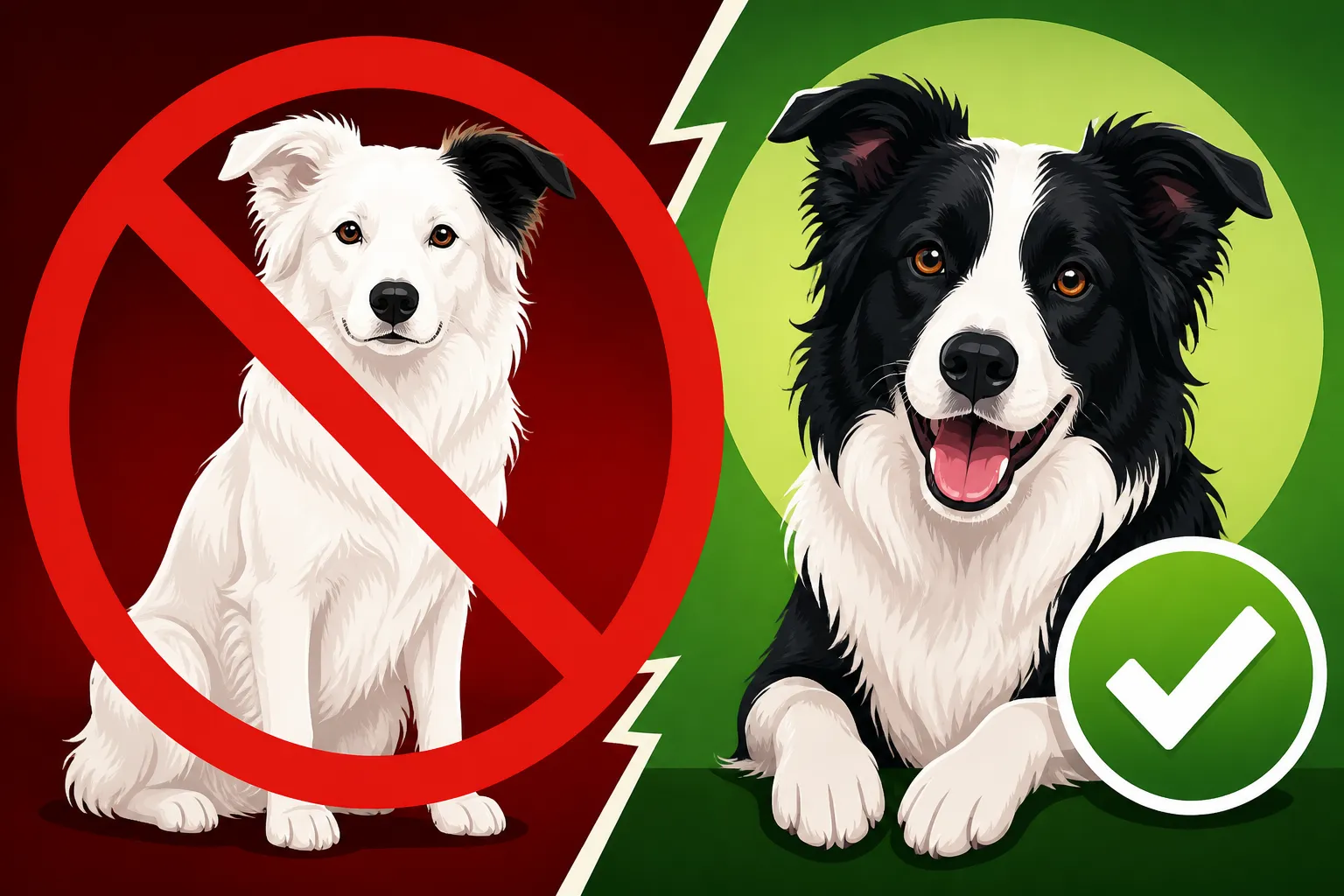
According to the AKC Border Collie breed standard, for instance, "Solid color, bi-color, tri-color, merle, or sable with or without tan points, all are acceptable, with white markings permissible but never predominant." This critical phrase, "never predominant," is what makes a "mostly white" Border Collie ineligible. Essentially, if a dog's coat is more than 50% white, it is considered a fault, and in many cases, a disqualification in the conformation ring. This isn't about arbitrary exclusion; it's about maintaining a specific aesthetic and historical representation of the breed. Imagine a Border Collie breeder researching pedigrees on Chewy's excellent breed information section, they'd notice the prevalence of traditional markings.
Let's break down what "never predominant" means in practical terms. A Border Collie with a classic black and white coat might have a white blaze, a white collar, white chest, white legs, and a white tip on its tail. These are all considered acceptable white markings. However, if that white collar extends too far up the shoulders, or the white on the legs creeps up the body significantly, or if the dog has large, irregular patches of white over its back and sides that dominate the overall appearance, it would likely be considered "mostly white." The colored patches, no matter the hue (black, red, blue, sable, etc.), must clearly be the primary color. A quick look at What the AKC Standard Says a Border Collie Is will show you just how particular these details can be.
This rule emphasizes the importance of a balanced appearance, where the dog's base color (or colors) clearly defines its pattern. It's a visual distinction that reinforces the traditional look of the breed, a look that developed both from practical needs in the field and the aesthetic preferences of early breeders. If you're wondering how this affects specific colors, take a look at Border Collie Colors and Coat Types, which delves into the accepted variations, and you'll see that "predominantly white" is consistently flagged as an issue across all acceptable colorations.
| Color Pattern | White Markings | Show Ring Status |
|---|---|---|
| Black & White | Acceptable, not predominant | Permitted |
| Tri-color | Acceptable, not predominant | Permitted |
| Merle (Blue, Red) | Acceptable, not predominant | Permitted |
| Sable | Acceptable, not predominant | Permitted |
| Solid Color | Minimal/no white | Permitted |
| Predominantly White | White covering >50% of body | Disqualified/Serious Fault |
Beyond Aesthetics: Why Show Standards Matter
You might be thinking, "What's the big deal? It's just a color!" And from a pet owner's perspective, you'd be absolutely right. A mostly white Border Collie can be a perfectly healthy, intelligent, and loving companion. The issue isn't about the dog's inherent worth or ability, but about adherence to a specific set of criteria established for conformation competition. These criteria are designed to preserve the breed's historical appearance and often, its structural integrity.
Breed standards aren't just arbitrary rules; they represent a consensus among breed enthusiasts and experts on what constitutes the ideal specimen of that breed. For Border Collies, while working ability remains paramount in the hearts of many, the show ring focuses on physical conformity to a written ideal. This ideal includes not just color but also body structure, head shape, tail set, and movement. The idea is that these physical traits are believed to be consistent with the breed's original function and overall health. So, when a breed standard specifies that white should not be predominant, it's about maintaining that recognized breed type. It's part of the visual signature that makes a Border Collie look like a Border Collie to a judge.
The development of these standards, particularly the inclusion of disqualifications for certain features, reflects a long history of breeding practices and the desire to guide breeders toward a consistent type. It ensures that when someone sees a Border Collie in the show ring, they see a dog that conforms to the established image of the breed. This strict adherence can sometimes lead to misunderstandings, especially among those new to the world of dog shows, but it is a fundamental aspect of how conformation events operate. If you're curious about other areas where a Border Collie might lose points, Where a Border Collie Loses Points in the Ring offers further insight into the nuances of judging.
It's also worth noting that the standards vary slightly between different kennel clubs. For instance, The Kennel Club Standard of 1977 (UK) might have slightly different phrasing or emphasis than the AKC standard, but the underlying principle regarding predominant white remains largely consistent across major registries. These standards become the blueprint that judges use, making it clear that a "mostly white" dog, no matter how charming or talented, simply doesn't fit the specified criteria for that particular competition.
Addressing Health Concerns: White Markings and Genetics
Sometimes, people mistakenly associate "mostly white" Border Collies with health problems like deafness or blindness, particularly if they've heard about these issues in other breeds with extensive white, such as Dalmatians or merle-patterned dogs. It's important to clarify that while certain genetic factors linked to coat color can indeed carry health risks, the "mostly white" disqualification in Border Collies isn't primarily about these health concerns. It's fundamentally an aesthetic and breed type standard.
However, it's a common misconception that any white leads to health issues. While a merle Border Collie, particularly one that is "double merle" (inheriting the merle gene from both parents), can sometimes have significant health problems like deafness, blindness, or microphthalmia due to the dilution of pigment, this is a distinct genetic issue from a dog simply having a lot of white markings that are not part of a merle pattern. A predominantly white dog could theoretically be black and white, but with just a lot of white. This doesn't automatically mean it's unhealthy. In fact, many healthy Border Collies have significant white markings without any merle genes present. You can find more information about merle-related issues in Deafness in Merle Border Collies.
The concern with "excessive white" in some breeds does stem from links between pigment production and the development of hearing and vision. In certain genetic combinations, the lack of pigment in areas like the inner ear can lead to deafness. This is why some breed standards for other breeds are very strict about white patterns. For Border Collies, however, the primary disqualification for predominant white is historically and aesthetically driven rather than a direct health mandate. It is a visual requirement that helps define the breed's appearance.
For owners of white-marked Border Collies, whether they are "mostly white" or just have generous white trim, routine veterinary care and health screening are always wise. For example, if you're concerned about your dog's genetics or want to understand their potential health risks, asking your vet about genetic panels can be incredibly insightful. Companies like Chewy often provide educational resources that can help owners understand complex topics like genetics and health. While a "mostly white" Border Collie won't be gracing the conformation ring, they can certainly excel in other areas, such as agility, obedience, or even therapy work, where their appearance is secondary to their trainability and disposition. Regardless of their coat, a healthy, well-adjusted Border Collie is a joy to live with, and understanding their unique characteristics, including their beautiful coats, is part of being a responsible owner.
Disclaimer
This article is for general informational purposes only and does not constitute professional advice. Laws, prices and regulations vary by location and change over time. Consult a qualified professional for guidance on your specific situation.