What Happens at a Sheepdog Trial With a Border Collie
A first sheepdog trial can look confusing from the sidelines: a dog disappears over a hill, sheep move across a field, and the handler’s whistles seem to mean everything and nothing at once. This guide walks through what happens at a sheepdog trial with a Border Collie, from check-in and the opening outrun to scoring, sheep welfare, and the practical realities of attending as a beginner.
Before the Border Collie Enters the Trial Field
Check-in, classes, and the course
A trial usually begins well before a dog runs. Handlers check in, confirm their class, learn where the course starts, and listen for any instructions about sheep, gates, boundaries, or the order of runs. The exact routine varies by organizer. A small local trial may feel informal, while a larger competition may have a posted schedule and a designated person calling handlers to the field.
Classes help group dogs and handlers by experience or competition level. A novice class is generally intended for less experienced teams, while more advanced classes ask for increasingly accurate work and may use a more demanding course. Some events also have nursery classes for young dogs. Class names and eligibility rules differ, so check the trial’s own information instead of assuming that every event uses the same divisions. For background on how competitions fit into the breed’s working tradition, see The Border Collie in Sheepdog Trials.
The course is the route the sheep and dog are expected to follow. It may include a distant starting point, a fetch toward the handler, a drive away from the handler, and a pen or shedding area. Land makes a big difference: one field might be fairly open, while another has a slope, uneven ground, or a natural boundary that changes how the sheep travel. A handler who has walked the course before the run can better understand the layout, but the dog still has to read the stock in real time.
Getting ready without winding the dog up
A Border Collie may arrive eager, watchful, or intensely focused on the sheep. That interest is part of what makes the breed suited to stock work, but a busy trial environment can add distractions: other dogs, whistles, spectators, vehicles, and sheep moving nearby. A calm routine helps. Keep the dog under control, allow enough space from livestock and other competitors, and avoid letting it rehearse uncontrolled chasing or fence-running while waiting.
Trial-day basics are simple but useful: a secure lead, water, a suitable resting place, and weather-appropriate equipment. Owners who need to replace ordinary travel supplies may find Chewy useful as one option for sourcing items such as bowls or crate bedding. Packing those familiar items before leaving can make a long day feel more manageable for both dog and handler. If you’re planning an event as a spectator rather than a competitor, the same preparations help your dog settle away from the competition area.
Avoid turning the wait into a long, frantic warm-up. A dog that has been repeatedly worked, teased with sheep, or wound up by endless ball play may reach its run already overstimulated. The goal is not to exhaust the Border Collie before its turn. It is to keep the dog safe, settled, and ready to respond to its handler.
What spectators should know
From the side of the field, the work can be easy to misread. A dog may appear to be moving slowly or holding a position, but it could be applying quiet pressure that helps the sheep stay together. Conversely, speed is not automatically a sign of good work. A fast dog that scatters or frightens the sheep may be less effective than one that moves with control.
Spectators should stay in the areas designated by the organizers and keep their own dogs well away from the course unless the event specifically allows them closer. Don’t call to a competing dog, whistle at it, or try to attract its attention. Those sounds may interfere with the handler’s commands or distract the dog at a critical moment.
It also helps to remember that the dog is not performing a rehearsed trick routine. The sheep have their own reactions and may change direction or resist moving. The handler and dog have to adjust together, which is why a run can look different from one minute to the next.
What Happens During a Border Collie’s Run
The outrun and lift
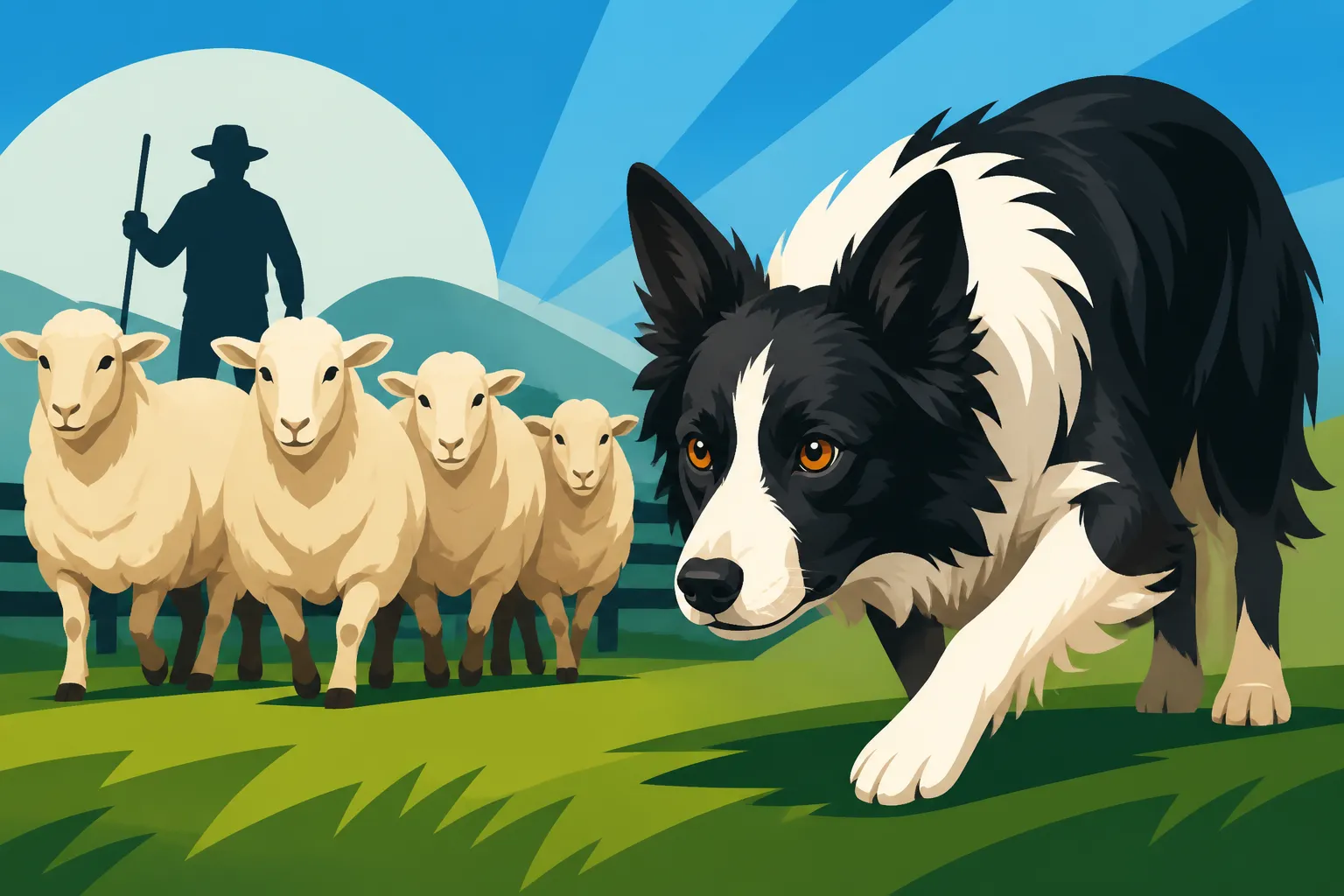
In many traditional courses, the run starts with an outrun. The dog leaves the handler and travels out in a broad arc toward sheep placed some distance away. A well-shaped outrun aims to bring the dog to a position behind the sheep without rushing straight at them. That approach gives the dog a chance to gather the group and begin moving it toward the handler.
The handler may send the dog in one direction or the other using a voice command, whistle, or a combination of both. Commands and whistles vary between handlers; a particular sound does not necessarily mean the same thing in every partnership. The dog’s job is to understand its own handler, not to follow a universal whistle vocabulary. The outrun is a major part of the work, and The Outrun a Border Collie Runs at a Trial explains why its shape and placement matter.
When the dog reaches the far side of the sheep, the next phase is the lift: the moment it begins to bring them forward. The lift should be controlled enough that the sheep move as a group rather than bolting in several directions. If the dog arrives too fast or too close, the sheep may scatter. If the dog is too far away or hesitant, they may not move toward the handler. The best distance depends on the sheep and the terrain.
From the sidelines, it may seem as though the dog simply runs around and then turns the sheep. In reality, the dog is balancing position, pressure, and movement. A handler may use small signals to adjust the dog’s line or pace, and the dog may change its position in response to the sheep rather than waiting for a new command at every step.
The fetch and drive
During the fetch, the dog brings the sheep from the far end of the course toward the handler, often through a marked gate. The route matters. A dog that gets the sheep through the gate calmly and on line is showing control, not merely getting them closer. The handler remains at or near the course’s starting point and directs the dog from a distance.
After the fetch, many courses include a drive. The dog guides the sheep away from the handler and through another part of the course, often through one or more gates. This can be challenging because the dog must keep working from behind or to the side of the sheep while the handler gives instructions from a distance. The handler is not walking alongside to steer the group.
The pressure applied by the dog needs to suit the sheep. Too much pressure can make them rush or split. Too little can leave them stopping, drifting off course, or turning back toward the handler. A good Border Collie reads those changes and adjusts its position. The handler, in turn, has to judge when to ask for a correction and when to let the dog solve the problem.
Course layouts differ, so not every trial uses identical gates or the same sequence. The judge’s briefing and the organizers’ course information are the best guides to what is expected that day. For a broader look at what judges may be assessing across a run, see What Judges Score on a Border Collie's Lift.
The shed, pen, and finish
Some courses include a shedding exercise, where the dog and handler separate particular sheep from the group. The task tests close cooperation and control: the dog may need to hold the larger group back while the handler identifies and guides selected animals away. The exact setup depends on the course and the rules for that class.
A pen may also be part of the run. The handler opens or manages the pen while the dog moves the sheep toward the entrance. It can look deceptively simple, but sheep may hesitate, crowd together, or turn away at the opening. The dog must apply enough pressure to encourage movement without making the group rush past the entrance. More detail on these late-course tasks is available in The Shed and Pen at the End of a Border Collie's Run.
A run ends when the required course is completed, the time limit is reached, or the handler and judge determine that the work should stop. A handler may retire from a run if the dog or sheep are not coping safely. That is not a failure of care; protecting the animals and keeping the situation under control matter more than forcing a course to continue.
Not every event includes every element. A novice course may be shorter or simpler, while an advanced course may include more demanding work. The structure also varies across organizations and regions, so it’s sensible to treat descriptions of a “typical” run as a guide rather than a promise about every trial.
How Scoring and Good Stock Work Are Judged
What judges watch for
Judges generally assess how effectively and accurately the team completes the course. Depending on the rules, scoring may reflect the dog’s route, control, response to the handler, and the sheep’s progress through required parts of the course. A missed gate or a sheep leaving the group can affect a score, but the precise scoring system depends on the event and class.
The dog is not judged only on obedience. A Border Collie that responds instantly but puts unnecessary pressure on sheep may not be doing good work. The judge is looking at the whole partnership: whether the handler gives useful directions, whether the dog responds appropriately, and whether the sheep are moved in a controlled way. To understand one part of that evaluation, What Judges Score on a Border Collie's Lift offers a closer look at how the dog’s work at the lift is considered.
It is also normal for a run to have rough patches. A dog may need to correct its line, sheep may resist, or the team may lose points on a gate. Trial work involves living animals, not a fixed course of objects. A handler’s ability to stay composed and make sensible decisions is part of the picture, even when the run does not go exactly to plan.
Why control and sheep welfare matter
Good stock work is not simply a matter of making sheep move. The dog should influence their direction without creating needless panic, and the handler should be prepared to stop or change the work if conditions become unsafe. Sheep can bunch, split, or react differently depending on their experience and the field. A dog that is still learning may need a simpler setting and close supervision rather than a demanding trial course.
Organizers typically set expectations around how competitors approach and handle stock, but the specific rules vary. If you are entering, read the event’s instructions and ask the organizer about anything unclear. If you’re attending as a spectator, follow requests about where to stand and when to move. Walking across a field or approaching a holding area at the wrong moment can disturb the sheep or disrupt a run.
A Border Collie’s instinct to gather and control movement does not make it safe to let the dog work livestock without appropriate training. An uncontrolled dog can stress or injure sheep, and the dog itself can be hurt in a confrontation or in rough terrain. If you’re new to stock work, learn from an experienced handler or instructor rather than trying to recreate a trial exercise on your own.
What happens after the run
After the dog leaves the field, the handler may check the posted score or wait for results. Some events publish scores as runs happen; others announce placements later. The result can help identify areas to work on, but it is only one snapshot of a partnership on one course, with one group of sheep, on one day.
Handlers often review what they saw: Did the dog take the intended line? Did the sheep respond calmly? Were the commands clear? Did the team lose time or control in a particular section? A thoughtful review is more useful than simply deciding that the dog “did well” or “did badly.” A run can include a strong outrun and a difficult drive, or a modest score alongside visible progress for a young team.
The dog also needs a quiet break after working. Offer water, allow it to rest in a secure place, and avoid immediately demanding more work because the run seemed short. Owners already thinking about trying a first event can read Taking a Border Collie to an Instinct Test for a related introduction to observing a dog’s interest in stock. An instinct test is not the same as a sheepdog trial, but it can help newcomers understand why safe, structured exposure matters.
Preparing a Border Collie for a First Trial
From interest in sheep to useful training
A Border Collie showing interest in sheep is not automatically ready to compete. The dog needs to learn how to respond to a handler, control its approach, and work around livestock safely. Training should be matched to the dog’s age, confidence, and experience. An experienced stock-dog instructor can help decide whether a dog is ready to begin and what kind of setup is appropriate.
A first session should not be about sending the dog on a full course. The dog and sheep need to be introduced in a way that allows the handler to intervene and keep the work calm. Progress might involve learning to stop, take direction, and move sheep without rushing them. For more on what a young dog may encounter in its first structured exposure, see The Nursery Class a Young Border Collie Starts In and The First Time a Border Collie Meets Sheep.
The handler is learning too. It takes practice to read the sheep, understand where the dog should be, and give a command early enough to help rather than react after a problem has begun. A knowledgeable instructor can explain why a dog’s position matters and when it is better to pause the session.
Choosing an appropriate first event
A suitable first trial depends on the dog’s preparation and the event’s format. Ask the organizer what classes are available, what experience is expected, and whether a novice run is appropriate for your team. Find out how the course is laid out, how dogs are called to the field, and what equipment or paperwork competitors need. Event rules are not interchangeable, so rely on the specific organizer’s guidance.
If your dog has not worked sheep before, a trial may be a poor place for its first exposure. The crowd, distant sheep, competing dogs, and pressure to complete a course can make the experience confusing. A quieter training session or a suitable introductory event may be a better first step. Some pet Border Collies can learn stock work, but a trial is not the right place to discover whether a dog has the foundation skills. See Whether a Pet Border Collie Could Ever Trial for a closer discussion of the path from pet home to competition.
Preparation also means considering the dog’s physical condition. A trial field may be uneven, and working involves turning, acceleration, and sustained attention. Build training gradually and consult a veterinarian if your dog has a health concern or shows lameness, unusual fatigue, or reluctance to work. The goal is a safe, positive experience, not pushing through signs that something is wrong.
A practical trial-day checklist
A little planning can prevent the familiar scramble of arriving with a dog, a lead, and no idea where the water bowl went. Use the organizer’s instructions as the final authority, but this checklist covers common basics:
- Confirm the check-in process, class, schedule, and course location.
- Pack a secure lead, water, a bowl, and a comfortable resting setup.
- Bring weather-appropriate protection for the dog and a way to keep it safely contained.
- Keep the dog away from sheep and competing dogs while waiting unless an organizer directs otherwise.
- Give the dog a calm break after its run and check its paws and general comfort.
- Follow the event’s instructions about parking, spectators, and movement around the field.
For ordinary travel essentials, Chewy may be one place to look for items such as a portable bowl or familiar bedding, but check that anything you bring suits the event and your dog. Chewy can also be relevant if you are replacing everyday supplies before a trial weekend; still, the most important preparation is training, safe handling, and following the organizer’s rules. If you already have a well-fitted crate, lead, and water setup, there is no need to buy special equipment just because you are attending a trial.
A sheepdog trial is a test of communication as much as speed or instinct. Once you know the basic sequence—outrun, lift, fetch, drive, and sometimes a shed or pen—the action becomes easier to follow. The details vary by course, class, and event, but the central aim remains a controlled partnership that moves sheep thoughtfully and safely.
Disclaimer
This article is for general informational purposes only and does not constitute professional advice. Laws, prices and regulations vary by location and change over time. Consult a qualified professional for guidance on your specific situation.