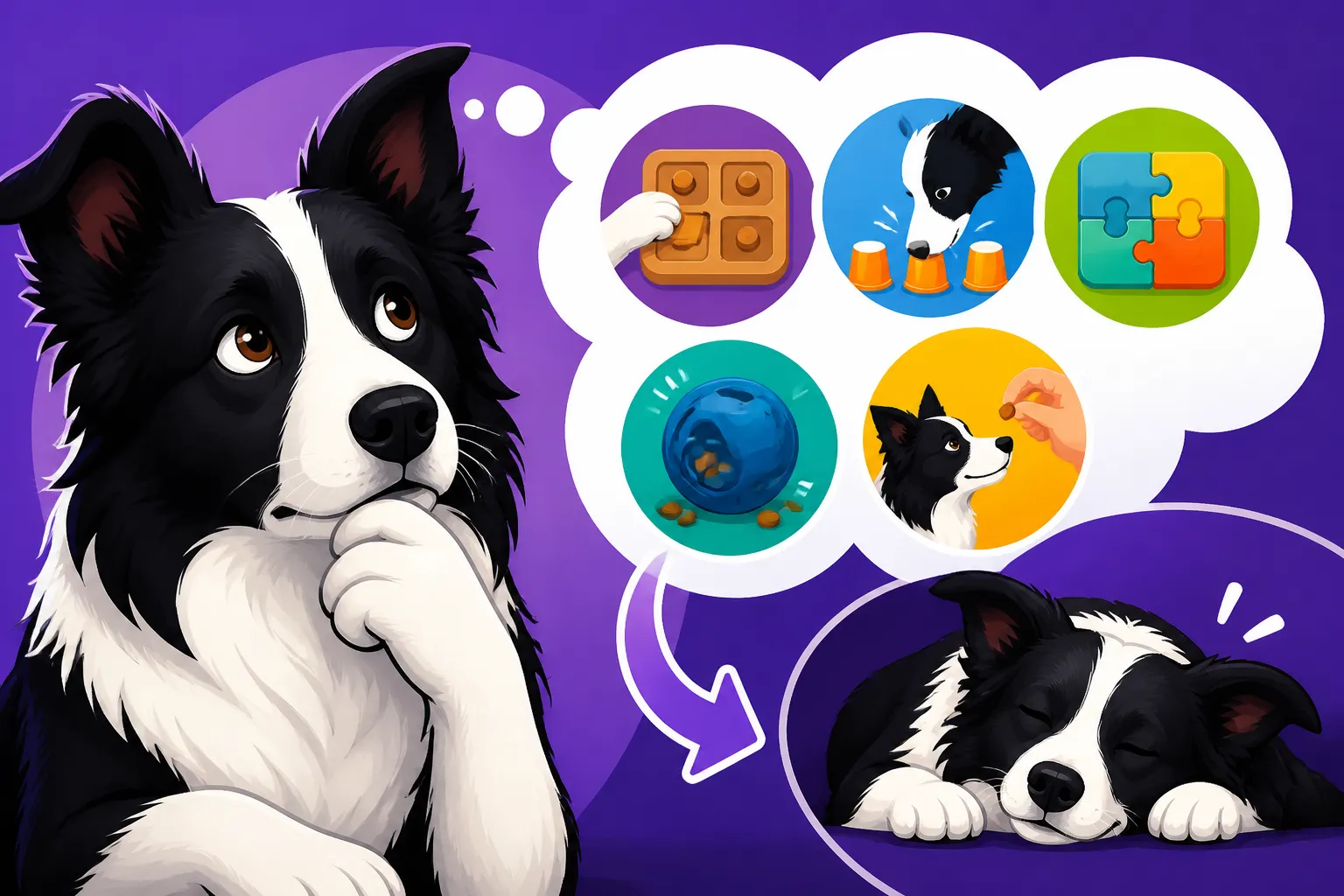
Mental Work That Tires a Border Collie Faster
One of the biggest struggles Border Collie owners face is feeling like they can never tire their dog out. You run them, you walk them, you throw the ball until your arm aches, and they still bounce back, ready for more, often with that intense stare that promises trouble if they don't get it. This comprehensive guide is here to explain why physical exercise alone isn't enough for these brilliant dogs and how engaging their minds can lead to a calmer, more contented Border Collie who actually wants to settle down.
Why Physical Exercise Alone Won't Cut It for a Border Collie
It's a common misconception that Border Collies just need endless physical exercise to be happy. Many new owners, lured by the breed's intelligence and athleticism, quickly find themselves in a perpetual motion cycle, convinced that if they just walk a little further or play fetch a little longer, their dog will finally be "tired." The reality is, for a Border Collie, physical exertion without mental engagement often creates a fitter, more restless dog, rather than a satisfied one.
The Perpetual Motion Machine Myth
You see them at the dog park, the Border Collies who run laps around every other dog, fetch a tennis ball a hundred times, and still seem to have energy to spare. This leads many to believe that Border Collies are simply perpetual motion machines that need to be run into the ground. But think about their original purpose: herding sheep. A working Border Collie isn't just running aimlessly; it's constantly observing, strategizing, responding to whistles and commands, making split-second decisions about flock movement, and thinking its way through the task. The physical exertion is a byproduct of intense mental engagement.
When we strip away that mental component and just provide physical exercise, we're essentially training our Border Collies to be marathon runners without a finish line in sight. They build incredible stamina, but their highly active brains remain under-stimulated. This can lead to a dog that's physically exhausted but mentally wired, often resulting in destructive behaviors, incessant barking, or anxiety. It's like sending a highly intelligent human to run on a treadmill for hours without giving them anything to read or think about – they might be physically spent, but they'd be incredibly bored and probably quite frustrated. This is why you'll often hear experienced owners say that a physically tired Border Collie is just a fitter Border Collie. You're simply making them better at running, not necessarily happier or calmer.
The Paradox of Fitness
Here's the twist: the more you physically condition your Border Collie without engaging their mind, the fitter they become, and the more physical exercise they require to achieve even a superficial level of tiredness. It's a never-ending escalation. If you start with an hour of fetch, soon they'll need 90 minutes, then two hours, just to get to the same point of physical fatigue. Their bodies adapt quickly, building muscle and cardiovascular endurance, making them even more capable of sustained physical activity.
This creates a serious problem for owners. Most of us have jobs, families, and other responsibilities, making it impossible to dedicate four or five hours a day to purely physical exercise for our dogs. We quickly hit a wall, feeling guilt and frustration as our Border Collie paces the house, staring at us with that intense "what's next?" gaze. This paradox of fitness demonstrates that simply burning off energy isn't the solution; we need to redirect that powerful brainpower into productive, satisfying activities. Without this mental component, your Border Collie can become an expert at bouncing off the walls, literally and figuratively. You might have even heard stories of owners saying Why a Fitter Border Collie Needs More once they get into a routine of purely physical workouts.
Understanding the Border Collie Brain and Its Needs
To truly satisfy a Border Collie, you have to understand the incredible engine beneath that furry coat. These aren't just intelligent dogs; they're purpose-driven dogs, bred over centuries to partner with humans in complex tasks. Their intelligence isn't just about learning tricks quickly; it's about problem-solving, anticipation, and sustained focus.
Instinctual Drives and Intelligence
The Border Collie's intelligence is deeply intertwined with its herding instincts. They possess an innate drive to gather, control, and move things. This manifests as "the eye" – that intense, focused gaze that can feel both captivating and unsettling. It's not just a look; it's a tool for control, a way to project their will onto the flock (or, in a pet home, onto children, other pets, or even moving shadows). Their problem-solving abilities are legendary because herding is a dynamic, unpredictable job. They have to adapt to terrain, sheep behavior, and handler commands, often operating at a distance with minimal input.
This incredible cognitive horsepower means their brains are constantly processing information, looking for patterns, and seeking a "job." If you don't provide them with appropriate mental outlets, they will invent their own jobs, and trust me, those jobs usually involve things you don't want them doing. This could be nipping at heels, circling family members, barking excessively at perceived threats (like the mail carrier or a leaf blowing across the yard), or even developing compulsive behaviors like shadow chasing or light fixation. Understanding these deep-seated instincts is the first step to channeling their energy constructively.
The Need for Purpose
Imagine a brilliant scientist confined to a small room with no books, no experiments, and no intellectual challenges. They would quickly become bored, frustrated, and likely exhibit distress. That's often what a Border Collie experiences when their life is devoid of purpose. They thrive on having a task, a goal, something to think about and accomplish. This isn't just about physical tasks; it's about mental tasks. They want to figure things out, to work with you, and to feel like they are contributing.
This need for purpose is why a Border Collie can often be found observing everything, trying to make sense of their environment, and sometimes, trying to organize it. Whether it's sorting toys, lining up shoes, or carefully placing their squeaky ball in your lap at precisely the right moment, they are trying to engage their mental faculties. Ignoring this fundamental need is like trying to fill a bucket with a hole in the bottom – no matter how much water (or physical exercise) you pour in, it will never feel truly full. Providing purposeful mental work addresses this core need, allowing them to expend mental energy in a way that feels satisfying and complete. This is the key to having a calm, fulfilled companion.
Types of Mental Work That Truly Tire a Border Collie
Once you understand why mental stimulation is crucial, the next step is to explore what kind of activities actually engage their minds effectively. It's not just about simple commands; it's about complex problem-solving, using their senses, and channeling their natural drives.
Puzzle Toys and Interactive Feeders
One of the easiest ways to inject mental stimulation into your Border Collie's day is through puzzle toys and interactive feeders. These aren't just for slowing down eating; they're designed to make your dog think about how to get their food or treats. Instead of wolfing down a meal in 30 seconds, a good puzzle feeder can turn mealtime into a 15-20 minute mental workout.
There's a huge variety out there, from simple KONGs filled with peanut butter (check the ingredients for dog safety!) or wet food, to more complex sliding puzzles, dispensing balls, and snuffle mats. Brands like Outward Hound offer a fantastic range of difficulty levels, from beginner to expert, ensuring your Border Collie stays challenged. You can find many options on Amazon that allow you to start simple and gradually increase the complexity as your dog's problem-solving skills grow. The beauty of these toys is that they offer independent mental work, perfect for those times when you can't actively engage with your dog but still want to keep their brain busy. Just remember to introduce them gradually and supervise initially to prevent frustration or destructive chewing. Sometimes, the simpler options are the most effective when first starting out. These can be particularly good for Puzzle Feeders That Hold a Border Collie.
Nose Work and Scent Games
Nothing tires a dog out quite like using their nose, and Border Collies are surprisingly good at it despite not being traditional scent hounds. Their intelligence and focus make them excellent candidates for nose work, which taps into one of their most primal senses. A ten-minute session of dedicated nose work can be as tiring, if not more so, than an hour-long walk because it requires intense concentration and problem-solving.
You can start simple: hide treats around a room and encourage your dog to find them. Use progressively harder hiding spots. A snuffle mat (again, widely available on Amazon) is a wonderful tool for beginners, turning mealtime or treat time into a search game. As your Border Collie gets better, you can introduce scent articles (like cotton swabs with essential oils, typically birch, anise, or clove, purchased from scent work suppliers) and teach them to search for specific odors. This activity builds confidence, reduces stress, and provides an immense sense of accomplishment. Think of the mental energy it takes for them to sift through all the ambient smells, pinpoint the target odor, and then communicate its location to you! These activities are perfect for when the weather is bad or you're short on time for physical exercise. Scentwork for a Border Collie Between Trial Seasons is a fantastic way to keep their minds sharp.
Trick Training and Advanced Obedience
While basic obedience is essential, taking it to the next level with trick training or advanced obedience routines is incredibly stimulating for a Border Collie. These dogs absolutely love to learn, and giving them new commands, sequences, and behaviors to master lights up their intelligent brains. It's not just about sitting or staying; it's about stringing together multiple commands, learning complex cues, and performing actions on cue.
Consider teaching them multi-step tricks like "put your toys in the box," "fetch my slippers," or "close the door." Advanced obedience, such as heeling patterns, retrieves, or even learning the names of all their toys (like the famous Chaser, the Border Collie who knew over a thousand nouns!), offers immense mental satisfaction. This type of training strengthens your bond, improves communication, and builds their confidence. Online training platforms, like those offered by BAXTER & Bella, can provide structured courses and guidance for teaching advanced skills, complete with video demonstrations and expert advice. The process of learning, processing, and executing these tasks engages their prefrontal cortex, leading to genuine mental fatigue. It's truly amazing How Many Words a Border Collie Can Learn and how quickly How Few Repetitions a Border Collie Needs for new commands. This kind of active learning is much more tiring than passive physical activity.
Herding Games and Controlled Outlets
For Border Collies, the instinct to herd is incredibly powerful. While not every Border Collie owner has access to livestock, you can provide controlled, appropriate outlets for this instinct that are hugely mentally stimulating. This isn't about letting them chase everything; it's about structured games that mimic aspects of herding.
One excellent option is "flirt pole" play. A flirt pole is essentially a long pole with a lure (like a strip of fabric or a squeaky toy) attached to a rope. You use it to make the lure dart and weave, and your Border Collie uses its herding eye, stalk, and chase instincts to try and "catch" it. This provides bursts of intense mental focus and controlled physical exertion, teaching impulse control as they learn to wait for your cues. Another great option is "big-ball herding" using a large, inflatable exercise ball. Your dog learns to move the ball around a designated area, using their body and eye, without actually nipping or gripping. This is safe, fun, and highly engaging. These activities allow them to tap into their deepest drives in a way that's appropriate for a pet home, offering a fulfilling mental and physical workout without the chaos of actual livestock.
Integrating Mental Work into Your Daily Routine
The key to a well-adjusted Border Collie is consistency. Mental stimulation shouldn't be an occasional treat; it needs to be woven into the fabric of their daily life. Even short bursts of mental activity can make a significant difference.
Morning Brain Boosters
Start the day right by engaging your Border Collie's mind before they've even had their breakfast. Instead of just putting their food bowl down, make them work for it. A classic KONG stuffed with their kibble and a little wet food, frozen overnight, can keep them occupied for a good 20-30 minutes. Or, use a snuffle mat or a puzzle feeder for their morning meal. This turns breakfast into a cognitive challenge.
Another idea is a short, focused training session. Before your first cup of coffee is even brewed, spend 5-10 minutes practicing a few tricks or obedience commands. Make it fun and high-energy. This gets their brain warmed up, sets a positive tone for the day, and gives them a sense of purpose. For example, have them "find it" (a hidden treat or toy) a few times, or run through a sequence of "sit-stay-come-down." These quick mental exercises can prevent that early morning "what do we do now?" restlessness that Border Collies are famous for, helping them to settle better while you get ready for your day.
Evening Wind-Down Activities
Just as important as morning engagement is providing mental activities to help your Border Collie wind down in the evening. This is particularly crucial for preventing that late-night "zoomies" or demanding behavior that can disrupt your quiet time. Again, puzzle toys or a stuffed KONG can be invaluable after their evening meal. The effort of extracting food is mentally tiring and physically calming.
Consider a quiet nose work session before bedtime. Hide a few high-value treats around the living room while your Border Collie watches, then release them with a "find it!" command. The focused searching is inherently calming. Another great option is a short, low-impact trick training session. Practice "stay," "place," or "settle" on their mat. This kind of structured, quiet work helps shift their brain into a calmer state. You might find some excellent guides for these types of activities on platforms like BAXTER & Bella, helping you to create a predictable routine. The goal is to provide satisfying mental closure to their day, leaving them feeling accomplished and ready for a good night's sleep, rather than pacing the house.
Structured Training Sessions
Beyond daily puzzles and informal games, dedicated, structured training sessions are paramount. These don't have to be long – 15-20 minutes, two to three times a day, is often more effective than one long, overwhelming session. The key is consistency and variety. Rotate through different types of mental work to keep things fresh and engaging.
Your training sessions can include anything from working on advanced obedience cues like a distance "down-stay" or a complicated heel pattern, to teaching new tricks, practicing agility obstacles (even homemade ones in the yard!), or refining their "off-switch" command where they learn to relax on cue. Use high-value rewards and keep the energy positive. These structured sessions provide not only mental stimulation but also crucial social interaction and bonding time with you. They reinforce that you are their leader and the source of interesting "work." A well-designed training plan, perhaps even one you pick up from a reputable online source or local club, can transform your Border Collie's daily life. It’s during these sessions that you can truly see The Border Collie That Learns Faster Than You Teach.
Addressing Common Challenges with Mental Stimulation
Even with the best intentions, implementing mental work can sometimes present its own set of challenges. It's important to recognize these and adapt your approach to keep your Border Collie engaged and happy, rather than frustrated or overwhelmed.
Over-stimulation and Frustration
Sometimes, we can go too hard or too fast with mental stimulation, leading to over-stimulation or frustration in our Border Collies. Just like humans, dogs can get mentally exhausted or frustrated if a puzzle is too difficult, a training session is too long, or the environment is too chaotic. An over-stimulated Border Collie might become hyper-vigilant, unable to settle, or even start barking excessively, pacing, or exhibiting increased compulsive behaviors. They might snap at a puzzle toy or just walk away from it, defeated.
The key here is balance and observation. Start with easier puzzles and gradually increase the difficulty. Keep training sessions short, positive, and end on a success. If your Border Collie is getting frustrated with a puzzle, make it easier or put it away for a while. If they seem "too wired" after a mental exercise, it might have been too intense, or they need a different type of wind-down activity. Always provide a quiet, comfortable space for them to decompress after an engaging mental session. Learning to read your dog's body language is crucial here – are they focused and engaged, or are their ears back, tail tucked, and eyes darting, signaling stress? If you observe The Border Collie That Chews Itself When Bored, it might be a sign they need more appropriate mental outlets, or perhaps a different kind of mental outlet.
Boredom Versus Genuine Fatigue
It’s a common mistake to confuse a Border Collie's cessation of demanding behavior with genuine mental fatigue. Sometimes they stop pestering you not because their brain is satisfied, but because they've become bored or have moved on to finding their own "job." This can be particularly sneaky because they might appear calm, but they're merely quiet before the storm, waiting for the next opportunity to engage their minds (often in a way you don't approve of). True mental fatigue results in a dog who is genuinely relaxed, perhaps napping deeply, not just passively observing.
To distinguish between boredom and genuine fatigue, observe their state of relaxation. A truly mentally tired Border Collie will often curl up for a solid nap, perhaps even sighing contentedly. They won't be twitching, monitoring every sound, or following your every move with their intense gaze. If your Border Collie quickly bounces back after a mental exercise, demanding more, it might indicate that the exercise wasn't challenging enough, or it wasn't the right kind of challenge to truly tap into their cognitive reserves. Experiment with different types of mental work – some dogs prefer scent games, others love intricate trick training. Find what truly engages your Border Collie's unique mind, and you'll see a profound difference in their overall demeanor. It's about quality, not just quantity.
The Benefits of a Mentally Stimulated Border Collie
Investing time and effort into your Border Collie's mental well-being pays dividends in myriad ways, leading to a happier dog and a more harmonious household.
A Calmer, Happier Dog
The most immediate and noticeable benefit of consistent mental stimulation is a calmer, more content Border Collie. When their intelligent brains are given appropriate "work" to do, they are less likely to invent their own, often undesirable, jobs. This means less nuisance barking, less destructive chewing, less pacing, and less incessant demanding behavior. Instead of a dog that's constantly on edge, seeking an outlet for its boundless energy, you get a dog that knows how to relax.
Imagine coming home to a dog that greets you happily, then settles down quietly, perhaps chewing contentedly on a puzzle toy, rather than one that jumps and barks frantically, begging for attention. This isn't magic; it's the result of fulfilling their intrinsic need for purpose and mental engagement. A mentally satisfied Border Collie is a more confident Border Collie, less prone to anxiety and more able to handle new situations. They've had their intellectual "fill" for the day, allowing them to truly switch off and enjoy their downtime. This is why Exercise, Work and What Actually Settles a Border Collie is such a critical topic for owners.
Strengthening Your Bond and Partnership
Engaging in mental work with your Border Collie isn't just about tiring them out; it's about building a deeper, more meaningful relationship. Every training session, every puzzle you solve together, every scent game you play, reinforces the bond between you. They learn to trust your guidance, to rely on you for interesting challenges, and to see you as their partner in "work."
This shared experience fosters mutual respect and understanding. You learn to read your dog's signals better, understanding when they're confused, frustrated, or exhilarated. Your Border Collie, in turn, learns that you are a reliable source of fun and fulfillment. This partnership is what these dogs were bred for – to work closely with a human handler. When you provide that intellectual engagement, you tap into that deep-seated desire, fulfilling a fundamental part of their nature. A strong bond, built on mutual understanding and shared purpose, is one of the most rewarding aspects of owning such an extraordinary breed. Many owners, looking back, often realize Why Border Collie Owners Say They Underestimated the importance of this mental connection.
| Mental Work Type | Primary Benefit | Example Activities | Ideal Duration | Energy Expended (Mental) |
|---|---|---|---|---|
| Puzzle Toys/Feeders | Independent Problem-Solving | KONG, snuffle mat, sliding puzzles, treat dispensers | 15-30 mins/meal | High |
| Nose Work/Scent Games | Olfactory Engagement | Hide-and-seek treats, formal scent detection, tracking | 10-20 mins/session | Very High |
| Trick Training | Cognitive Learning | "Fetch X toy," "clean up," complex sequences, new commands | 5-15 mins (2-3x/day) | High |
| Advanced Obedience | Focus & Precision | Distance recalls, retrieve items, complex heeling patterns | 10-20 mins/session | High |
| Controlled Herding | Instinctual Outlet | Flirt pole, large exercise ball herding, "find my sheep" | 10-15 mins/session | Very High |
Disclaimer
This article is for general informational purposes only and does not constitute professional advice. Laws, prices and regulations vary by location and change over time. Consult a qualified professional for guidance on your specific situation.