The Look Back Command on a Border Collie
It's incredibly frustrating when your smart, driven Border Collie gets focused on something in the distance, their ears tuned to every rustle, their eyes locked, and they seem to forget you even exist. You call, you whistle, but they’re just… gone. The "look back" command is a game-changer for maintaining that vital connection, no matter how far out your dog ranges. This guide is all about mastering this crucial command, ensuring your Border Collie always knows to check in with you, keeping them safe and responsive, even when their incredible instincts kick in.
Understanding the "Look Back" Command and Its Importance
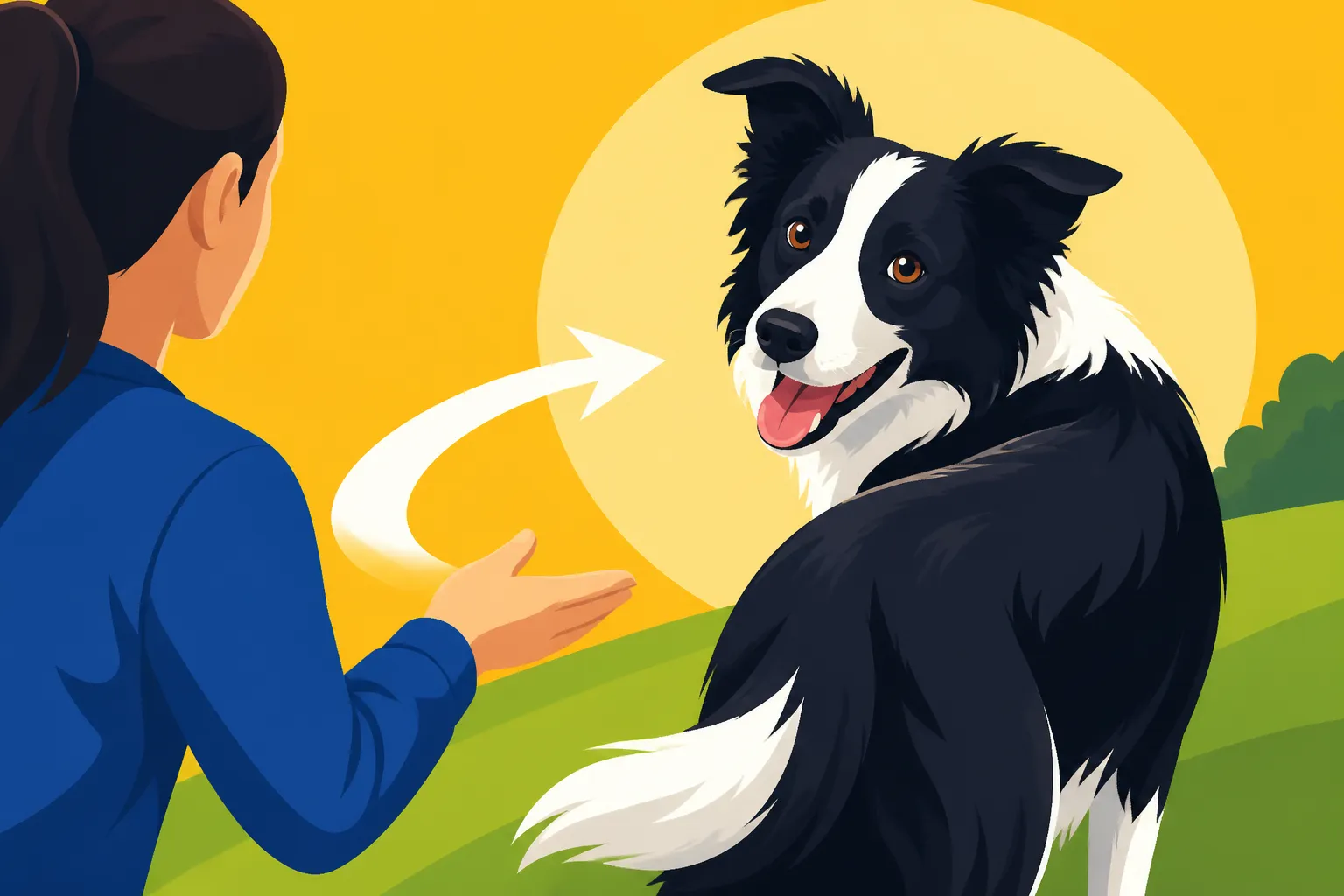
The "look back" command, often simply called a "check-in," is precisely what it sounds like: your Border Collie turning their head, meeting your gaze, and acknowledging your presence and direction, even from a considerable distance. It’s not necessarily a full recall, where they physically return to you, but rather a moment of reconnection, a mental check-in that says, "I see you, what's next?"
Why "Look Back" is Different from a Full Recall
Many people confuse "look back" with a standard "come" or "here" command, but they serve distinct purposes, especially with a breed like a Border Collie. A full recall means your dog disengages from whatever they're doing and returns directly to your side. This is, of course, absolutely vital. However, the "look back" is about maintaining awareness of you while still potentially being at a distance or engaged in an activity like searching for a disc, working stock, or simply exploring on a hike. Think of it as opening a communication channel that can then lead to a full recall, a directional change, or simply a confirmation that they’re still connected to you. It's about proactive control rather than reactive retrieval.
For instance, if your Border Collie is working sheep far out in a field, you might not want them to abandon the sheep entirely and run back to you. Instead, you need them to check in, receive a new direction with a whistle or hand signal, and then continue working. Similarly, on a wide-open trail, if they've rounded a bend and are about to disappear, a "look back" can stop them in their tracks, get their attention, and wait for your next instruction. It reinforces the idea that you are the center of their universe, even when the world is full of exciting distractions.
The Safety and Communication Benefits
The benefits of a solid "look back" command are immense, particularly for a breed so driven and often ranging far from its handler. First and foremost, it's a huge safety net. Border Collies, with their intense focus and speed, can vanish from sight in seconds, especially in dense brush or undulating terrain. A reliable "look back" prevents them from getting completely lost or encountering unexpected hazards like roads, wildlife, or unfamiliar people without your knowledge. You can stop them before they disappear, giving you precious seconds to assess the situation and issue a more specific command.
Beyond safety, it significantly enhances your communication. Border Collies thrive on working with their humans; it's what they were bred to do. The "look back" fosters that partnership by establishing a constant, subtle dialogue. It teaches them to value your input, to regularly seek your guidance, and to not get so lost in their own world that they become deaf to you. This command builds trust and strengthens your bond, turning your outings into a true team effort rather than a constant game of "find the Border Collie." It truly makes a difference in how confident you feel letting your dog enjoy appropriate off-leash freedom.
Breaking Down the "Look Back" Command: Step-by-Step Training
Teaching the "look back" is a process that requires patience, consistency, and a good understanding of how Border Collies learn. It’s all about building value and making it a habit, starting simple and gradually adding complexity.
Step 1: Foundation in a Low-Distraction Environment
You always want to start a new command where your dog can focus entirely on you. Your living room, a quiet backyard, or an empty hallway are perfect. Your goal here is to establish the association between the cue (verbal, hand signal, or both) and the action of looking at you.
Start by having your Border Collie a short distance away, maybe 5-10 feet. Have some high-value treats ready – little pieces of chicken, cheese, or whatever your dog goes absolutely bonkers for. You can use a specific hand signal, like pointing a finger over your shoulder or making a motion like you’re turning their head. As you give the verbal cue – "Look Back," "Check In," or even "Where Are You?" (choose one and stick with it!) – take a few steps away from them, or put yourself slightly out of their direct line of sight. The moment they turn their head and meet your gaze, even for a split second, enthusiastically mark the behavior with a "Yes!" or a clicker, and immediately deliver that super-tasty reward. Repeat this many times. The key is to catch them in the act of turning their head towards you and instantly rewarding it. Don't wait for them to come back to you at this stage; just the head turn and eye contact is the win.
Step 2: Adding Distance and Mild Distractions
Once your Border Collie reliably looks back at you in your quiet starting location, it’s time to slowly increase the challenge. This is where a long line or a The Thirty-Foot Line a Border Collie Recall Needs becomes an invaluable tool. It allows you to practice at a greater distance while still having control and preventing them from making poor choices, like bolting in the wrong direction.
Move your training sessions to a slightly more distracting environment, like a quiet park or a large, fenced field during off-peak hours. Start with the same short distance you mastered indoors, then gradually extend it. If your dog is 15 feet away and gets distracted by a squirrel, use your "look back" cue. If they turn and look, reward heavily! If they don't, gently guide them with the long line, or take a step backward to re-engage their attention, and then try again. The long line isn't for yanking, but for gentle reminders and preventing failure.
Introduce mild, non-moving distractions first, like a parked car or a person sitting quietly in the distance. Work on this until they are consistently checking in at 20-30 feet. Always keep your rewards high-value during this phase to compete with the emerging distractions. Remember, Border Collies learn incredibly fast, but they also need thorough proofing of commands in various settings. You want that "look back" to be as automatic as breathing.
Step 3: Generalization and Real-World Application
This is where the rubber meets the road. Your Border Collie needs to understand that "look back" isn't just a game played in the park, but a command that applies everywhere. Take your training to different types of environments: busy trails (with appropriate leash management), open fields with other dogs (at a safe distance), or even places with new smells and sounds.
Vary your position. Don't always stand in the same spot. Sometimes you're behind them, sometimes to the side, sometimes you duck slightly behind a tree before calling. The goal is for them to actively seek you out with their eyes, not just turn in a predictable direction. If you're struggling to get them to focus, especially when they're truly locked onto something exciting, try using a whistle cue for your "look back" command. A distinct whistle can cut through distractions far better than a voice for a breed like the Border Collie, whose ears are always tuned in. You can find excellent training resources, including guidance on whistle commands, from places like BAXTER & Bella, which offer structured online programs that can help guide you through these advanced stages. For training supplies like a good whistle or a variety of high-value treats, online retailers like Amazon are always well-stocked.
Remember to reward not just with food, but with praise, a quick game of fetch, or even permission to go back to what they were doing after they've checked in. This reinforces that checking in doesn't mean the fun stops, it just means they acknowledge you.
Common Challenges and Troubleshooting
Even with the smartest dogs, training isn't always a straight line. Border Collies, with their intense drive, can present unique challenges when it comes to breaking focus.
The Border Collie That's Too Focused to Look Back
This is a classic Border Collie conundrum, isn't it? Their ability to intensely focus is their superpower on the farm or in the agility ring, but it can be a real headache when you need them to disengage from a fascinating scent, a distant deer, or even a leaf blowing in the wind. When your Border Collie has The Border Collie Stare and Where It Comes From, getting them to break it and acknowledge you can feel impossible.
The key here is prevention and escalation of reward. First, don't wait until they're already at their peak focus. Try to anticipate when they might lock on and issue the "look back" command before they're completely consumed. If they do lock on, your cue needs to be strong enough to break through. This means using your highest-value rewards – maybe it's not just chicken, but a squeaky toy they absolutely adore, or a quick, vigorous game of tug. For some Border Collies, a specific, high-pitched whistle blast might cut through the noise better than your voice.
If they still don't respond, don't just repeat the command endlessly. That teaches them to ignore it. Instead, physically intervene gently using your long line to guide their head towards you, or move closer to them, tap them lightly on the shoulder, or make a sudden, startling (but not scary) sound like a clap. The moment their eyes flicker to you, mark it and reward heavily. You're teaching them that your presence and your cue are always more rewarding than the distraction.
Inconsistent Responses and "Selective Hearing"
"Selective hearing" is a term often humorously applied to Border Collies, but it speaks to a real challenge: sometimes they respond beautifully, and other times it's like you're speaking a foreign language. This inconsistency usually stems from a few factors:
- Insufficient Proofing: You might have only practiced in a few environments. Your dog truly needs to practice "look back" in dozens of different places, with varying levels of distraction, until it becomes truly ingrained.
- Variable Rewards: Are you always using high-value treats? If you're sometimes rewarding with dry kibble and other times with steak, your dog will learn that the reward isn't always worth breaking focus for. Be consistent with high-value rewards, especially in challenging environments.
- Too Much Distance, Too Soon: If you push the distance too quickly, your dog might fail, and failures erode the reliability of the command. Always set them up for success, even if it means reeling them in on the long line for a moment and starting closer.
- Lack of Consequence for Not Responding: This doesn't mean punishment, but simply that there's no benefit to not looking back. If they ignore you and nothing happens, they learn that ignoring is an option. Use your long line to gently guide them to success, ensuring that looking back always results in a positive outcome. If you call "look back" and they don't, you must ensure they eventually perform the action (with your help) and then get rewarded. This builds the understanding that the command means "do this, and get awesome stuff."
Making it Stick: Generalization and Reinforcement Schedule
The goal is for "look back" to be a reflex, not a choice. To achieve this, you need a smart reinforcement schedule and relentless generalization.
Early on, reward every single time they perform the command correctly. This is called a continuous reinforcement schedule and it builds the behavior quickly. Once they're consistently performing it in various environments, you can transition to an intermittent reinforcement schedule. This means you don't reward every time, but unpredictably. Sometimes they get a treat, sometimes enthusiastic praise, sometimes a quick toss of a favorite toy. This actually makes the behavior stronger and more resistant to extinction because they never know when the big reward is coming, so they keep trying.
Also, continue to practice in diverse settings. Practice at the park, on the beach, in the woods, near a quiet road, even in your own yard when children are playing. The more situations your Border Collie practices the "look back" command, the more generalized and reliable it will become. Think about incorporating it naturally into your walks. Every few minutes, especially if they're ranging ahead, cue that "look back." Acknowledge them, give them a good job, and let them continue their sniffing and exploring. This integrates the command into their normal routine, making it part of their overall awareness of you during their activities. This command, along with a strong Recall on a Border Collie That Has Locked On, forms the backbone of reliable off-leash work.
Integrating "Look Back" into Real-World Scenarios
A command is only as good as its real-world application. For a Border Collie, this means being able to use "look back" effectively whether you're working stock, hiking a busy trail, or simply playing in the park.
On the Trail: Preventing Unwanted Encounters
Imagine you're hiking with your Border Collie off-leash (where permitted and safe, of course), and they're happily trotting along, sniffing every interesting scent. Suddenly, they round a bend ahead of you, and you realize there might be other hikers, cyclists, or even wildlife just out of sight. This is a prime moment for the "look back" command.
Instead of waiting for them to come all the way back, or worse, making an unwelcome approach to another trail user, a quick "Look Back!" cue can stop them in their tracks. Their head snaps around, they make eye contact with you, and then you can issue a follow-up command: "Come!" if you need them by your side, "Wait!" if you want them to hold their position while you catch up, or a directional command if you spot something you want them to avoid. This proactive approach not only keeps your dog safe but also makes you a responsible trail user, preventing potential conflicts or startling encounters. It's about maintaining that invisible leash, that constant awareness of your presence, even when your Border Collie is enjoying the freedom of the trail.
Working Stock: Maintaining Connection at a Distance
For Border Collies who work stock, the "look back" (or a similar check-in command) is absolutely fundamental. When your dog is hundreds of yards out, pushing sheep or cattle, visual contact can be difficult, and you need to ensure they are still attuned to your instructions. While traditional herding commands like Come Bye and Away to Me on a Border Collie direct movement, a "look back" or "watch me" might be used to confirm they understand the previous instruction or to prepare them for a new one.
For example, if you've sent your dog on a wide outrun and they're about to gather a group of sheep, you might give a quiet whistle or verbal "look back" to ensure they're focused before issuing the "lift" command. Or, if they seem to be misinterpreting a flank, a quick check-in can bring their mental focus back to you, allowing you to correct the direction. This isn't just about control; it's about partnership. It's the silent agreement that even across vast distances, they are always listening, always watching for your next signal. It’s part of what separates a truly great working dog from one that just runs.
Enhancing Everyday Obedience and Focus
Even for pet Border Collies who may never see a sheep, the "look back" command significantly boosts their overall obedience and responsiveness. Think about times when your dog is engrossed in a scent in the park, fixated on a ball, or distracted by another dog. These are moments where a clear, reliable "look back" can be invaluable.
Instead of yelling their name repeatedly or physically dragging them away, you can use your practiced cue to momentarily break their intense focus and redirect their attention to you. This can then lead into other commands, like "heel," "sit," or even just a calm walk away from the distraction. It empowers you to manage their incredible drive and focus, channeling it constructively rather than constantly battling against it. It reinforces that, regardless of what's happening around them, your voice, your whistle, or your signal holds paramount importance. This kind of consistent communication helps Exercise, Work and What Actually Settles a Border Collie by providing mental engagement and structure, rather than just physical exertion. A well-trained Border Collie is a happy Border Collie, and the "look back" is a cornerstone of that positive relationship.
| Training Stage | Environment | Distance | Distraction Level | Reinforcement Strategy | Key Focus |
|---|---|---|---|---|---|
| Foundation | Quiet Indoor Space (Home) | 5-10 ft | None | Continuous (every time) with high-value treats | Establish head turn & eye contact with cue |
| Building Distance | Quiet Outdoor Space (Yard) | 10-20 ft | Minimal | Continuous with high-value treats | Introduce long line; increase distance gradually |
| Adding Distraction | Park (off-peak), Quiet Trail | 20-30 ft | Low to Medium | Continuous, varied rewards (treats, toys, praise) | Practice around stationary objects, distant people |
| Generalization | Varied locations (Trails, Fields, Pet Stores) | 30+ ft | Medium to High | Intermittent, unpredictable high-value rewards | Practice with moving distractions, varied cues (whistle) |
Disclaimer
This article is for general informational purposes only and does not constitute professional advice. Laws, prices and regulations vary by location and change over time. Consult a qualified professional for guidance on your specific situation.