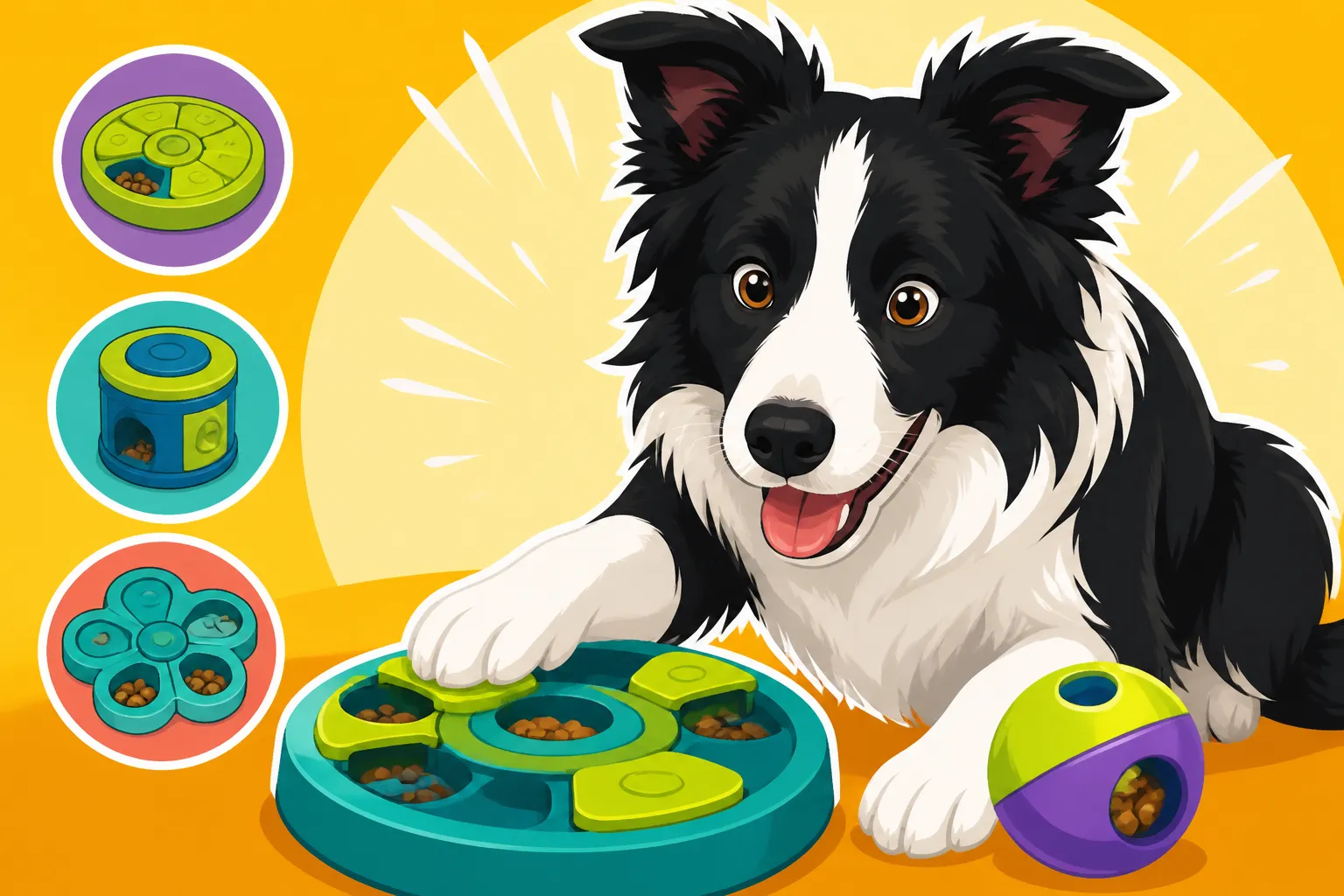
Puzzle Feeders That Hold a Border Collie
If you're reading this, chances are you've experienced the phenomenon of a Border Collie inhaling their dinner in thirty seconds flat, then looking at you expectantly as if to ask, "Is that all there is?" It’s a common frustration among us Border Collie folks: these brilliant dogs can turn mealtime into a blink-and-you-miss-it event, leaving them physically fed but still brimming with mental energy. This guide is here to dive deep into the world of puzzle feeders, helping you discover options that will truly challenge and engage your super-smart companion, turning mealtime into a satisfying brain workout rather than a race to the bottom of the bowl.
Why Traditional Bowls Just Don't Cut It for a Border Collie
Let's be honest, a standard food bowl is about as exciting as watching paint dry for a Border Collie. These dogs were bred for complex problem-solving, for navigating vast landscapes, and for outsmarting sheep. Tossing their meal into a static dish doesn't even register as a warm-up for their formidable intellect. It's not just about slowing down their eating; it's about honoring their inherent need for mental engagement.
The Boredom Trap and Fast Eaters
Imagine being given a puzzle book and just being told to eat it. That's essentially what a normal food bowl is to a Border Collie. They don't need to think, strategize, or work for their reward. This lack of engagement can quickly lead to boredom, and for a Border Collie, boredom is often the root of many behavioral issues. A bored Border Collie isn't just lying around; they're actively looking for a job, and if you don't provide one, they'll invent their own, which might not align with your idea of a well-behaved dog.
Beyond the mental aspect, fast eating can have physical consequences. Gulping down food too quickly can lead to indigestion, gas, and in severe cases, a life-threatening condition called bloat (gastric dilatation-volvulus). While Border Collies aren't as prone to bloat as some deeper-chested breeds, any dog that eats at warp speed runs a higher risk. Slowing down their eating pace is crucial for their physical well-being, allowing proper digestion and reducing the amount of air they swallow with their food.
The Mental Need Behind Their Drive
Border Collies thrive on work. Their ancestors spent entire days making complex decisions, reading animal movements, and responding to intricate commands. This isn't just physical exertion; it's intense mental labor. When we bring these dogs into our homes, even if they aren't working livestock, that fundamental drive for mental stimulation doesn't just disappear. It needs an outlet. If you've ever had a Border Collie that seems to learn The Border Collie That Learns Faster Than You Teach, you know exactly what I mean. They pick up new commands in a flash, and then they're ready for the next challenge.
Puzzle feeders tap directly into this innate drive. They transform mealtime from a mundane refuel into a mini-mission. Your dog has to sniff, nudge, paw, and think their way to every morsel, mimicking the natural foraging behaviors of wild canids. It requires focus and persistence, two qualities our Border Collies possess in spades. Providing this kind of mental enrichment isn't just a nicety; it's a necessity for a well-adjusted, happy Border Collie who isn't left feeling that inexplicable "something is missing" after their dinner.
Types of Puzzle Feeders: Finding the Right Challenge
The world of puzzle feeders is vast and varied, ranging from simple designs to elaborate brain teasers. The key is to know your dog and understand where they are in their puzzle-solving journey. What might hold one Border Collie's attention for twenty minutes could be solved by another in two. You want something that challenges them, not something that frustrates them into giving up, or conversely, is so easy it's over before you can blink.
Beginner-Friendly Snuffle Mats and Slow Feeders
For a Border Collie new to puzzle feeders, or one that tends to get easily frustrated, starting with something that offers a gentle introduction to "working for food" is ideal. Snuffle mats are fantastic for this. They're essentially fabric mats with various textures and hiding spots where you can scatter kibble or treats. Your dog has to use their nose to "snuffle" through the fabric strands to find their food, engaging their natural scent drive without requiring complex manipulation skills. They slow down eating significantly and provide satisfying nose work. You can find a good variety of these on platforms like Amazon, offering different levels of fabric density and complexity.
Slow feeder bowls are another excellent starting point. These aren't puzzles in the traditional sense, but their internal labyrinths, ridges, and mazes force your dog to eat around obstacles, preventing them from gulping. They're perfect for the dog whose only problem is speed, without needing the mental challenge of a true puzzle. They teach patience and reduce gulping, setting the stage for more complex problem-solving down the line. Look for designs that are stable and difficult to flip, especially with a determined Border Collie.
Intermediate Puzzles: Lids, Levers, and Slides
Once your Border Collie has mastered the basics and shows a keen interest in seeking out food, it's time to step up the game. Intermediate puzzles introduce elements like movable parts, lids to lift, levers to press, or sliding components that reveal hidden compartments. These require more cognitive effort and paw/nose dexterity. For instance, some feeders have small compartments covered by sliding discs that your dog needs to push with their nose or paw to access the food. Others might have small drawers that need to be pulled out.
These types of puzzles encourage your Border Collie to experiment with different actions. They learn cause and effect: "If I push this, then the food appears." Brands like BAXTER & Bella often recommend incorporating such puzzles into their training programs, as they build confidence and problem-solving skills which are foundational for a well-rounded dog. The trick here is finding one that isn't too easy, where they get the hang of it in minutes, but also not so difficult that they just give up. You want that sweet spot where they're genuinely thinking and working, perhaps even letting out a happy "aha!" bark when they figure it out.
Advanced Brain Games: Multi-Step Challenges
For the true Border Collie genius in your life – and let's face it, many of them are – advanced puzzles are where the real fun begins. These feeders often involve multiple steps and different types of mechanisms that need to be solved in a specific sequence. Think of them as miniature escape rooms for dogs. They might require lifting a lid, then sliding a panel, then perhaps turning a wheel to release food. Some even incorporate weights or buttons that need to be pressed in conjunction with other actions.
These puzzles are fantastic for Mental Work That Tires a Border Collie Faster, as they demand sustained focus and strategic thinking. They can truly exhaust a Border Collie's mind in a way that physical exercise alone sometimes can't. When choosing an advanced puzzle, look for durability and cleanability, as your dog will be interacting with it quite vigorously. They should be made from sturdy, non-toxic materials. The joy of watching your highly intelligent Border Collie methodically work through a complex puzzle, finally retrieving their reward, is truly satisfying for both of you. It's proof of their incredible problem-solving abilities and a testament to how much they enjoy a good mental workout.
Choosing and Introducing the Perfect Puzzle Feeder
Selecting the right puzzle feeder is more art than science, and it often involves a bit of trial and error. What one dog loves, another might ignore. The goal is to provide a challenge that's stimulating without being overwhelming, growing with your dog's capabilities.
Matching the Feeder to Your Border Collie's Prowess
Think about your dog's personality. Is your Border Collie a persistent problem-solver who enjoys figuring things out, even if they're difficult? Or do they tend to get frustrated easily and give up if a task isn't immediately solvable? For the latter, start simpler. A snuffle mat or a basic slow feeder bowl is a great beginning. As they gain confidence, you can introduce feeders with one or two movable parts.
For the naturally tenacious Border Collie, you might be able to jump straight to an intermediate puzzle. Observe how they interact with it. Are they pushing it around idly, or are they actively trying different methods to get the food out? If they solve it too quickly, it's time for a more complex version. If they ignore it after a few tries, it might be too hard, or perhaps they need a more enticing treat inside. Remember, the idea is to engage, not to intimidate. This is also a great way to bond and build confidence, especially if you're following a structured training program like those offered by BAXTER & Bella.
Tips for a Successful First Introduction
When introducing a new puzzle feeder, especially a more complex one, set your Border Collie up for success. Don't just dump it in front of them and walk away. Start by making it very easy. For a sliding puzzle, you might leave some compartments open or barely cover them initially, so your dog gets immediate success and understands the concept of "food comes from here." You can even use a high-value treat, something really delicious, to heighten their motivation.
Supervise their first few interactions. You want to make sure they're using it as intended and not trying to chew through the plastic or flip it over in frustration. If they're struggling, offer gentle guidance. Point to a slider, nudge a lid, or even manually open a compartment to show them how it works. Positive reinforcement is key here – lots of praise and encouragement when they make progress, even small steps. Make it a fun, rewarding experience, not a test. This positive association will encourage them to keep trying and develop their puzzle-solving skills.
Rotating for Continued Engagement
Even the most challenging puzzle feeder can become routine if it's used every single day, all the time. Border Collies, with their incredible intelligence, can quickly memorize solutions. Once they've "solved" a puzzle, its novelty and challenge diminish. To keep them truly engaged and prevent them from becoming bored with their feeders, rotate them regularly. Think of it like a library of brain games.
Having a selection of 2-3 different types of puzzle feeders and rotating them throughout the week can make a huge difference. You might use a snuffle mat one day, a sliding puzzle the next, and an advanced multi-step feeder on another. This keeps your Border Collie guessing and continually applying their problem-solving skills to new scenarios. It also helps prevent them from learning to Why a Border Collie Cannot Stop on Its Own when it comes to a specific game, ensuring they continue to think critically rather than just performing a rote action. Variety is the spice of life for an active Border Collie mind!
Beyond the Bowl: Integrating Puzzle Feeders into Daily Life
Puzzle feeders aren't just for replacing dinner. They can be incredibly versatile tools for managing your Border Collie's energy, alleviating boredom, and even enhancing their training. Thinking creatively about how and when you use them can unlock even more benefits for your clever companion.
Using Them for Meal Times and Training
Of course, the primary use of puzzle feeders is to make meal times more engaging. Instead of simply pouring kibble into a bowl twice a day, divide your Border Collie's daily ration among one or two puzzle feeders. This means they're working for their food at every meal, consistently exercising their brains. This simple change can make a profound difference in their overall mental satisfaction and reduce restless behavior around the house. Consider this an essential part of What a Border Collie Does With Its Whole Day.
Beyond meals, puzzle feeders can be fantastic for training. If you're working on Trick Training a Border Collie Indoors, using small pieces of their kibble in a feeder as a reward can keep them focused and motivated. They're not just getting a treat; they're getting a mini-puzzle to solve as a reward for their good work. This can be particularly useful for impulse control exercises, as they have to wait patiently for the puzzle to be set up and then work to earn the reward. Some Border Collie owners even use puzzle feeders to occupy their dogs during short periods of alone time, helping to prevent A Border Collie That Chews Itself When Bored.
Common Pitfalls and How to Overcome Them
While puzzle feeders are wonderful, they're not without their potential challenges. One common pitfall is that some Border Collies, in their enthusiasm, might try to chew or destroy the feeder to get to the food faster. If your dog is a vigorous chewer, look for feeders made from very durable, hard plastic or rubber, rather than softer materials that can be easily gnawed. Always supervise new feeders to ensure they're using them safely.
Another issue can be frustration. A Border Collie that finds a puzzle too difficult might give up, or worse, become anxious or stressed. If you notice your dog pawing frantically, barking at the feeder, or abandoning it altogether, it's a sign that the puzzle might be too advanced for them right now. Go back to an easier feeder, or simplify the current one by leaving more food exposed. Remember to keep it positive and fun. Also, ensure the puzzle feeder is clean; some dogs are sensitive to lingering food smells that might deter them. Regular cleaning, especially if using on-the-go feeders from brands like Amazon, will keep them enticing.
Ultimately, puzzle feeders are an investment in your Border Collie's mental well-being. They provide an enriching activity that taps into their natural intelligence and drive, turning routine mealtimes into stimulating brain games. By choosing wisely, introducing them thoughtfully, and rotating them regularly, you can provide endless hours of satisfying mental work for your incredible companion.
Disclaimer
This article is for general informational purposes only and does not constitute professional advice. Laws, prices and regulations vary by location and change over time. Consult a qualified professional for guidance on your specific situation.