Fencing a Yard a Border Collie Cannot Leave
One of the biggest anxieties for any Border Collie owner is the thought of their brilliant, energetic dog finding a way out of the yard. These aren't just ordinary dogs; they're canine Einsteins with an Olympic athlete's physique, and a standard fence can often feel less like a barrier and more like a gentle suggestion. This guide is here to walk you through exactly what it takes to build or reinforce a perimeter that even the most determined Border Collie will struggle to outsmart, giving you the peace of mind you deserve.
Understanding the Border Collie's Instinct to Explore
Before you can build an escape-proof fortress, you need to understand the mind of the architect trying to get out: your Border Collie. Their drive isn't malicious; it's simply an inherent part of who they are, bred for centuries to range far and wide, solving problems and managing livestock. This deep-seated instinct needs to be respected and understood when planning your containment strategy.
The Drive to Herd and Roam
Border Collies were developed to work tirelessly across vast fields, often out of sight of their handler, bringing in sheep from great distances. This isn't just a job; it's ingrained in their very being. When they're not given a proper outlet for this innate desire to move, to 'herd,' and to cover ground, their energy doesn't just dissipate. Instead, it often manifests as a compelling urge to find something to do, and that "something" might just be what's on the other side of your fence. They're not simply running away; they're exploring, seeking stimulation, or looking for a "job." If they see movement—a squirrel, a jogger, another dog, or even a leaf blowing—their instinct can kick in, overriding any training or perceived boundary.
This strong instinct also means that if your Border Collie is not sufficiently engaged, they will actively seek out engagement elsewhere. A yard, no matter how large, can feel restrictive if it doesn't offer enough mental and physical challenges. This can lead to them becoming what we fondly (or exasperatedly) call "escape artists."
Intelligence and Problem-Solving Skills
It's no secret that Border Collies are incredibly intelligent. They consistently rank high on canine intelligence scales for a reason, demonstrating an uncanny ability to learn, remember, and problem-solve. This intelligence isn't limited to learning complex commands or performing amazing tricks; it also extends to figuring out their environment. They observe. They analyze. They test boundaries.
A Border Collie can watch you open a gate latch once and try to replicate it the next time. They'll push at weak spots, dig under loose sections, and test the give of every board. They are adept at finding patterns in your routine and exploiting any perceived weaknesses in your fencing system. For instance, if you always use the same gate, they might focus their escape efforts there. They aren't just brute-forcing their way out; they're often thinking their way out. This means your fence needs to be more than just tall; it needs to be clever.
Boredom and Lack of Stimulation
Many escape attempts, particularly with a Border Collie, stem from boredom or insufficient mental and physical stimulation. A dog left alone in a yard for hours with nothing to do will start looking for entertainment, and unfortunately, that often means finding a way out. Imagine being stuck in a room with nothing to engage your brilliant mind; you'd probably start examining the exits too.
Physical exercise alone, while crucial, often isn't enough for these dogs. They need their brains worked just as hard as their bodies. Without engaging tasks, even the most beautiful yard can become a monotonous prison, driving them to seek excitement beyond its borders. This is why a truly secure environment for a Border Collie involves a combination of robust physical barriers and a rich, stimulating daily routine that includes focused training, puzzle toys, and plenty of opportunities to burn off both physical and mental energy. A dog tired from a good training session or a vigorous game of fetch is far less likely to spend its time plotting an escape. If you're wondering how much engagement is enough, remember that Exercise, Work and What Actually Settles a Border Collie often goes far beyond a simple walk around the block.
Essential Features of an Escape-Proof Fence
When you're dealing with a Border Collie, you can't think of a fence as merely a line in the sand. It needs to be a truly formidable barrier, addressing their vertical prowess, digging tendencies, and their surprising dexterity.
Height Requirements: Going Vertical
One of the first things people underestimate with a Border Collie is their jumping ability. These dogs are built like springs, designed for agility and quick bursts of speed. A standard four-foot privacy fence might as well be a hurdle for some of them. While not every Border Collie will clear six feet from a standstill, many are capable of scaling or jumping fences that are five feet high, especially if they have a good run-up or any sort of toe-hold.
To be truly secure, particularly for a dog that is motivated to escape, you should aim for a minimum of a six-foot fence. Even better, consider options that include an inward or outward lean at the top, or a "coyote roller" system. These additions prevent them from getting purchase to climb over the top. If your dog is particularly athletic, or if there's something incredibly tempting on the other side of the fence, even a six-foot barrier might need further reinforcement.
Preventing Digging and Tunneling
Just as Border Collies can go up and over, they can also go down and under. Digging is another natural behavior for many dogs, and for a Border Collie, it can become a calculated escape route. They're often strong, persistent diggers, especially if they catch a scent of something interesting on the other side, or if they're simply bored.
To prevent tunneling, you need to secure the base of your fence. There are several effective methods:
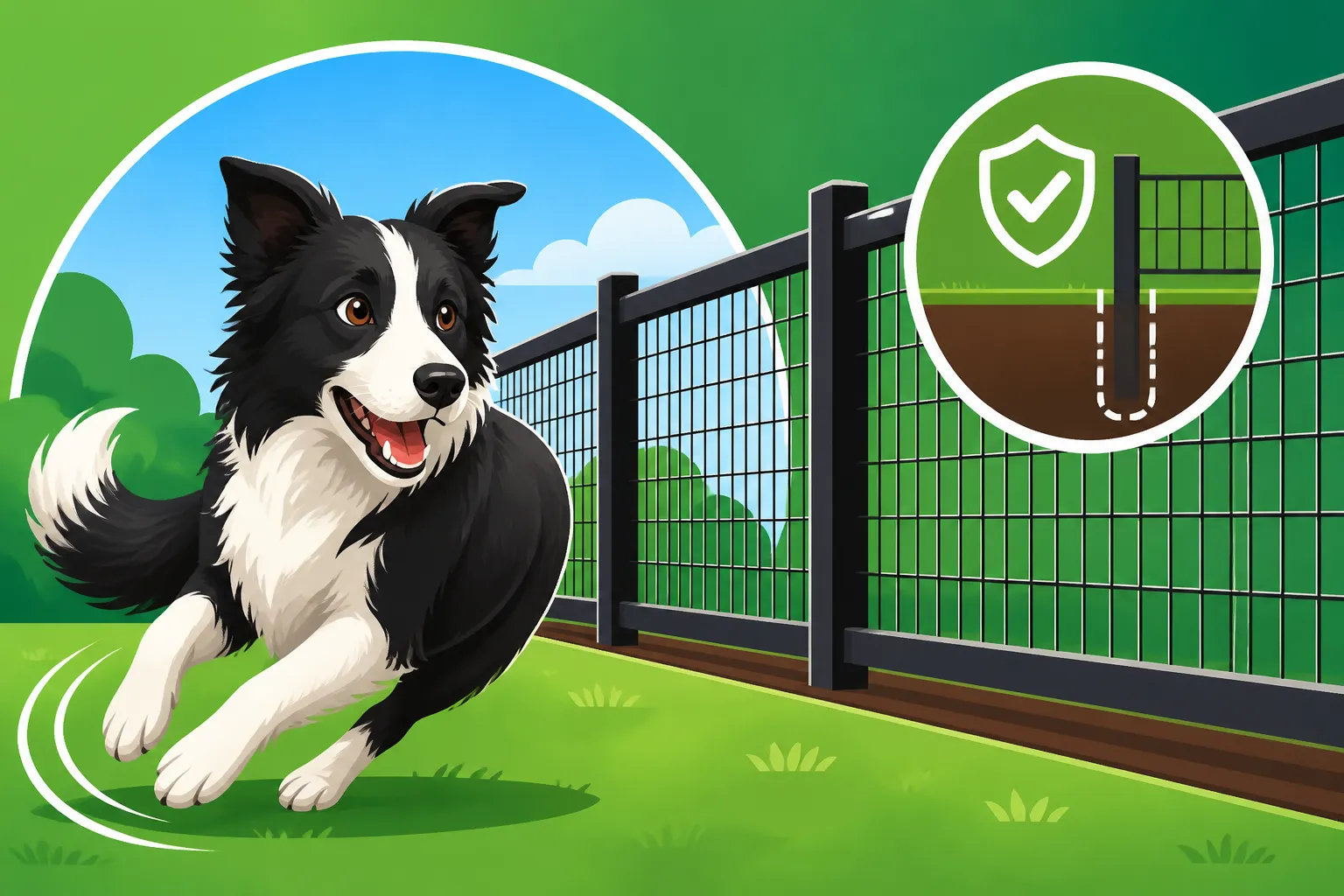
- Burying the Fence: Extend your fence material (e.g., chain link, hardware cloth) at least 12-18 inches below the ground. Bend it into an "L-footer" shape, so it extends horizontally inward along the ground. This makes it difficult for a dog to dig directly down the fence line.
- Concrete Curb: Pouring a concrete curb along the base of the fence line is one of the most robust solutions. It's labor-intensive and more expensive initially but offers a virtually impenetrable barrier against digging.
- Heavy Landscaping or Rocks: While less foolproof than buried wire or concrete, placing large, heavy rocks, concrete blocks, or heavy landscaping ties along the inside perimeter of the fence can deter some diggers. However, a truly determined Border Collie might just move them.
Remember, even a small gap can become a large tunnel over time. Regular checks of the fence line are crucial to catch any nascent digging efforts before they become successful escape routes.
Gate Security and Latches
A fence is only as strong as its weakest point, and often, that weakest point is the gate. Border Collies are smart enough to figure out simple latches. A basic hook-and-eye or a flimsy thumb latch might last a week, a day, or even an hour before your dog has it mastered.
Here's how to beef up gate security:
- Double-Latching Mechanisms: Install at least two sturdy latches on your gate, preferably at different heights and types. A spring-loaded gravity latch combined with a padlock or a barrel bolt can be highly effective.
- Self-Closing Hinges: These ensure the gate always swings shut automatically. This prevents accidental escapes if a visitor or child forgets to close it properly.
- No Gaps: Ensure there are no significant gaps under, beside, or above the gate that a Border Collie could squeeze through. Add a bottom sweep or weather stripping to close any gaps along the ground.
- Padlocks and Carabiners: For critical times, or if you have a particularly clever Border Collie, a simple carabiner clip or padlock on the gate latch can be a cheap but effective deterrent.
Don't forget about access points for deliveries, gardening services, or other visitors. Make sure everyone who might use your gate understands the importance of securing it completely, every single time. Your Border Collie is watching and learning, especially around points of entry.
Types of Fencing: Pros and Cons for Border Collies
Choosing the right type of fencing is a critical decision, and each option comes with its own set of advantages and disadvantages when it comes to containing a high-drive Border Collie. What works for a less active breed might not cut it for these intelligent athletes.
Physical Barrier Fences (Wood, Chain Link, Vinyl)
Traditional physical fences are often the first choice for homeowners, but their effectiveness for a Border Collie depends heavily on their construction and maintenance.
-
Wood Fences (Privacy or Picket):
- Pros: They block visual stimuli, which can be a huge benefit for a Border Collie that might be triggered by seeing dogs, people, or wildlife on the other side. This can reduce barking and the urge to chase. They also offer good aesthetic appeal and privacy.
- Cons: Wood fences require significant maintenance (staining, painting, replacing warped boards). Gaps can open up as wood shrinks or warps, creating potential escape routes. Picket fences, while attractive, offer footholds for climbing and clear visibility to the outside world, which can be a strong motivator for a Border Collie to go after The Border Collie That Runs the Fence at Traffic.
- Security for Border Collies: For a wood fence to be secure, it needs to be solid (no gaps between boards), at least 6 feet high, and ideally reinforced at the bottom to prevent digging. Look for smooth boards that offer no easy climbing purchase.
-
Chain Link Fences:
- Pros: Generally less expensive upfront than wood or vinyl, and easier to install. Offers good visibility, which can be a con or a pro depending on your dog.
- Cons: The biggest drawback for Border Collies is that chain link provides an excellent ladder. Their strong paws and grip allow them to scale these fences surprisingly quickly. They also don't block visual stimuli, meaning your dog is constantly exposed to outside triggers.
- Security for Border Collies: A chain link fence needs to be very tall (8 feet is often recommended if used as a sole barrier for a climber), and the bottom must be secured against digging with an L-footer or concrete. Even then, an agile Border Collie might still find a way over.
-
Vinyl Fences:
- Pros: Durable, low maintenance, and often come in solid panels that block visual stimulation, similar to wood privacy fences. They don't splinter, warp, or rust.
- Cons: Can be more expensive than wood or chain link for initial installation. Can crack in extreme temperatures or if impacted forcefully.
- Security for Border Collies: Vinyl fences are generally good for Border Collies if they are at least 6 feet tall and properly installed with a secure base to prevent digging. Their smooth surface makes them difficult to climb, and the solid panels minimize external distractions.
Invisible or Electronic Fences
Invisible fences, often relying on an underground wire and a collar that delivers a static correction, seem like a convenient solution, but they come with significant caveats for Border Collies.
- How They Work: A wire is buried around the perimeter of your yard, connected to a transmitter. Your dog wears a receiver collar that beeps when it approaches the wire, and if it continues, it receives a mild static correction.
- Pros: Aesthetically pleasing as there's no visible fence. Can be a cost-effective option for large or irregularly shaped yards.
- Cons: This is not a physical barrier. A highly motivated Border Collie, especially one driven by prey drive or fear, can and often will "run through" the static correction if the reward (a squirrel, another dog, the freedom of escape) is perceived as greater than the momentary discomfort. Furthermore, an invisible fence does nothing to keep other animals or people out of your yard, leaving your Border Collie vulnerable or able to interact with outside threats. They also require consistent battery changes in the collar and can be prone to wire breaks. For a breed that requires extensive Mental Work That Tires a Border Collie Faster, reliance on purely negative reinforcement for boundaries isn't always ideal.
- Security for Border Collies: For these reasons, invisible fences are generally not recommended as the primary containment solution for a Border Collie. They can be a supplemental layer of security within an existing physical fence, perhaps to keep a dog away from a specific garden bed, but they rarely offer the foolproof containment needed for this breed's intelligence and drive.
Creative Solutions and Add-ons (Rollers, Hot Wire, Fence Extensions)
Sometimes, a standard fence just isn't enough, and you need to think outside the box (or inside the fence line) to truly secure your Border Collie.
-
Coyote Rollers/Fence Rollers: These are PVC pipes or similar materials installed along the very top of your fence. When a dog attempts to get a grip to climb over, the rollers spin, preventing them from getting purchase.
- Pros: Highly effective for preventing climbing and scaling without increasing the actual height of the fence.
- Cons: Can be visible, may require professional installation, and adds to the overall cost.
- Security for Border Collies: Excellent for deterring climbers. Combined with adequate height and dig-proofing, rollers can make a fence significantly more secure.
-
Hot Wire/Electric Fence (Low Voltage): A single or double strand of low-voltage electric wire can be run along the inside base of the fence (for diggers) or near the top (for climbers).
- Pros: Provides a significant deterrent. The unpleasant, but harmless, jolt teaches the dog to respect the boundary quickly.
- Cons: Requires careful installation to be safe for both dogs and humans. Needs to be clearly marked. Can be aesthetically unappealing.
- Security for Border Collies: Can be very effective for persistent diggers or climbers who repeatedly challenge the fence line. It's a behavioral deterrent rather than a physical barrier, working by discouraging contact.
-
L-Footers and Mesh Extensions: As mentioned, L-footers buried at the base are crucial for diggers. Additionally, you can extend the height of an existing fence with mesh or lattice extensions, bending them slightly inward at the top to further deter climbers. These solutions require careful integration to ensure they are robust and don't create new vulnerabilities.
Designing a Secure Yard for Your Border Collie
Beyond the fence itself, how you design and maintain your yard plays a significant role in its security. A smart Border Collie will exploit anything that gives them an advantage in their quest for freedom.
Strategic Placement and Landscaping
Think like a Border Collie for a moment. What would help you get over that fence? Anything near the fence line that offers a boost or a stable platform is a potential aid for escape.
- Avoid "Launch Pads": Remove anything near the inside perimeter of the fence that a dog could use to jump onto or from. This includes dog houses, storage sheds, woodpiles, sturdy outdoor furniture, or even large boulders. Your Border Collie might not be able to jump six feet from a flat surface, but give them a three-foot boost, and suddenly that fence is only three feet high. Even trees with low-hanging branches near the fence should be trimmed back or have their access restricted.
- Create "No-Go" Zones: Consider planting dense, thorny bushes or creating a gravel strip along the fence line. This makes the area less appealing for lurking or digging. While not foolproof, it adds another layer of discouragement. Be mindful of plant toxicity, of course.
- Terracing and Slopes: If your yard has a natural slope leading up to the fence, this can effectively reduce the fence's height for a dog. Consider adjusting the grading or adding internal landscaping to level out the area near the fence.
Double-Gating and Secure Entrances
The gate is almost always the weak link. For a highly driven and intelligent Border Collie, extra precautions at entrances are not overkill; they're essential.
- The "Sally Port" or Double-Gate System: If you have an area that is frequently entered or exited, such as a main access point from the house or a common service entrance, consider installing a double-gate system. This creates a small, enclosed vestibule between two gates. You close the first gate before opening the second, ensuring that if your dog slips past the first, they are still contained within the second. This is especially useful for high-traffic areas or if you frequently have guests or service people who might not be as vigilant about closing gates.
- Visibility at Gates: Ensure you have clear sightlines to your gates from inside the house or main activity areas. This allows you to quickly spot if a gate has been left ajar or if your dog is attempting to manipulate a latch.
- Educate Everyone: It's not enough for you to be vigilant. Every single person who enters or exits your yard—family members, friends, dog walkers, landscapers, delivery personnel—must understand the absolute necessity of securing the gates immediately and completely. A simple sign on the gate can serve as a polite but firm reminder.
Regular Inspection and Maintenance
Even the best-built fence will eventually succumb to time, weather, or a persistent Border Collie if not regularly inspected and maintained. This is not a one-and-done project.
- Daily or Weekly Checks: Make it a habit to walk the perimeter of your fence regularly, ideally daily or at least several times a week. Look for:
- Loose boards or panels: Especially after high winds or heavy rain.
- New dig sites: Even a small depression can quickly become a tunnel.
- Damage to wire mesh: Rust, breaks, or bent sections.
- Gate integrity: Ensure latches are working correctly, hinges aren't seized, and there are no new gaps.
- Vegetation: Overgrown bushes can hide damage or provide climbing aids.
- Seasonal Maintenance: Pay extra attention to your fence after significant weather events like heavy snow, ice storms, or strong winds. These can cause damage that might not be immediately obvious. In areas with significant frost heave, posts can shift, creating new gaps.
- Proactive Repairs: Don't wait for an escape to fix a problem. Address any weaknesses immediately. Patch small holes, tighten loose fasteners, and reinforce suspect sections before your Border Collie discovers them. A small repair now can save you a world of heartache later.
Beyond the Fence: Training and Management
While a secure physical barrier is paramount, it's only one piece of the puzzle when it comes to containing a Border Collie. Their intelligence and drive mean that behavioral strategies are just as important.
Foundation Obedience and Recall
No fence is entirely foolproof, and even with the most robust barriers, there's always a chance of human error or unforeseen circumstances. This is where solid obedience training becomes your ultimate backup plan. A Border Collie with a strong foundation in obedience, especially a rock-solid recall, is your best defense against an accidental escape turning into a lost dog situation.
Teach your Border Collie a bomb-proof "come" command, practiced in various environments with increasing distractions. This isn't just about calling them back from across the yard; it's about calling them back when their instincts are screaming at them to chase that squirrel, or when they've found a gap in the fence. A truly reliable Recall on a Border Collie That Has Locked On could mean the difference between a minor scare and a serious incident. Beyond recall, teaching "stay" and "leave it" can also be invaluable for managing their impulses around the fence line or open gates.
Supervised Outdoor Time
Even with the most secure fence and the best training, direct supervision is incredibly important, especially during the crucial stages of a Border Collie's development or when they are new to your home. Leaving a young, energetic Border Collie unsupervised in a yard for extended periods is an open invitation for them to test boundaries.
Initially, every moment your Border Collie spends in the yard should be supervised. This allows you to:
- Observe their behavior: See where they're sniffing, digging, or pushing. These are your early warning signs of potential escape routes.
- Interrupt and Redirect: If you see them beginning to dig or show interest in a weak spot, you can immediately intervene and redirect their attention to appropriate activities or reinforce boundaries.
- Prevent success: The more times a Border Collie succeeds at an escape attempt, the more ingrained the behavior becomes. Preventing that first successful escape is key to establishing good habits.
As your dog matures and you're confident in both your fence and their training, you might relax supervision somewhat, but regular check-ins and an understanding of their current energy levels and mental state are always wise.
Mental and Physical Enrichment
A bored Border Collie is a destructive Border Collie, and an under-exercised Border Collie is an escape-prone Border Collie. These dogs need a significant amount of mental and physical stimulation to be truly content within their boundaries. Don't fall into the trap of thinking a large yard alone will satisfy them; Why Walking a Border Collie Is Not Enough is a concept many new owners learn the hard way.
- Physical Exercise: Daily, vigorous exercise is non-negotiable. This could mean long, brisk walks, running, fetch sessions, or engaging in dog sports. The amount needed varies, but often two hours or more of active exercise daily is a good baseline. Consider using high-quality performance foods, like those offered by Ollie, to fuel their active lifestyle properly.
- Mental Stimulation: This is where their intelligence shines and needs to be channeled constructively.
- Training Sessions: Dedicate time daily to training new commands, reinforcing old ones, or practicing tricks.
- Puzzle Toys: Invest in puzzle feeders and interactive toys that make them work for their food or treats. Brands found on platforms like Chewy often have a wide selection of these.
- Scent Work: Hide treats around the yard for them to find. This engages their nose and brain in a rewarding way.
- Dog Sports: Consider agility, flyball, obedience, or even actual herding if you have access to stock. These activities are tailor-made for Border Collies and provide immense satisfaction.
- Structured Play: Engage them in games that require thinking, like "find the toy" or hide-and-seek.
The goal is to provide so much engaging activity that the thought of escaping the yard simply doesn't hold the same appeal. A truly tired and mentally satisfied Border Collie is a far happier and more contained companion.
Cost Considerations for Border Collie Fencing
Let's be real: securing a yard for a Border Collie is an investment. It's not usually a cheap fix, but thinking about it as an expenditure for your dog's safety and your own peace of mind can help put the figures into perspective.
Initial Investment vs. Long-Term Peace of Mind
The upfront cost of installing a truly escape-proof fence can be substantial, ranging from a few thousand dollars for a basic, well-reinforced fence to significantly more for higher-end materials, larger yards, or complex add-ons like coyote rollers or extensive landscaping changes. This can feel daunting, especially when considering What a Border Collie Puppy Costs From a Working Breeder to begin with, which is already a notable expense.
However, consider the alternatives:
- The Cost of Escape: A Border Collie that repeatedly escapes can incur significant costs. There are potential fines for loose dogs, vet bills if they get injured or hit by a car, or even legal fees if they cause an accident or injure another animal or person. Not to mention the emotional toll of a lost or injured pet.
- Insurance Implications: While pet insurance from providers like Healthy Paws can help with unexpected vet bills, preventing these incidents in the first place is always the best approach. Some policies might even have stipulations regarding secure containment.
- Quality of Life: A secure fence allows your Border Collie safe outdoor access, promoting their physical and mental well-being without constant leash supervision. This improves their quality of life and yours.
Viewing a high-quality fence as a long-term investment in your Border Collie's safety and your household's harmony makes the initial cost much more palatable. It's often cheaper in the long run than dealing with the consequences of an insecure yard. Indeed, The Annual Border Collie Budget Nobody Plans For often includes emergency vet visits that could have been prevented with better containment.
DIY vs. Professional Installation
When it comes to building or reinforcing a fence, you generally have two main routes: doing it yourself or hiring professionals.
-
DIY Installation:
- Pros: Can save significantly on labor costs, making your fencing project more affordable. You have complete control over materials and construction methods.
- Cons: Requires significant time, physical effort, and specific tools and skills. Mistakes in installation (e.g., posts not deep enough, improper gate alignment, overlooked dig spots) can compromise the fence's integrity and prove costly to fix later. For complex solutions like L-footers or coyote rollers, expertise is beneficial.
- Recommendation: DIY can be a good option for small, straightforward repairs or reinforcements if you're handy and have the time. For a full, complex, escape-proof fence, carefully assess your skills and resources.
-
Professional Installation:
- Pros: Ensures proper, durable construction by experienced individuals. Professionals can offer insights into the best materials and techniques for your specific property and dog. They often provide warranties on their work. It saves you time and labor.
- Cons: Significantly higher cost due to labor. You have less direct control over the day-to-day process.
- Recommendation: For building a new, comprehensive, escape-proof fence, especially for a clever breed like a Border Collie, professional installation is often worth the investment. Their expertise in ensuring proper height, dig-proofing, and gate security can prevent costly mistakes and give you greater confidence in your containment solution.
Maintenance and Repair Budget
Even the best fence isn't a "set it and forget it" solution. Over time, fences will inevitably require maintenance and repairs due to weather, wear and tear, and your dog's continued presence. Budgeting for these ongoing costs is a wise move.
- Annual Checks: Plan for annual or bi-annual professional checks, especially if you have a larger or more complex fence system. They can spot issues you might miss.
- Repair Fund: Set aside a small emergency fund specifically for fence repairs. This could be for replacing a broken board after a storm, reinforcing a section your Border Collie has targeted for digging, or fixing a gate latch that's worn out.
- Material Costs: Even if you do the repairs yourself, you'll still need to purchase materials like wood, wire, concrete, or hardware. Keeping a small stock of common replacement parts can save time during an emergency.
A table comparing common fence types might help illustrate some of these points:
| Fence Type | Pros for Border Collies | Cons for Border Collies | Ideal Height | Dig-Proofing Needs | Overall Security (with reinforcement) |
|---|---|---|---|---|---|
| Solid Wood | Blocks visual distractions; attractive | Maintenance heavy; gaps can form; can be climbed if texture allows | 6 ft+ | High | Very Good |
| Vinyl Panels | Low maintenance; smooth surface discourages climbing; blocks views | Can be pricey; may crack; doesn't hide dirt/mud stains well | 6 ft+ | High | Excellent |
| Chain Link | Cost-effective; durable | Easy to climb; doesn't block views | 8 ft+ | Very High | Moderate (unless very tall & reinforced) |
| Welded Wire Mesh | More difficult to climb than chain link; good visibility | Can be pricey; may rust; doesn't block views | 6 ft+ | High | Good |
| Invisible/Electronic | Aesthetic; flexible layout; keeps dog in (sometimes) | Not a physical barrier; can be "run through"; doesn't keep others out | N/A | N/A | Low (as sole solution) |
This ongoing commitment to maintenance, like regular training, is part of responsible Border Collie ownership. It reinforces the investment you've already made and keeps your clever companion safely where they belong.
Disclaimer
This article is for general informational purposes only and does not constitute professional advice. Laws, prices and regulations vary by location and change over time. Consult a qualified professional for guidance on your specific situation.