Moving a Border Collie From Voice to Whistle
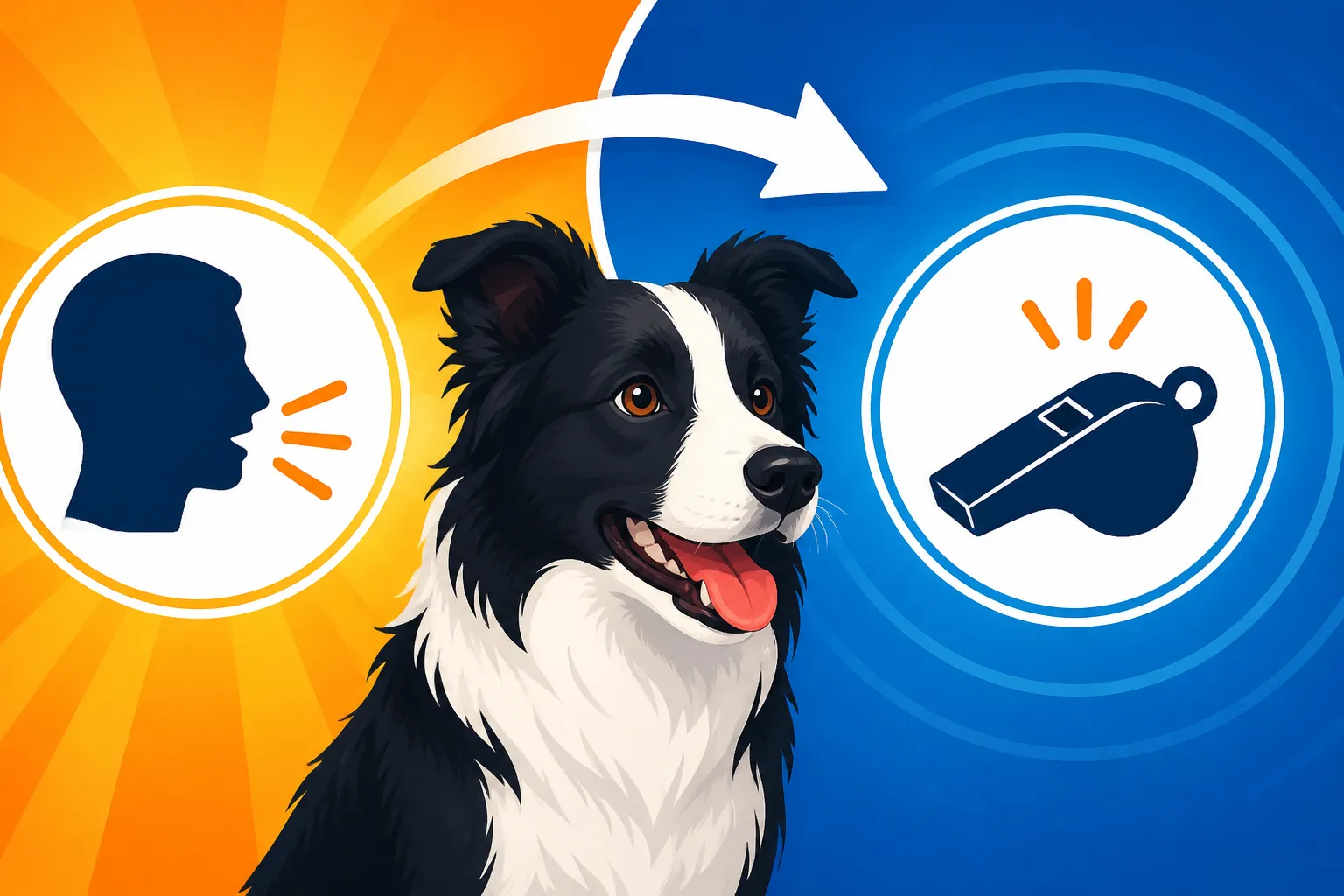
You've poured countless hours into training your Border Collie, perfecting their recall and mastering foundational commands with your voice. They're usually brilliant, responding to your every word. But then you’re out in an open field, or the wind picks up, or they’re totally engrossed in a distant scent, and suddenly your voice feels like a whisper in a hurricane. That familiar frustration, the feeling of your well-trained dog being just out of reach of your vocal cues, is incredibly common. This guide is here to walk you through the process of moving your Border Collie from those reliable voice commands to the clear, consistent, and far-reaching power of whistle signals, transforming your communication, especially at a distance.
Why Transition from Voice to Whistle? The Practical Advantages
Many Border Collie owners, particularly those involved in working trials, agility, or even just enjoying vast open spaces, eventually realize that voice commands have their limitations. While your voice is perfectly adequate for close-range communication and in quiet environments, the real world often presents challenges that a simple whistle can overcome with ease. It's not about replacing your voice entirely, but enhancing your communication toolkit.
Consistency and Clarity in All Conditions
Imagine trying to call your dog back during a blustery day when the wind is whipping past your ears, or when there's background noise from a nearby highway or another dog barking. Your voice, no matter how loud or distinct, can easily get lost or distorted. This isn't your dog being disobedient; it's simply a breakdown in communication. A whistle, however, produces a sharp, piercing sound that travels much further and cuts through ambient noise with remarkable efficiency. The tone of a whistle is always the same, too. It doesn't carry the emotion or inflection that your voice might, which can sometimes confuse a sensitive Border Collie. If you're stressed or excited, your voice might sound different, but the whistle's pitch and rhythm remain constant, providing an unwavering signal your dog can always rely on.
Think about situations where you might be hoarse or unwell, and your voice isn't as strong as usual. A whistle requires minimal effort to produce a clear, authoritative signal. This consistent auditory input helps prevent confusion and reinforces the command precisely, no matter your physical state or the environmental conditions. It's a reliable, unwavering signal that your Border Collie can depend on, which in turn builds their confidence in responding, knowing exactly what is expected of them.
Extending Your Reach: Communicating at a Distance
One of the most immediate and impactful benefits of whistle training for a Border Collie is the ability to command them effectively over significant distances. These dogs are bred to work far from their handler, often out of vocal range. If you're asking your dog to turn sheep on the far side of a pasture, or execute a down-stay when they've chased a ball a quarter-mile away, your voice simply won't cut it. A whistle allows you to maintain control and direct your dog's actions when they are hundreds of yards away, which is critical for their safety and for any advanced work you might do together.
For instance, when teaching a Border Collie to stop at a distance, as covered in Getting a Border Collie to Stop at Two Hundred Yards, a distinct whistle command is indispensable. Without it, you'd be yelling yourself hoarse, and your dog might only pick up fragments of your instruction, or worse, ignore you altogether because they can't understand. The whistle becomes an extension of your presence, a clear beacon of direction that spans the distance between you and your dog, allowing them to perform intricate tasks and ensuring their safety when off-leash in large areas. This extended reach isn't just for working dogs; it’s invaluable for pet Border Collies who might bolt after a squirrel or get distracted far from you in a park or trail setting.
The Standard for Working and Sport Border Collies
If you have aspirations of participating in sheepdog trials, advanced obedience, or competitive dog sports like agility or flyball, whistle commands are often the standard. Handlers in these fields rely heavily on whistles for precise, rapid, and long-distance communication. The nuanced signals possible with a whistle allow for complex directions, distinguishing between "lie down," "walk up," or specific directional commands like "come bye" and "away to me." Teaching a Border Collie the Herding Commands often involves integrating whistle cues early on.
Consider the precision required in an agility course or a herding trial. A split-second delay or misinterpretation of a voice command can cost you points or even disqualify you. Whistles offer a universal language within many canine sports communities, meaning your dog can understand commands from a judge or another handler if needed, though primarily it streamlines your own communication. It’s a tool that elevates your partnership with your Border Collie, allowing for a level of communication that simply isn't achievable with voice alone, pushing the boundaries of what you and your dog can achieve together.
The Step-by-Step Process: Linking Voice to Whistle Commands
Transitioning your Border Collie from responding to your voice to understanding whistle commands might seem like a daunting task, but it’s actually a very logical and rewarding process. The key is to create a strong association between the known voice command and the new whistle sound. We're not throwing out the old; we're building a bridge to the new.
Introducing the Whistle: Associating Sound with Action
The first step is always to introduce the whistle in a low-distraction environment where your dog is already reliably responding to your voice commands. Choose one command to start with, perhaps "sit" or "down," because these are often well-established. The technique is simple: say the voice command, immediately follow it with the corresponding whistle signal, and then reward your dog when they perform the action.
For example, if you're teaching the "sit" command:
- Say "Sit."
- Immediately blow your chosen "sit" whistle signal (e.g., one short blast).
- As your dog performs the sit, praise and reward them with a treat or a quick game.
Repeat this sequence many, many times over several short training sessions. The goal here is for your Border Collie to understand that the whistle sound means the exact same thing as your voice command. They should begin to anticipate the whistle after the voice, and then eventually, act on the whistle alone. Remember to keep sessions positive and upbeat. You can find a good quality shepherd's whistle or even a basic sport whistle on platforms like Amazon, but choose one that produces a clear, consistent sound you can easily replicate. Which Whistle a Border Collie Handler Uses delves into different whistle types if you're looking for guidance there.
Fading the Voice Command and Increasing Distance
Once your Border Collie consistently responds to the voice-whistle combination, it's time to start fading out the voice command. This is where the magic really begins. Instead of saying "Sit" and then whistling, you'll start to give the whistle signal just before your voice command, almost simultaneously, then gradually reduce the volume and clarity of your voice until it's a whisper, and finally, disappear altogether.
Here's how to do it:
- Blow the "sit" whistle.
- Immediately and softly say "Sit."
- Praise and reward when your dog sits.
As you repeat this, make your voice command softer and softer, or even mouth the word silently, until your dog is only responding to the whistle. Once they are reliably performing the command with just the whistle in a close-range, low-distraction setting, you can start increasing the distance between you and your dog. Begin by taking just a few steps back, then gradually move further and further away. Make sure your whistle signal is strong enough to reach them clearly at each new distance. If your dog seems confused, reduce the distance or reintroduce the voice command briefly, then fade it again. This gradual progression is crucial for building confidence and understanding. Many online training resources, including comprehensive programs like those offered by BAXTER & Bella, include modules on transitioning to whistle commands, providing structured guidance and video demonstrations to help with this fading process.
Practicing in Varied Environments and with Distractions
A command isn't truly learned until it can be performed reliably in various environments and with distractions present. Once your Border Collie is responding to whistle commands in your quiet backyard, it's time to take the training on the road. Start with mildly distracting environments, like a quiet park, and gradually work your way up to busier places.
The key is to set your dog up for success. Don't go from your living room to a bustling dog park and expect perfection immediately. Start small, increase distractions incrementally, and always be ready to step in and help your dog if they're struggling. If your dog fails to respond, it usually means the environment is too distracting, or the distance is too great for their current level of understanding. Retreat to a simpler scenario, solidify the command, and then try again. This proofing process is vital. For example, practicing recall with the whistle while your dog is mildly distracted by a scent or another person walking by, then eventually building up to more stimulating situations, will cement the reliability of the command. Just as with voice commands, consistency and patience are paramount here.
Common Commands to Whistle: A Practical Breakdown
When you're starting to incorporate whistle commands, it helps to think about the most essential commands your Border Collie already knows and how you can translate them into distinct whistle signals. The goal is clarity and consistency, ensuring each whistle sequence means one thing and one thing only.
The Universal "Stop/Lie Down" Whistle
For many working dog handlers, the "stop" or "lie down" command is arguably the most critical whistle signal. It needs to be clear, easily distinguishable, and carry the most weight. This command often takes precedence because it's vital for controlling a dog at a distance, especially if they are heading into danger or over-enthusiastic about their work. A common signal is a single, long, sustained blast on the whistle.
Imagine your Border Collie is chasing a flock of birds towards a busy road, or getting too close to livestock. A sharp, sustained whistle blast gives them an immediate, unambiguous instruction to halt their movement and lie down, bringing them to a safe stop. Why a Border Collie Is Taught to Lie Down First explains the foundational importance of this command. This particular whistle should be drilled relentlessly, always pairing it with a visual hand signal if you use one, and a verbal "down" or "stop" command initially. The clarity of this whistle must be absolute, as it's often an emergency command.
Directional Whistles: "Come Bye," "Away to Me," and "Walk Up"
Border Collies are renowned for their ability to be directed with precise commands, often through specific whistle sequences. These directional cues are the backbone of their herding work and incredibly useful in other sports or even just navigating obstacles on a walk.
- "Come Bye" (Go Left/Clockwise): A common whistle for this might be a series of short, quick bursts, sometimes increasing in frequency. This tells the dog to move to the handler's left, or to drive the stock clockwise.
- "Away to Me" (Go Right/Counter-Clockwise): For "Away to Me," a common signal might be two slightly longer, distinct blasts, or a specific rising and falling tone. This directs the dog to the handler's right, or counter-clockwise around the stock.
- "Walk Up" (Move Forward): A single, softer, often rising tone can signal "Walk Up," meaning the dog should move directly forward, perhaps to gather stock or to approach an obstacle.
The key with directional whistles is to ensure they are distinct enough not to be confused with each other. Consistency in your whistle pattern is paramount. Different handlers develop slightly different whistle languages, so you’ll want to pick yours and stick to it. Resources that detail What Come Bye Means to a Border Collie and What Away to Me Means to a Border Collie can help you understand the nuances of these commands before translating them to whistle. Practice these commands by walking your dog in patterns, using cones or natural landmarks, and gradually introducing the whistle as you did with the "sit" or "down" command.
Recall and Other Essential Signals
Beyond the critical stop and directional commands, a reliable whistle recall is fundamental. This might be a series of rapid, high-pitched chirps or a specific melodic sequence. Whatever you choose, ensure it's unique and carries urgency without sounding alarming. The Emergency Word a Border Collie Must Know highlights the importance of an undeniable recall, and a whistle can often provide that undeniable signal, cutting through distractions far more effectively than a yelled name.
Other useful whistle commands can include:
- "That'll Do" (End of work/disengage): A longer, fading whistle, indicating the session is over, or the dog should disengage from the task.
- "Fetch/Bring It": A couple of short, sharp blasts followed by a pause.
- "Here/Heel": A rhythmic pulse.
Here’s a simple table illustrating common whistle patterns, keeping in mind that these are examples, and you should choose patterns that are comfortable for you to consistently produce and distinct for your dog to interpret.
| Voice Command | Example Whistle Pattern | Description | Primary Use Case |
|---|---|---|---|
| Stop/Down | Single, long, sustained blast | Clear, urgent, immediate stop or lie down | Safety, herding control, distance obedience |
| Recall | Series of rapid, high-pitched chirps (e.g., pip-pip-pip-pip) | Urgent call to return to handler | Safety, off-leash reliability |
| Come Bye | Series of short, quick bursts (e.g., pip-pip-pause-pip-pip) | Directs dog to move left (clockwise) | Herding, directional control in sports |
| Away to Me | Two slightly longer, distinct blasts (e.g., piiiiip-paaaap) | Directs dog to move right (counter-clockwise) | Herding, directional control in sports |
| Walk Up | Single, softer, rising tone (e.g., piiiii-up) | Directs dog to move straight forward | Herding, advancing through obstacles |
| That'll Do | Longer, fading whistle (e.g., piiiiiioooooow) | Signals end of work, disengage, relax | Herding, ending training sessions |
Troubleshooting and Refinement: Making Whistle Commands Stick
Even with the best intentions and consistent training, you might encounter bumps in the road when transitioning to whistle commands. Border Collies are incredibly smart, but they're still dogs, and sometimes our communication isn't as clear as we think it is. Don't get discouraged if progress isn't perfectly linear; it's all part of the learning process for both of you.
Common Pitfalls and How to Overcome Them
One of the most common issues is inconsistency from the handler. If you use slightly different whistle patterns for the same command, or if your voice sometimes sneaks back in, your dog will get confused. Imagine if someone kept changing the word for "sit" on you; you'd probably stop responding too. The solution is rigorous self-discipline. Practice your whistle patterns when your dog isn't around so that when you use them with your dog, they are identical every single time. It can be helpful to record yourself whistling and listen back to ensure consistency in pitch, duration, and rhythm.
Another pitfall is advancing too quickly. If you move to distractions or distance before the whistle command is rock-solid in a quiet, close environment, your dog will likely fail. This isn't stubbornness; it's a lack of understanding under pressure. If your dog isn't responding, don't just repeat the whistle louder or more angrily. Instead, go back a step. Reduce the distance, remove distractions, and re-pair the whistle with the voice command if necessary. Build success layer by layer, reinforcing at each stage. Remember that a Border Collie's ability to focus is immense, but so is their ability to pick up on environmental cues, so ensure the whistle is the most prominent and consistent cue.
Finally, lack of reinforcement can quickly demotivate your highly driven Border Collie. Just because they understand the command doesn't mean they don't appreciate a reward. Especially during the transition phase, generous and high-value rewards (whether treats, praise, or a quick game of fetch) are crucial for solidifying the association and making the whistle command truly desirable to obey. Over time, the intrinsic reward of working with you and the satisfaction of a job well done can become primary motivators, but never underestimate the power of positive reinforcement, particularly when introducing something new.
Advanced Tips for Whistle Mastery
Once your Border Collie is responding reliably to basic whistle commands, you can start to refine your technique and expand their understanding. This is where you really start to leverage the incredible intelligence and biddability of the breed.
Consider using a silent or "shepherd's" whistle. These whistles often produce sounds at frequencies less audible to the human ear but perfectly clear to dogs. This can be beneficial in environments where you don't want to disturb others, or simply for a more discreet communication method. However, ensure you can still hear something to verify you're blowing it consistently. Many experienced handlers prefer these for their precision and ability to cut through wind without being jarringly loud to humans.
Also, think about building combinations of whistle signals for more complex instructions. For example, a "stop" whistle followed by a "come bye" whistle could mean "stop and then move left." Just be sure to teach these combinations in clear, sequential steps, never rushing the process. For instance, The Look Back Command on a Border Collie might involve a specific whistle sequence that tells your dog to pause their current action and look back at you for further instruction, a vital tool for intricate work at a distance.
Finally, remember that ongoing practice and proofing are essential for maintaining the sharpness of whistle commands. Incorporate them into your daily routines, not just formal training sessions. When you're out for a walk, use a whistle to call your dog over to you for a quick check-in, then release them. This keeps the commands fresh and reinforces that the whistle isn't just for "work" but for all aspects of your life together. Consistent, positive interaction with your whistle commands will keep your Border Collie keen to listen and respond, no matter the situation.
Disclaimer
This article is for general informational purposes only and does not constitute professional advice. Laws, prices and regulations vary by location and change over time. Consult a qualified professional for guidance on your specific situation.