Progressive Retinal Atrophy in an Older Border Collie
It's incredibly difficult to watch our beloved Border Collies, the epitome of boundless energy and sharp intelligence, start to show signs of aging. One of the most heartbreaking changes can be the subtle, then increasingly obvious, decline in their vision. This guide is here to walk you through Progressive Retinal Atrophy (PRA) in older Border Collies, a common inherited eye condition that can slowly steal their sight, helping you understand its progression and how to best support your loyal companion through these changes.
Understanding Progressive Retinal Atrophy in Border Collies
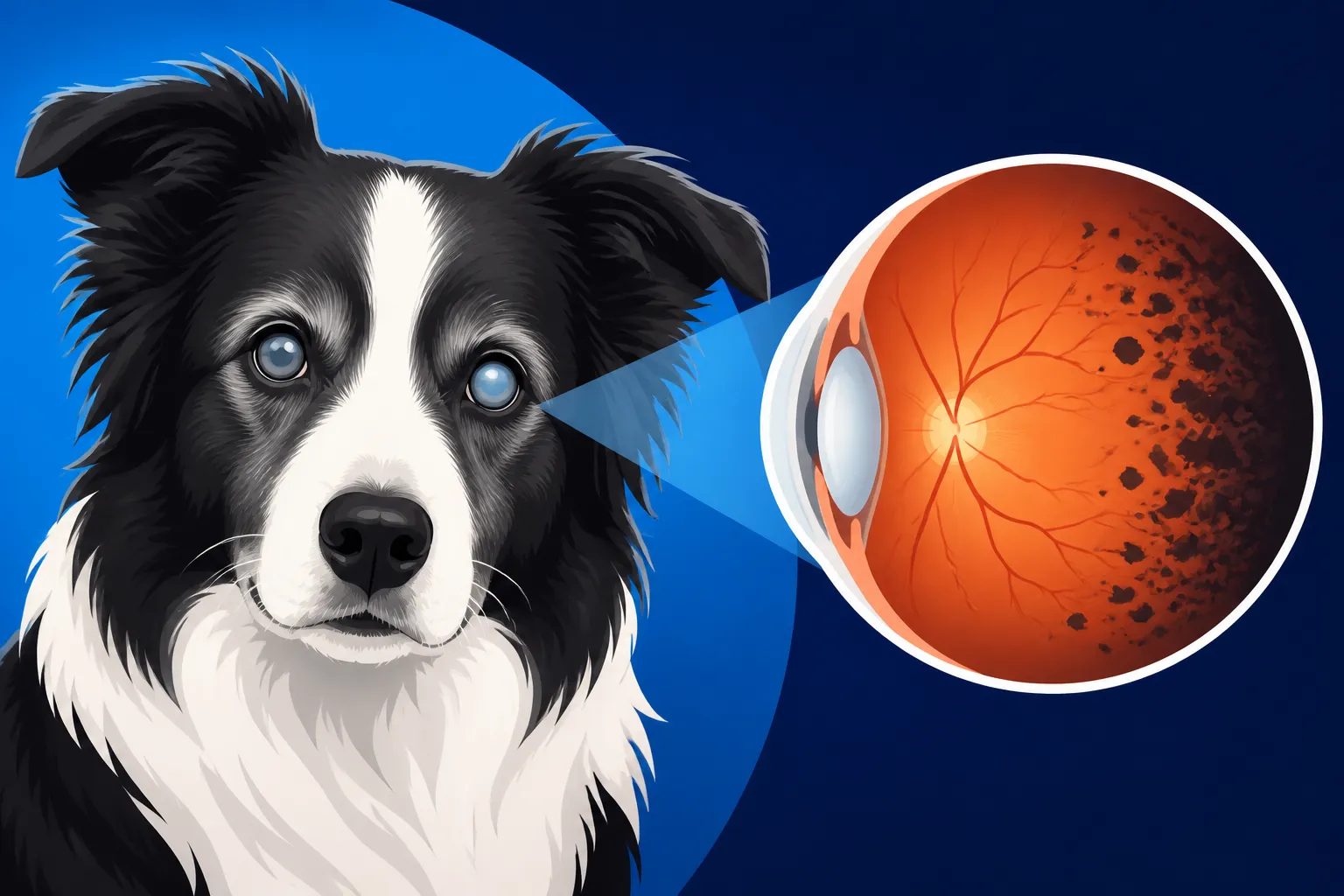
Progressive Retinal Atrophy, often simply called PRA, is a collective term for a group of inherited degenerative diseases affecting the retina. The retina, at the back of the eye, contains specialized cells called photoreceptors—rods and cones—that are responsible for detecting light and transmitting visual information to the brain. In dogs with PRA, these photoreceptor cells gradually deteriorate over time, leading to progressive vision loss and, eventually, blindness.
What is PRA and How Does It Affect Vision?
Imagine the retina as the film in an old camera, capturing all the light and detail of the world. Rods are the photoreceptors responsible for vision in low light (night vision), while cones handle bright light, color, and fine detail (day vision). In most forms of PRA, the rods are affected first, which means the initial signs are usually subtle and noticeable only in dim lighting conditions. Your Border Collie might start hesitating on evening walks or bump into furniture after the sun goes down.
As the disease progresses, the cone cells also begin to degenerate. This leads to a loss of day vision, making it harder for your dog to see clearly even in well-lit environments. Because the process is gradual, spanning months or even years, many Border Collies adapt remarkably well, relying more heavily on their other senses, like their incredible hearing and keen sense of smell. However, the emotional toll on owners watching their once-sharp dog lose its sight can be profound.
Genetic Basis and Breed Predisposition
The "inherited" aspect of PRA is crucial to understand. It means the genes responsible for the condition are passed down from parent to offspring. While Border Collies are renowned for their intelligence and robust health, they are not immune to genetic predispositions, and certain lines may be more prone to PRA. The specific genetic mutations can vary, leading to different forms of PRA, but the underlying mechanism is always a breakdown of those vital retinal cells. Responsible breeders go to great lengths to screen their breeding stock for a range of genetic conditions, though some forms of PRA can have a late onset, meaning signs might not appear until a dog is well into its senior years, long after they've been bred.
For any Border Collie owner, understanding their dog's genetic background, if possible, can be helpful. While you can't change genetics, knowing the risks allows for earlier vigilance. Even if your dog is a beloved pet and not from a breeding program, it’s beneficial to be aware of the potential for these inherited conditions. Reputable breeders often utilize extensive testing, including panels that screen for conditions like The Border Collie Genetic Panel and What It Screens, which might include certain types of PRA, though not all.
Types of PRA Affecting Border Collies
PRA isn't a single disease but rather a blanket term covering various genetically distinct conditions. For instance, in other breeds, you might hear about prcd-PRA (progressive rod-cone degeneration) or different rcd (rod-cone degeneration) types. While specific forms of PRA with known genetic markers are more prevalent in other breeds, Border Collies can develop forms of PRA that manifest in their later years. These late-onset types can be more challenging to track genetically because the affected dogs may have lived full lives and even reproduced before showing any symptoms.
Regardless of the specific genetic type, the common thread is the irreversible degeneration of the retina. What this means for your older Border Collie is a slow, usually painless, decline in their ability to see. The specific gene might influence the age of onset and the rate of progression, but the outcome is generally the same. It's important to remember that this isn't usually due to injury or lifestyle but an inherent part of their genetic makeup that simply reveals itself as they age.
Recognizing the Early Signs of PRA
Catching PRA early can be challenging because Border Collies are incredibly resilient and adaptive. They often mask their vision loss by memorizing their environment and relying more on their other senses. However, as their sight diminishes further, certain behavioral and physical changes become more apparent, signaling that something is amiss.
Night Blindness: The First Clue
The very first symptom that most owners notice, often subtly at first, is night blindness. Because the rod cells, which handle low-light vision, degenerate initially, your Border Collie will start to struggle in dim conditions. You might observe them hesitating on familiar evening walks, bumping into furniture in a poorly lit room, or becoming more reluctant to go outside after dusk. What was once an effortless dash through the yard in the evening might become a cautious, slow shuffle.
Perhaps you’ll find them struggling to locate a dropped toy in the shadow of the couch, or they might seem startled when you approach them quietly in the dark. These are often the tell-tale signs that their night vision is failing. It’s a heartbreaking realization, especially for a breed known for its agility and keen perception. If you suspect this, try observing them closely in different lighting conditions, noting any changes in confidence or navigation.
Behavioral Changes and Navigational Challenges
As PRA progresses and both night and day vision are affected, your Border Collie's behavior might shift. They may become more anxious or clingy, especially in new or unfamiliar environments where their learned spatial map no longer serves them. They might start bumping into objects they previously navigated with ease, leading to startled reactions or a general hesitancy to move around. You might notice them walking more slowly, keeping their head lower to the ground, or relying on sniffing to identify their path.
Tasks that once seemed simple, like jumping onto a couch or descending stairs, can become daunting. They might hesitate, misjudge distances, or even refuse to do them altogether. This isn't stubbornness; it's genuine uncertainty and a fear of injury. Remember, for a dog whose world was once defined by its sharp vision and quick reflexes, this is a profound change. These behavioral shifts are often a cry for help, indicating that their visual world is becoming increasingly blurry and unpredictable. In some cases, these changes might even be compounded by other age-related cognitive declines, making it harder for dogs to process new information or adapt, as described in guides like Canine Cognitive Dysfunction in an Old Border Collie.
Physical Changes in the Eyes
While the early signs of PRA are mostly behavioral, there are physical changes in the eyes themselves that a veterinarian can spot, and that astute owners might notice over time. One common indicator is pupil dilation. To compensate for less light reaching the degenerating retina, the pupils will often remain wider, even in brightly lit environments, in an attempt to gather as much light as possible. This can give your Border Collie's eyes a "shiny" or "reflective" appearance.
You might also notice an increased "tapetal reflection" – the green or yellow-orange glow you see in your dog's eyes in flash photographs might become more intense. This is because the tapetum lucidum, a reflective layer behind the retina, becomes more exposed as the retinal tissue thins. While PRA itself doesn't cause the cloudy appearance of cataracts, sometimes secondary cataracts can develop alongside PRA, further complicating vision. This is why regular veterinary eye exams are so crucial as your Border Collie ages, as discussed in posts like What a Border Collie Eye Exam Costs Each Year.
The Progression of PRA and Living with Vision Loss
Knowing that PRA is a progressive disease means understanding that your Border Collie's vision will continue to decline. While this can be a difficult reality to face, the gradual nature of the condition often allows dogs to adapt remarkably well. Your role as their caretaker becomes about creating a safe, predictable, and enriching environment that supports their evolving needs.
Gradual Decline to Complete Blindness
PRA is not a sudden affliction; it's a slow, insidious process. It often begins with subtle night blindness, which over months or even years, will worsen. Eventually, day vision will also begin to deteriorate significantly. The pace of this decline varies greatly from dog to dog and depends on the specific genetic mutation at play. Some dogs might maintain partial vision for a long time, while others might progress to complete blindness more rapidly.
It's vital to remember that throughout this process, your Border Collie is likely adapting. They are smart, resilient creatures, and their other senses will step up to fill the void. They might start to rely more on the feel of the ground under their paws, the scent of a familiar path, or the sound of your voice. The goal isn't to prevent the inevitable, but to make the journey as comfortable and stress-free as possible, ensuring their quality of life remains high, even as their world becomes darker.
Adapting the Home Environment for Safety
One of the most impactful things you can do for a Border Collie with PRA is to create a consistent and safe home environment. This means minimizing changes to furniture arrangement. Once your dog has memorized the layout, stick to it. If you do need to move something, guide them around it several times and use verbal cues to help them re-learn the space. Using different textures on the floor (e.g., a rug near the water bowl, a mat by the door) can serve as tactile markers.
Consider placing baby gates at the top and bottom of stairs to prevent accidental falls. Padding sharp corners of furniture can also prevent painful bumps. Ensure pathways are clear of clutter. For outdoor spaces, keep the yard clear of obstacles and supervise them closely. If you have a swimming pool, make sure it’s securely fenced off. Your Border Collie’s incredible intelligence means they will quickly learn a new "map" of their home, provided it remains consistent.
Maintaining Quality of Life and Mental Stimulation
While physical vision may be fading, your Border Collie's sharp mind and desire for engagement are not. It's crucial to continue providing mental stimulation to prevent boredom and anxiety. Focus on activities that engage their other powerful senses. Scent games are excellent: hide treats around the house, encouraging them to use their nose to find them. This is a perfect way to keep their brains active and provides a sense of accomplishment. You can even explore more formal activities like scent work, similar to Scentwork for a Border Collie Between Trial Seasons.
Continue with regular, leashed walks in familiar, safe areas. The scents, sounds, and feel of the ground are immensely enriching. Talk to your dog constantly, using a cheerful, reassuring tone, giving verbal cues before you approach or touch them, and guiding them through obstacles. Toys that make noise, like squeaky balls or crinkly plushies, can still provide immense joy. Maintaining a consistent daily routine can also provide comfort and predictability, helping them feel secure in their changing world.
Diagnosis and Management of PRA
If you suspect your older Border Collie is developing PRA, the first and most important step is a visit to your veterinarian. While there's no cure for PRA, an accurate diagnosis is essential to rule out other treatable conditions and to establish a clear plan for managing your dog's quality of life.
Veterinary Examination and Diagnostic Tests
Your regular vet will perform a thorough eye examination. They might use an ophthalmoscope to look at the back of the eye, checking for characteristic changes like retinal thinning, increased tapetal reflection, and attenuation (narrowing) of the retinal blood vessels. These are tell-tale signs of retinal degeneration. Often, they will refer you to a veterinary ophthalmologist, a specialist in animal eye care, for a definitive diagnosis.
The gold standard for diagnosing PRA is an electroretinography (ERG). This test measures the electrical activity of the retinal cells in response to light, much like an EKG measures heart activity. A dog with PRA will show reduced or absent electrical responses, confirming the diagnosis. Genetic testing can also be performed to identify specific gene mutations associated with PRA, especially if you want to understand the hereditary aspect, as discussed in articles like The Border Collie Genetic Panel and What It Screens. While genetic testing is often used in younger dogs or breeding animals, it can also provide confirmation for an older pet.
Supportive Care and Nutritional Considerations
It’s important to be realistic: currently, there is no cure or medical treatment that can stop or reverse the progression of PRA. Any claims of "miracle cures" should be met with extreme skepticism. The focus of management is entirely on supportive care. This means ensuring your Border Collie remains healthy overall and adapting their environment to their visual impairment.
Some veterinarians might suggest antioxidant supplements (such as vitamins C and E, lutein, and zeaxanthin) to support general eye health. While these supplements are unlikely to halt the progression of PRA, they may help mitigate oxidative stress in the eye and are generally considered safe. Always discuss any supplements with your vet to ensure they are appropriate for your dog and won't interact with other medications. A balanced, high-quality diet that supports overall health is always beneficial for senior dogs, contributing to their vitality and resilience.
Financial Planning for Long-Term Care
Caring for an older Border Collie with PRA can involve various costs, from initial specialist vet visits and diagnostic tests to potential supplements and modifications to your home. While the costs may not be as high as, say, surgery for a major injury, these ongoing expenses can add up over time. It’s a reality many pet owners face, and it’s completely understandable to feel overwhelmed by the financial aspect. This is where forward-thinking financial planning, perhaps even considering pet insurance when your dog is young, can make a huge difference.
Companies like Healthy Paws offer robust pet insurance plans that can cover accidents, illnesses, and even chronic conditions. The key, however, is to enroll your Border Collie before any symptoms of a condition like PRA appear, as most insurance policies have exclusions for pre-existing conditions. While it won't cover PRA if diagnosed prior to enrollment, having a policy in place can provide peace of mind for future health challenges. Many owners find that having financial support for veterinary care allows them to make decisions based on their pet's well-being rather than their wallet. It’s also wise to consider a dedicated savings account for pet emergencies and ongoing senior care, creating your own financial safety net for things insurance might not cover. This proactive approach can significantly ease the burden when your beloved companion needs you most, just as planning for unforeseen events like Insuring a Border Collie Against Epilepsy and Joints is crucial.
Distinguishing PRA from Other Age-Related Eye Conditions
When an older Border Collie starts to show signs of vision impairment, it's natural to assume the worst. However, not all vision problems in senior dogs are PRA. Many other age-related eye conditions can present with similar symptoms, and some are treatable. That's why an accurate diagnosis from a veterinary professional is so critical. Understanding the differences can help you provide your vet with better observations and contribute to a more precise diagnosis.
Cataracts vs. PRA: Key Differences
Perhaps the most common confusion arises between Progressive Retinal Atrophy and cataracts. While both can lead to vision loss, they affect different parts of the eye and have distinct characteristics. Cataracts involve the clouding of the eye's lens, which normally sits behind the iris and pupil. When a cataract forms, the lens becomes opaque, blocking light from reaching the retina. You can often see a cloudy, white, or milky appearance within the pupil.
PRA, on the other hand, is a disease of the retina, the light-sensing tissue at the back of the eye. In PRA, the lens usually remains clear, at least in the initial stages. The dog's vision is lost because the cells that receive the light degenerate, not because the light is blocked from entering. While advanced PRA can sometimes lead to secondary cataract formation, the primary issue is retinal degeneration. Crucially, cataracts can often be treated surgically by removing the cloudy lens and sometimes replacing it with an artificial one, potentially restoring vision. There is no surgical solution for PRA, emphasizing the importance of accurate diagnosis.
Here's a quick comparison of key differences:
| Condition | Primary Affected Part | Visual Appearance (Owner View) | Primary Symptom (Early) | Potential Treatment |
|---|---|---|---|---|
| Progressive Retinal Atrophy (PRA) | Retina (photoreceptor cells) | Pupils dilated, increased eye shine | Night blindness, hesitancy | None (supportive) |
| Cataracts | Lens | Cloudy, milky, or opaque lens | Hazy vision, bumping into objects | Surgery |
| Glaucoma | Optic nerve (due to pressure) | Redness, cloudy cornea, pain, enlarged eye | Acute pain, sudden vision loss | Medication/Surgery |
| Dry Eye (KCS) | Tear glands | Redness, thick discharge, irritation | Chronic irritation, squinting | Medication |
Glaucoma and Its Unique Symptoms
Glaucoma is another serious eye condition that can affect older Border Collies, but it's very different from PRA. Glaucoma is characterized by increased pressure within the eyeball, which can severely damage the optic nerve and retina, leading to rapid and painful vision loss. Unlike the gradual, painless progression of PRA, glaucoma can be an acute emergency.
Symptoms of glaucoma often include intense pain, which your dog might show by rubbing their eye, squinting, or becoming withdrawn. The affected eye might appear red, cloudy (due to corneal edema), and the pupil may be dilated. In chronic cases, the eyeball itself can become visibly enlarged. Glaucoma requires immediate veterinary attention to reduce intraocular pressure and save any remaining vision. This condition is far more about pressure and pain than the slow cellular decay of PRA.
Other Ocular Issues in Senior Border Collies
Beyond PRA, cataracts, and glaucoma, senior Border Collies can develop a range of other ocular issues. Dry Eye, or Keratoconjunctivitis Sicca (KCS), occurs when the eye doesn't produce enough tears, leading to chronic irritation, redness, and a thick, mucus-like discharge. This can be managed with daily eye drops that stimulate tear production. Distichiasis or Ectopic Cilia (extra eyelashes growing in abnormal places) can also irritate the eye, though these are often present from a younger age.
Sometimes, dogs can experience sudden, acute vision loss due to conditions like SARDS (Sudden Acquired Retinal Degeneration Syndrome), which is rapid and not progressive like PRA. Regular eye examinations are incredibly important for senior dogs. Not only can they help identify PRA, but they can also catch other treatable conditions early, ensuring your Border Collie's comfort and helping to preserve their vision for as long as possible. Remember, a comprehensive eye exam is an integral part of managing your older Border Collie's health.
Disclaimer
The information provided in this article is for general informational purposes only and is not a substitute for professional veterinary advice. Always consult with a qualified veterinarian regarding any medical condition or treatment for your Border Collie.