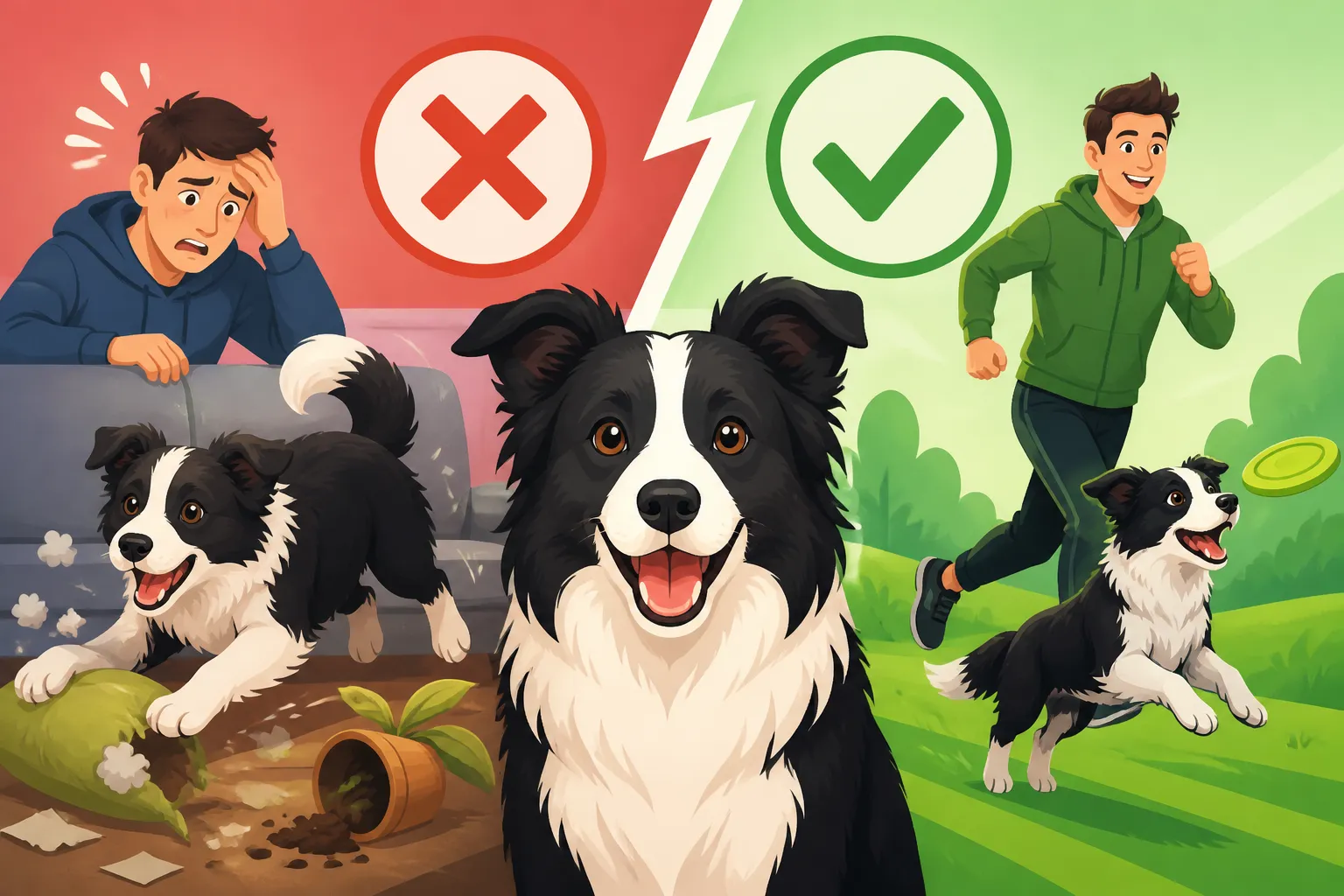
What New Border Collie Owners Get Wrong About Energy
A Border Collie who keeps bringing the ball back, patrols the windows, or invents a job the moment the house gets quiet can make a new owner feel permanently behind. The common mistake is treating energy as a demand for more exercise. This guide explains what Border Collie energy really looks like, how to meet it without creating an endurance athlete, and how to teach a dog to rest.
What Border Collie energy really means
Activity is only one part of the picture
Border Collies are bred to notice movement, respond to direction, and stay engaged with a task. That can look like physical stamina, but it also shows up as alertness: watching people, tracking activity outdoors, anticipating routines, and reacting quickly to small changes. A dog can have had a long walk and still be mentally switched on, scanning for the next thing to do.
This is why “tired out” can be a slippery goal. A brisk outing may help your dog move and explore, but it does not necessarily teach them how to settle afterward. In some dogs, repeated high-energy activities—especially endless ball throwing—build even more eagerness for the next round. The dog gets fitter and more practiced at being excited, while the owner wonders why the exercise seems to have stopped working.
Think of energy as a mix of movement, mental engagement, arousal, and rest. A balanced routine gives a dog chances to explore and learn, but it also includes predictable downtime. Exercise, Work and What Actually Settles a Border Collie offers more detail on how those pieces fit together.
“More exercise” can become a treadmill
A common pattern starts innocently. A young Border Collie pesters the owner, so the owner adds another walk or another game of fetch. The dog enjoys it, returns home briefly satisfied, and then asks for more. The owner increases the activity again. Over time, the dog may become very fit and highly conditioned to expect an intense outing, without becoming any better at relaxing between outings.
That does not mean exercise is unhelpful. It means activity should be chosen for quality, not just duration or intensity. A loose-leash sniffing walk, a short training session, and a calm search game can meet different needs than sprinting after a toy. Why Walking a Border Collie Is Not Enough explains why a walk alone may leave some dogs looking for a more engaging task.
Pay attention to the dog after the activity, too. A dog who can drink, lie down, and sleep has likely had an appropriately paced experience. A dog who continues pacing, barking, or demanding more may be over-aroused, under-practiced at settling, or struggling with another issue. The answer is not automatically another lap around the block.
Every Border Collie is an individual
Breed traits are tendencies, not a fixed exercise prescription. Age, health, temperament, past experience, and the dog’s ability to recover all affect what a sensible day looks like. A puppy, a healthy adult, and an older dog with stiff joints should not be expected to follow the same plan. Even two adult Border Collies in the same home may have different needs.
New owners sometimes compare their dog with a working sheepdog or a sport competitor and assume they must reproduce that level of activity at home. But a working dog’s job is structured, purposeful, and guided by a handler. Simply keeping a pet dog in constant motion is not the same thing—and can make daily life harder if the dog never learns that quiet time is part of the routine.
A better question than “How many hours should my dog exercise?” is “Can my dog participate in appropriate activities, recover afterward, and spend ordinary parts of the day calmly?” Whether a Border Collie Ever Gets Tired is a useful companion topic if your dog seems to have an unusually endless supply of enthusiasm.
Mistakes that accidentally create an exhausting dog
Relying on repetitive fetch
Fetch is convenient: it takes little equipment, most dogs understand it quickly, and a few throws can make a Border Collie look delighted. But the repeated sprint, chase, turn, and retrieve can be intensely stimulating. Some dogs become fixed on the ball, bark when it is put away, or struggle to disengage even after the game ends.
If fetch is already a major part of the day, try making it more structured rather than abruptly turning it into a battle. Put the toy away between brief rounds, ask for a simple pause before restarting, and alternate with sniffing or low-key training. Stop while your dog can still respond to you. The aim is not to make every game longer; it is to help your dog practice switching between excitement and calm.
This matters especially for dogs who seem more frantic after play than before it. Taking Balls Away From an Obsessive Border Collie explores that pattern, while Mental Work That Tires a Border Collie Faster offers ideas for activities that use attention without relying on repeated high-speed chasing.
Treating a yard as a complete exercise plan
A yard is useful for toileting, short play, and supervised exploration. It is not automatically a job. A dog who spends time alone outdoors may simply patrol the fence, watch pedestrians, bark at passing dogs, or rehearse chasing wildlife. Those activities can increase vigilance rather than provide balanced enrichment.
A dog’s environment can also create a misleading impression of freedom. They may have room to move but little opportunity to practice walking with you, exploring new scents, learning calm behaviors, or engaging in a shared task. A few purposeful activities with a person can be more satisfying than a long stretch of unstructured yard time.
Use outdoor space as one part of the routine, not the entire plan. Mix it with supervised sniffing walks, short training, food searches, and quiet time indoors. Whether Acreage Alone Satisfies a Border Collie goes deeper into why space and meaningful activity are not interchangeable.
Rewarding constant demands without meaning to
A Border Collie may learn quickly that dropping a ball, nudging a hand, barking, or pacing makes the owner get up. Often, the owner is not deliberately teaching this; they are just trying to keep the peace. But if the dog’s demands reliably start an exciting activity, the behavior can become stronger.
That does not mean you should ignore every request. First check whether your dog needs a toilet break, water, food, reassurance, or help with discomfort. Once basic needs are met, avoid making every nudge the start signal for a game. Offer activities on a predictable schedule, and reward calm choices as deliberately as you reward action.
A simple alternative is to notice the moment your dog lies down or rests quietly, then calmly reinforce it with praise, a small treat, or continued access to the relaxed space. If your dog is barking or escalating, avoid turning that exact moment into a high-energy game. Why a Border Collie Cannot Stop on Its Own looks at the difference between a dog who needs more activity and one who needs help learning to disengage.
Build a routine that includes work and recovery
Use a balanced daily rhythm
There is no single ideal schedule for every Border Collie. Still, it helps to organize the day around different kinds of needs rather than trying to solve everything with one huge outing. A routine might include a walk with time to sniff, a brief training session, a meal delivered through a simple search activity, and planned quiet periods.
Here is one way to think about the options:
| Activity | What it can provide | What to watch for |
|---|---|---|
| Sniffing walk | Exploration, movement, and time to process the environment | Pulling or scanning that never eases may mean the route is too stimulating |
| Short training session | Focus, communication, and a clear task | End before the dog becomes frustrated or frantic |
| Food search | Nose work and slower engagement with a meal | Keep the setup easy enough that the dog can succeed |
| Fetch or tug | Play and shared interaction | Repeated high arousal can make settling harder |
| Rest on a bed or mat | Practice relaxing while household life continues | Build gradually; do not expect a new dog to settle for long immediately |
For example, a household with a morning commute might take a sniff-focused walk before work, provide a safe food-search activity, and then arrange a quiet rest period. After work, the dog could have a short training session and a supervised outing, followed by a familiar settle routine. That is often more sustainable than trying to exhaust the dog in a single evening marathon. A Border Collie in a Nine-to-Five Household covers the practical challenges of fitting a dog’s needs around a workday.
Teach calmness as a skill
Many owners assume a dog will naturally learn to relax once they are tired enough. Some do; others need practice. Start when your dog is already calm, perhaps after a walk or meal. Settle near a comfortable bed or mat, reward a quiet lie-down, and keep the interaction low-key. Gradually practice while you sit, read, or do ordinary household tasks.
At first, success may be brief. That is fine. If your dog gets up, guide them back without scolding, or make the exercise easier by reducing distractions and shortening the session. A dog who can settle in a quiet room may not yet be ready to relax while children run through the kitchen or visitors arrive.
Use the same calm cues and expectations across the household. If one person rewards a quiet lie-down while another immediately starts a game whenever the dog stands up, the dog receives mixed information. Settling a Border Collie on a Mat and Getting a Border Collie Puppy to Rest on Cue offer useful next steps for teaching this skill.
Make enrichment easy enough to repeat
Enrichment does not have to be elaborate. Hide a few pieces of the dog’s meal in a safe, familiar area and invite them to search. Practice simple cues for a few minutes. Rotate toys instead of leaving every option out all day. Let a dog sniff new routes at a comfortable pace. These small activities can be easier to sustain than a complicated schedule built around constant entertainment.
Choose activities according to the dog in front of you. A dog who gets frustrated with puzzle toys may do better with scattered kibble or a basic scent search. If you use food puzzles, check that the design is appropriate for your dog’s chewing habits and supervision needs. Stores such as Chewy may carry a range of food-dispensing options, but the useful question is whether a particular item is safe, manageable, and engaging for your dog—not whether it is marketed as a high-energy solution.
Keep the setup simple at first. For instance, if your dog has never searched for food, place a few pieces in easy-to-find spots rather than hiding the whole meal behind furniture. If the dog gives up or starts chewing the object, make the challenge easier or choose another activity. Chewy may also be a convenient place to compare basic enrichment supplies, but you can often begin with safe household objects and meals your dog already eats.
Know when energy points to a bigger concern
Read the difference between excitement and distress
A lively dog may bounce around before a walk, then settle once the routine begins. A dog who cannot sleep, repeatedly paces, startles at ordinary sounds, or seems distressed when separated may need more than added exercise. Restlessness can reflect anxiety, discomfort, a change in the home, or a health problem. It is worth paying attention to when the behavior began and what else changed around the same time.
Keep a simple record for several days. Note sleep, meals, walks, training, play, and the times your dog seems most unsettled. Include what happened just before the behavior—such as a visitor arriving, a delivery truck passing, or a sudden increase in fetch. Patterns can help you make practical adjustments and give your veterinarian or qualified behavior professional clearer information.
Do not assume every behavior is “just the breed.” A sudden shift in activity, difficulty resting, or signs of pain deserve attention. If your dog is distressed or the behavior is affecting safety and daily life, seek guidance rather than trying to wear them down with longer and longer outings.
Set realistic goals for a new home
A Border Collie may take time to adapt after coming home, especially if they have moved between homes, kennels, or routines. The first goal is not to provide a perfect lifestyle immediately. It is to establish predictable meals, toileting, calm handling, safe exploration, and short periods of rest. Add activities gradually and observe how your dog responds.
A new owner may see another dog calmly sleeping through the afternoon and wonder what they are doing wrong. Try not to use another household’s routine as a measuring stick. Instead, look for steady progress: less frantic anticipation, faster recovery after play, more ability to lie down while you are busy, and fewer attempts to invent unsafe jobs.
If you need supplies for a consistent setup—such as a bed, a food-search toy, or a secure walking harness—Chewy is one place owners may browse, but the product itself will not teach a dog to switch off. Your routine, the dog’s comfort, and patient reinforcement do that work. When you focus on a balanced day instead of maximum exhaustion, a Border Collie’s energy becomes easier to understand and live with.
Disclaimer
This article is for general informational purposes only and does not constitute professional advice. Laws, prices and regulations vary by location and change over time. Consult a qualified professional for guidance on your specific situation.