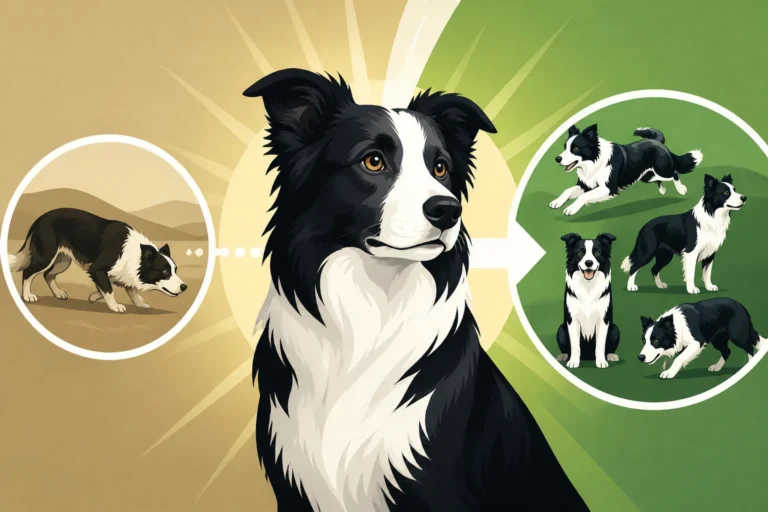
Whether a Border Collie Mix Keeps the Drive
A Border Collie mix may inherit the breed’s intense interest in movement, quick learning, and need for purposeful activity—but a mix is never a predictable halfway version of either parent. If you’re wondering whether your dog will herd children, chase bikes, or need hours of exercise, this guide explains what ancestry can suggest, what it cannot tell you, and how to respond to the dog in front of you.
What Border Collie drive means in a mixed breed
Drive is more than high energy
People often use “drive” to mean a dog has lots of energy, but the word covers more than stamina. A Border Collie may be highly motivated to watch, chase, gather, control movement, solve problems, or repeat a familiar game. Those tendencies can show up separately. One dog might be a relentless ball chaser but have little interest in herding; another might quietly track moving people or animals without seeming especially athletic.
A mixed-breed dog can inherit some of these traits without looking much like a Border Collie. It might have a Border Collie parent, a more distant ancestor, or a combination of traits from several breeds. Appearance alone—including a black-and-white coat, a white blaze, or a particular ear shape—doesn’t reliably establish how much drive the dog will have.
It also helps to distinguish enthusiasm from an inability to settle. A dog that enjoys a brisk walk and a training game may still relax at home. A dog that can’t disengage from shadows, bicycles, or a ball may need a different kind of help. The Border Collie That Will Not Break Its Stare explores how intense focus can become a challenge when a dog struggles to switch attention.
Why a mix may still show herding behaviors
Herding behavior is built from patterns such as watching, approaching, circling, and responding to movement. In a working context, those patterns are shaped by training and a handler’s control. In a home, the same instincts can be directed toward joggers, children running across a yard, cats, or dogs playing at a park. That doesn’t mean every Border Collie mix will herd, or that every chase is herding. It does mean movement can be especially compelling for some individuals.
For example, imagine a young dog who calmly watches a child until the child starts running, then begins circling or cutting across their path. The dog may not be “trying to dominate” the child. Fast movement may be triggering a deeply rewarding chase-and-control sequence. Still, the behavior can frighten or injure someone, so it needs management rather than a reassuring label.
If you’re seeing this pattern, calmly interrupt and create distance from the trigger before the dog gets wound up. Use barriers, a leash, or a quieter route while you work on training. A Border Collie That Herds Joggers and A Border Collie Circling Children in the Yard offer related examples of movement-focused behavior and why supervision matters.
Genetics are a clue, not a forecast
A dog inherits a mix of traits from both parents, and siblings from the same litter can behave quite differently. One pup may be eager to chase a thrown toy; another may prefer sniffing and exploring. Experience matters too. Early learning, socialization, opportunities to practice a behavior, health, and the dog’s age can all influence what you see.
A Border Collie parent can make certain tendencies more plausible, but it cannot tell you exactly how much exercise the puppy will need, whether it will enjoy herding, or whether it will be easy to train. Even a breeder or rescue that knows the parents can offer only a more informed impression, not a guarantee. Whether a Border Collie Mix Keeps the Drive is a useful starting point, but your own observations should guide day-to-day decisions.
Signs your Border Collie mix may have strong drive
Watch what captures and holds attention
Notice what your dog seeks out without being prompted. Does it repeatedly watch moving cars through the window, chase leaves, track a soccer ball, or try to control where other dogs move? Does it quickly return to the same activity after you interrupt it? These observations can tell you more than a general label such as “high energy.”
Keep a simple log for a week. Note the trigger, the setting, what the dog did, how long it took to settle, and what helped. A dog that chases a ball for a few minutes and then rests is different from one that barks, paces, and remains fixated after the game ends. The record also helps you spot practical patterns, such as whether the behavior is more intense when the dog is tired, confined, or already excited.
Be cautious about deliberately provoking a behavior to test the dog. Repeatedly shining lights, revving a toy, or encouraging a dog to chase children can rehearse the very habit you’re trying to understand. Instead, observe ordinary situations from a safe distance and prevent unwanted chasing where possible. For light or reflection fixation, The Border Collie That Chases Reflections explains why this behavior deserves careful attention.
Look for the ability to recover
The dog’s response after excitement is often as informative as its response during the activity. Can it take a treat, respond to its name, sniff the ground, and settle after a short play session? Or does it keep scanning for the ball and struggle to rest? A dog with a strong interest in movement may still learn to pause, but it needs opportunities to practice calm behavior.
A useful everyday example is a dog that sees a cyclist on a neighborhood path. If it can turn back to you and continue walking at a comfortable distance, that’s a workable starting point. If it lunges, barks, or remains highly aroused long after the cyclist passes, increase distance and make the situation easier. Don’t wait until the dog is at the end of the leash to ask for focus.
Recovery can change with age, health, sleep, and the environment. A puppy may be excitable because it is immature, while a newly adopted adult may need time to decompress. Sudden changes in attention, activity, or behavior can also reflect discomfort or illness, so talk with a veterinarian if you notice a sharp or unexplained change.
Consider both physical and mental needs
A strong desire to work isn’t necessarily solved by simply adding more running. Endless fetch can make a dog fitter and more eager to chase, while offering little practice in stopping. Some dogs benefit more from short training sessions, sniffing walks, food-search games, and structured play with clear beginnings and endings.
This doesn’t mean exercise is unimportant. A dog that has been indoors all day may need a chance to move, explore, and use its brain. The aim is to offer a balanced routine that allows activity and recovery, rather than trying to exhaust the dog into good behavior. Exercise, Work and What Actually Settles a Border Collie discusses this balance in more detail.
| What you notice | What it may suggest | A useful first response |
|---|---|---|
| Chases balls but settles afterward | Enjoys fast play and may have good recovery skills | Use short, structured games and practice a calm finish |
| Fixates on bikes or running people | Movement is a strong trigger | Increase distance, use a leash, and reward turning back to you |
| Circles children or other pets | Herding-like behavior may be emerging | Supervise closely and prevent unsupervised chasing |
| Paces after games and can’t disengage | The activity may be too intense or too long | End earlier and add quiet recovery activities |
| Shows little interest in chase games | Drive may be expressed in other ways, or may be lower | Explore sniffing, training, or other activities the dog chooses |
These are clues, not diagnoses. The same behavior can have different causes, and a dog may show several patterns at once.
How to meet the needs of a driven mix
Build a routine with work and rest
A steady routine often helps more than occasional marathon outings. Consider several kinds of activity across the week: relaxed walks that allow sniffing, brief reward-based training, appropriate play, and quiet time at home. Keep sessions short enough that your dog can still respond and finish calmly. If the dog gets more frantic as a game continues, that’s useful feedback to shorten the next session.
Teach a clear end-of-activity cue, then follow it with something predictable: a walk back to the car, a drink of water, or a settle on a mat. The point isn’t to punish enthusiasm. It’s to help the dog learn that fun activities have an ending and that resting is part of the routine. Settling a Border Collie on a Mat provides ideas for building that skill.
For food-search activities, you can scatter part of the dog’s meal in a safe area or use a puzzle feeder suited to its experience. If you’re comparing enrichment supplies, Chewy is one retailer where owners may browse categories such as puzzle toys, but choose based on your dog’s size, chewing style, and supervision needs. No toy replaces interaction or training, and any item that breaks or becomes small enough to swallow should be removed.
Prevent rehearsal of unsafe chasing
Management is not a failure. It is how you keep a dog and the people around it safe while skills develop. Use a leash near roads and busy paths, a secure fence where appropriate, and gates or room dividers when children are playing. Don’t rely on a verbal cue alone if the dog is already racing toward a cyclist or livestock.
Work at a distance where your dog can notice the trigger without immediately losing the ability to respond. Reward the dog for looking back at you, moving away, or choosing to sniff. Over time, you can practice closer to the trigger if the dog remains comfortable. If it can’t take food, turn away, or settle, the situation is probably too difficult at that distance.
Around children, provide active adult supervision and give the dog a separate resting space where it won’t be followed or bothered. Teach children not to run toward, tease, corner, or grab the dog. A baby gate can prevent a stressful interaction before it happens. What Children Have to Learn Around a Border Collie offers more guidance for households with kids.
Choose activities for the individual dog
Some Border Collie mixes enjoy agility foundations, scent work, trick training, or structured retrieve games. Others prefer leisurely exploration or short sessions of basic obedience. You don’t have to turn a companion dog into a sport dog to meet its needs. Begin with low-pressure activities, watch for signs of enjoyment, and stop before the dog becomes overtired or overexcited.
Stock work is a specialized activity, not a casual test of whether a dog “has the instinct.” Livestock can be stressed or injured, and a dog can learn unsafe habits if introductions aren’t managed by someone experienced. If you’re curious about herding, seek knowledgeable instruction and ask how the dog will be assessed and kept under control. Whether a Pet Border Collie Should Learn to Herd explains why interest alone isn’t enough to make livestock work suitable.
You can also make training practical around daily life. Reward a calm pause at the door, a check-in during a walk, or choosing a bed while dinner is prepared. These small routines give the dog useful ways to engage with you without turning every moment into a high-speed game. For ideas that suit indoor days, Mental Work That Tires a Border Collie Faster covers alternatives to simply adding more distance.
What to consider before adopting a Border Collie mix
Ask about observed behavior, not just breed labels
If you’re meeting a dog through a rescue or shelter, ask what staff or foster caregivers have actually seen. Does the dog chase cars, fixate on toys, react to children running, or settle after a walk? How does it behave in a home, around other animals, and when left alone? A detailed account of real situations is more useful than a guess based on appearance or a vague description such as “needs an active home.”
Ask whether the dog has been observed in different settings. A shelter environment can be noisy and stressful, while a foster home may reveal how the dog rests, plays, and handles ordinary routines. Even then, behavior can change after adoption as the dog settles in. Plan for a transition period and avoid assuming the first few days show the dog’s permanent personality.
If you’re choosing a puppy, ask about both parents where that information is available, and ask what the puppies have experienced so far. No answer can promise a particular temperament, but thoughtful observations can help you prepare. What New Border Collie Owners Get Wrong About Energy is a helpful companion read if you’re weighing whether a high-drive dog suits your household.
Match the dog to your real daily life
Be honest about the time and structure you can offer on an ordinary workday, not just a weekend with no plans. A dog that needs training, supervision, exercise, and calm practice may be a poor match for a household that is already stretched thin. A yard can help with safe play, but it doesn’t replace interaction, enrichment, or a secure setup.
Think about your environment, too. Apartment living doesn’t automatically rule out a Border Collie mix, but shared hallways, close neighbors, traffic, and limited safe off-leash space can make management more demanding. A house with acreage isn’t automatically enough either if the dog spends the day rehearsing fence running or chasing wildlife. Acreage Alone Satisfies a Border Collie explores why space and meaningful activity are not the same thing.
Finally, consider the whole dog rather than chasing an imagined ideal of a tireless athlete. The best match may be a dog that enjoys learning but also naps through a quiet afternoon. Another may need careful management around movement and a more structured routine. With a Border Collie mix, ancestry offers a useful clue; observation, humane training, and a realistic match are what make daily life work.
Disclaimer
This article is for general informational purposes only and does not constitute professional advice. Laws, prices and regulations vary by location and change over time. Consult a qualified professional for guidance on your specific situation.