Settling a Border Collie on a Mat
It’s a common scenario: you’ve just come in from a long walk, a training session, or even a full day of fieldwork, and your Border Collie, despite being physically tired, just can’t seem to truly switch off. They might pace, demand attention, or even still look for a job to do. This constant "on" state can be exhausting for both you and your dog, leading to a home environment that feels more chaotic than calm. This guide will walk you through the process of teaching your Border Collie to truly settle and relax on a mat, providing them with a much-needed "off-switch" for a more peaceful life together.
Why Teaching a "Mat" Command is a Game-Changer for Border Collies
Border Collies are phenomenal dogs, truly brilliant and tirelessly driven. But that incredible drive, which makes them such stellar working dogs and sports partners, can also be their biggest challenge in a home environment. Many owners find themselves asking, "Why is my Border Collie never truly settled?" The "mat" command, often called "place" or "bed," isn't just a trick; it's a foundational skill that addresses the core need for an off-switch in a breed hardwired for constant engagement. It teaches them that there are times to work, and times to just be.
Addressing the High-Drive Mentality
The Border Collie's instinct is to observe, react, and work. Their minds are constantly processing information, looking for patterns, and anticipating movement. This means that even after a physically demanding day, their brains can still be buzzing. Without a clear signal or designated space to relax, they might continue to scan the room, alert to every sound and shadow, making true rest elusive. It's not that they don't want to relax, but often, they simply don't know how, or they lack the environmental cues that tell them it's okay to do so.
Teaching "mat" provides a specific, predictable expectation. It's a clear boundary that tells your Border Collie, "When you are on this mat, your job is to relax." This helps to quiet their busy minds and allows them to transition from high-alert mode to a state of calm. It's an essential skill for any Border Collie, especially those in pet homes who may not have daily access to traditional livestock work.
Creating an "Off-Switch" in Any Environment
Think about it: a working Border Collie knows when it's time to gather sheep and when it's time to rest in the kennel. They have a structured routine. For pet Border Collies, this structure is often missing, leading to dogs who try to create their own jobs, which might look like herding children, barking at shadows, or constantly seeking interaction. The mat provides that structure in a portable way.
This "off-switch" is invaluable for managing your Border Collie in various situations. Imagine having guests over, and instead of your dog circling them, they are calmly resting on their mat. Or going to a dog-friendly cafe, where your dog can settle quietly under the table. It also becomes a safe haven for them when things get overwhelming, such as during a noisy party or when the vacuum cleaner comes out. This skill empowers them to manage their own energy in a way that benefits everyone.
Getting Started: Choosing the Right Mat and Setting the Scene
Before you even begin the training, selecting the appropriate "mat" and deciding on its location are crucial first steps. This isn't just any old blanket; this is going to be your Border Collie's designated relaxation zone, so it needs to be comfortable, easily identifiable, and consistent.
Selecting the Perfect "Place"
The "mat" itself can be anything from a simple bathmat, a dog bed, a crate pad, or even a towel. The key is that it's distinct from the rest of the floor and comfortable. For puppies, you might start with something thinner and easily washable, knowing they might have accidents. For adult Border Collies, consider something with good padding. If you're looking for something durable and easily portable, a sturdy, non-slip mat from a large retailer like Amazon can be a great starting point. Some people even use cooling mats in warmer climates, giving their Border Collie an extra incentive to stay.
Avoid anything that blends too much into the carpet or floor, as your Border Collie needs to clearly understand where their "place" begins and ends. Size matters too; it should be large enough for your Border Collie to comfortably lie down, stretch out, and turn around on, but not so large that it becomes just another patch of floor. Remember, the goal is a defined space.
Strategic Placement for Success
Where you initially place the mat is almost as important as the mat itself. For the initial training phases, choose a low-distraction area in your home where you can easily interact with your dog. This might be a quiet corner of the living room, a hallway that isn't a main thoroughfare, or even in a den area. You want to set your Border Collie up for success, meaning fewer distractions vying for their attention.
As your Border Collie progresses, the mat's portability becomes its superpower. You'll eventually want to move it around to generalize the skill, but start simple. Avoid placing it in a high-traffic zone where family members are constantly walking past, as this will make it harder for your dog to relax. Once your Border Collie understands the concept, the mat can become their portable calm zone, accompanying you to different rooms, outside, or even on trips. Living With a Border Collie in an Apartment can be greatly enhanced by a well-established mat routine, providing a personal space in a smaller dwelling.
Step-by-Step Training for Mat Settlement
Teaching your Border Collie to settle on a mat requires patience, consistency, and a positive approach. We’re not just asking them to lie down; we’re teaching them to choose to be calm in that spot. This process builds confidence and a real understanding of the command, rather than just rote obedience.
Luring, Rewarding, and Building Duration
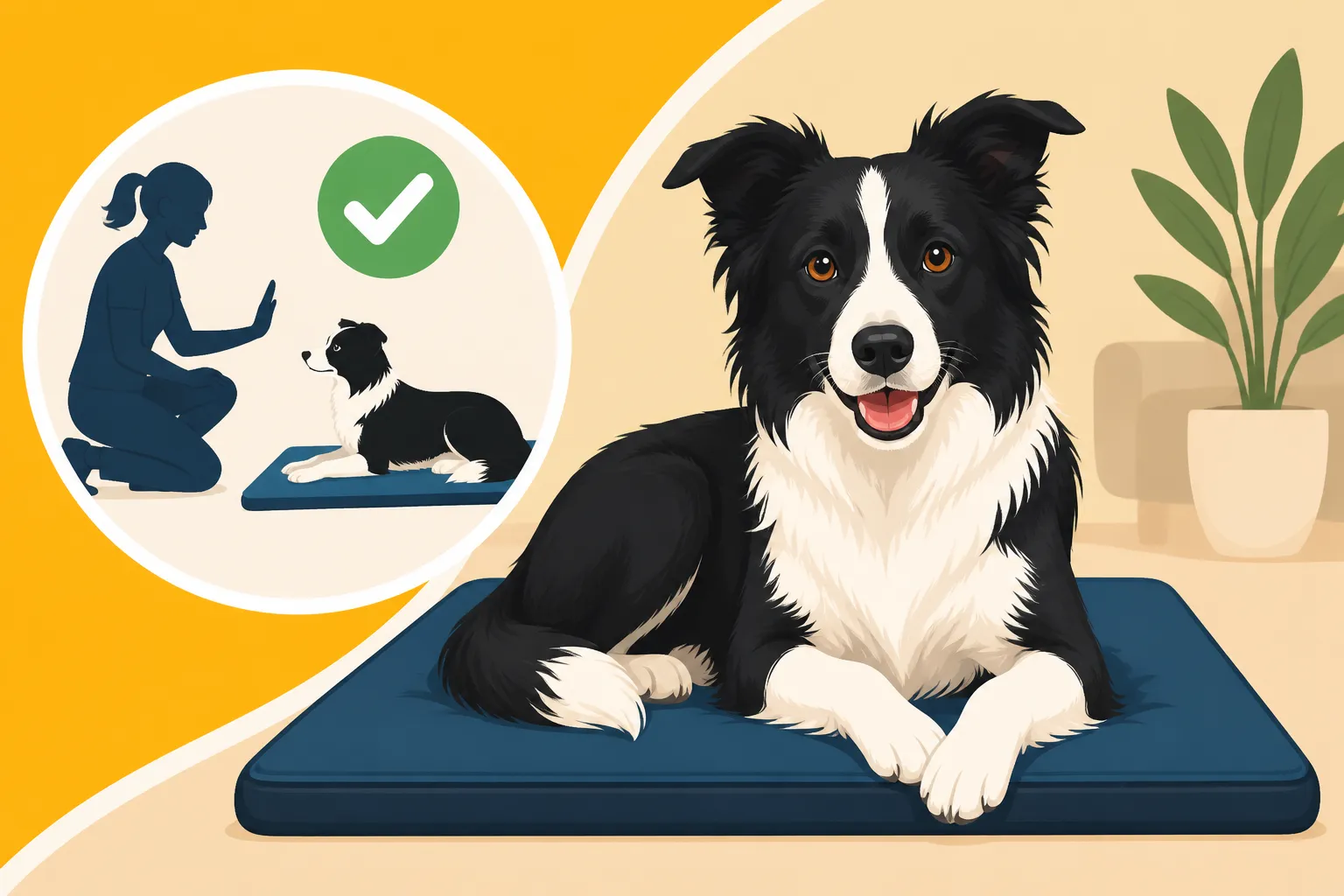
Start by placing the mat on the floor. With your Border Collie nearby, take a tasty treat and use it to lure them onto the mat. Hold the treat in front of their nose and guide them onto the mat. As soon as all four paws are on the mat, say "Yes!" or click your clicker, and immediately give them the treat. Repeat this several times. The goal in this first stage is simply to get them to understand that "mat" (or "place" or "bed") means "get on this specific item."
Once your Border Collie is reliably going onto the mat with the lure, you can start building duration. Lure them onto the mat, then take a step back. If they stay, mark and reward. Gradually increase the time they need to stay on the mat before getting the reward. Start with one second, then two, then five. Don't rush this. Scatter treats on the mat while they are lying there, making the mat a rewarding place to be. You want them to think, "Good things happen when I'm on this mat!" This is a prime opportunity to use small, high-value training treats. Many online programs, such as those offered by BAXTER & Bella, emphasize this positive reinforcement approach to mat training.
Adding the "Relax" Factor: Capturing Calm
This is where the "settle" truly comes in. While your Border Collie is on the mat, wait for them to offer a natural calm behavior, such as a sigh, resting their head down, or even starting to doze. The moment you see this relaxation, mark it (with "Yes!" or a click) and reward them with a treat, ideally delivered calmly to their mouth while they are still in that relaxed position. This teaches them that calmness itself is what you're rewarding.
It’s about capturing those fleeting moments of genuine peace. Don't prompt them; just observe and reward when they choose to relax. You can also incorporate a chew toy or a long-lasting treat (like a Kong stuffed with peanut butter) once they're on the mat, making the mat synonymous with quiet enjoyment. This not only encourages them to stay but also helps them truly unwind. Puzzle Feeders That Hold a Border Collie can be excellent for this, engaging their minds gently while they relax on their mat.
Introducing Distance and Distractions
Once your Border Collie can stay on the mat for a minute or two in a quiet room, it's time to gradually introduce distance and distractions. Start by taking a step away, then returning to reward. Increase the distance slowly: two steps, across the room, out of sight for a moment. If your Border Collie gets up, simply reset them to the mat with a calm "mat" command and try again with less distance or distraction.
For distractions, start with mild ones: you walking around, someone else moving in the room, a quiet conversation. Gradually work up to more challenging scenarios like the doorbell ringing, other pets moving about, or even visitors. Always start with short durations and high rewards, slowly increasing the challenge. Remember, the goal isn't just obedience, but maintaining that calm state amidst the chaos of everyday life. This foundational training helps them develop a strong "stay" command, which is invaluable for Recall on a Border Collie That Has Locked On later, giving you more control in higher-distraction environments.
Troubleshooting Common Mat Training Challenges
Even with the best intentions, training a Border Collie can sometimes present roadblocks. Their intelligence can be a double-edged sword; they learn quickly, but they can also become frustrated quickly if they don't understand or if the environment isn't set up for their success. Here are some common issues you might encounter and how to work through them.
My Border Collie Won't Stay on the Mat
This is perhaps the most common struggle. If your Border Collie keeps getting up or wanders off, it's usually a sign that you've moved too fast. You might be asking for too much duration, too much distance, or there's too much distraction in the environment for their current skill level. Go back to basics:
- Reduce the criteria: Ask for shorter durations. If they can only stay for 5 seconds, reward at 3 seconds. Build up slowly.
- Increase rewards: Use higher-value treats that are more enticing. Small pieces of cooked chicken or cheese can work wonders.
- Minimize distractions: Move to a quieter room. Ensure there's nothing else competing for their attention.
- Re-evaluate the mat: Is it comfortable? Is it truly a distinct "place"?
- Don't scold, just reset: If they get up, calmly lead them back to the mat with no fuss, say "mat," and start the exercise over. Avoid making it a punishment. The mat should always be a positive place.
My Border Collie Is Anxious or Restless on the Mat
Some Border Collies, particularly those who are highly sensitive or have existing anxiety, might find the "forced" stillness of the mat challenging at first. They might whine, pace, or constantly shift. This isn't defiance; it's often an inability to truly relax.
- Focus on capturing calm: Spend more time simply rewarding any brief moment of stillness or a head resting. Don't demand; wait for it.
- Physical and mental exercise before mat work: Ensure your Border Collie has had appropriate exercise and mental stimulation before a mat session. A tired body and a gently used mind are more conducive to relaxation. Exercise, Work and What Actually Settles a Border Collie highlights the importance of this balance.
- Comfort items: Place a favorite toy or a blanket that smells like you on the mat to provide comfort.
- Consult a professional: If anxiety is severe or persistent, a certified professional dog trainer or veterinary behaviorist can provide tailored strategies and support. They might explore options like calming supplements or environmental enrichment strategies.
The Mat is Just Another Place to Play/Chew
If your Border Collie sees the mat as a new playground or a chew toy, it means the association with calm has not yet been strongly established.
- Define its purpose: Only introduce chew toys or puzzle feeders to the mat after your Border Collie has settled and is showing signs of relaxation. Don't offer them immediately upon command, or the mat just becomes a place to get goodies, not a place to chill.
- Supervise: Always supervise early mat sessions. If your Border Collie starts to play with or chew the mat, calmly redirect them or remove the mat temporarily.
- Material choice: If chewing is a persistent issue, consider a more durable mat that isn't as tempting to destroy. Some mats are designed with more robust materials.
| Challenge | Potential Cause | Solution |
|---|---|---|
| Won't Stay on Mat | Too much too soon (duration, distance, distraction) | Go back to easier steps. Shorter durations, less distance, fewer distractions. Increase treat value. Calmly reset without scolding. |
| Anxious/Restless | Inability to relax, insufficient pre-exercise | Focus heavily on capturing any brief moments of calm. Ensure adequate physical/mental stimulation before training. Provide comforting items. Consider professional help for severe anxiety. |
| Plays/Chews Mat | Mat seen as toy, not a calm spot | Only offer specific, high-value chew toys after calm is established. Supervise closely; redirect or remove mat if chewing occurs. Consider a more durable mat material. |
| Barks on Mat | Frustration, seeking attention, over-arousal | Ignore barking if possible (as long as it's not extreme). Reward silence. Ensure the environment is calm enough. Re-evaluate if pre-exercise was sufficient. If attention-seeking, ensure you're not inadvertently rewarding it. |
| Only Settles at Home | Lack of generalization | Practice in different rooms, then gradually introduce new, mildly distracting environments (e.g., quiet backyard, friend's house). Start with very short durations in new places and high rewards, gradually building up. |
Consistency is your most powerful tool. Keep sessions short, positive, and frequent. A few 5-10 minute sessions a day are far more effective than one long, frustrating session.
Extending the Mat Work: Generalization and Real-World Application
Once your Border Collie is a pro at settling on their mat in a quiet room, it’s time to expand their understanding of this crucial skill. The real value of mat training comes when your dog can apply that calm behavior in various places and situations. This process is called generalization, and it’s what turns a practiced behavior into a truly useful life skill.
Practice in Diverse Environments
The first step in generalization is moving the mat to different locations within your home. Start with rooms that have slightly more activity, like a busier part of the living room, the kitchen while you're cooking, or even outside on a patio. Each new location is a mini-lesson in itself, so remember to start with shorter durations and higher-value rewards, just as you did in the initial stages. Gradually introduce environments with more sensory input, such as a quiet park, a friend's house, or even a dog-friendly cafe.
The key is progressive exposure. Don’t jump from your quiet living room to a bustling dog park. Go slowly, observe your Border Collie's comfort level, and always set them up for success. This systematic approach ensures that the "mat = relax" association holds strong, no matter where they are. Imagine how helpful this can be when you need your Border Collie to Stay on its bed while you eat dinner or have company.
Integrating the Mat into Daily Routines
Beyond just moving the mat, integrate its use into everyday scenarios where you need your Border Collie to be calm and out of the way. This could include:
- During meal prep: Have your Border Collie go to their mat while you're in the kitchen.
- When guests arrive: This is a fantastic opportunity to teach them that the mat is their safe, calm place when new people enter the house.
- During family movie night: Instead of begging for attention, they're settled on their mat nearby.
- As a substitute for crating: While crates are excellent tools, a mat can offer a similar sense of security and a boundary without the enclosure, especially for short periods.
The more you use the mat in these practical contexts, the stronger the behavior becomes. It transforms from a training exercise into a natural part of your Border Collie's daily rhythm, creating predictability and reducing stress for everyone.
The Mat as a Tool for Impulse Control
Border Collies are incredibly impulsive, often reacting instantly to movement, sound, or a command. The mat command, especially when practiced with distance and distractions, becomes a powerful tool for impulse control. It teaches them to pause, to listen, and to choose calm over immediate action. This is incredibly beneficial for dogs who struggle with behaviors like barking at the doorbell, lunging on leash, or constantly demanding attention.
By making the mat their go-to place for quiet, you're building a foundation of self-control that can carry over into other areas of their training and life. It's not about suppressing their natural drive, but rather teaching them when and where that drive is appropriate, and when it's time to simply relax and wait.
The Long-Term Benefits of a Relaxed Border Collie
The journey to a truly settled Border Collie might take time and dedication, but the rewards are profound and far-reaching. It’s not just about having a dog that lies down on command; it’s about fostering a calmer, happier, and more well-adjusted canine companion, which in turn enhances the entire household.
A More Harmonious Household
A Border Collie with a reliable "off-switch" contributes significantly to a more peaceful home environment. Gone are the days of constant pacing, attention-seeking nudges, or incessant demands. Instead, you'll find your Border Collie can calmly exist alongside you, whether you're working, relaxing, or entertaining. This reduces overall stress for both you and your dog.
Think about the difference a truly relaxed Border Collie makes when you have visitors. Instead of being an unruly whirlwind, they can greet guests politely, then retreat to their mat, becoming a calm observer rather than a participant in every interaction. This makes your dog a more enjoyable companion in a wider range of social situations. What Children Have to Learn Around a Border Collie can include teaching them to respect the dog's mat space as a "do not disturb" zone, further solidifying its purpose.
Enhanced Confidence and Reduced Anxiety
While it might seem counterintuitive, teaching a dog to settle can actually boost their confidence. Knowing what's expected of them, and having a designated safe space to retreat to, provides a sense of security and predictability. For a breed that thrives on structure, this can significantly reduce underlying anxiety. They learn that they don't always have to be "on duty" or constantly seeking stimulation.
The mat becomes their personal sanctuary, a place where they can truly decompress. This is particularly valuable for sensitive Border Collies or those prone to stress. This newfound calm can even translate to better behavior in challenging situations, such as vet visits or during travel, as they have a coping mechanism they can take with them. A Border Collie That Panics When You Leave might find comfort in their mat when left alone, as it provides a consistent, familiar anchor.
A Stronger Bond Between Dog and Owner
Ultimately, a well-trained and settled Border Collie leads to a deeper, more enjoyable relationship with their owner. When your dog is calm and respectful, you're more likely to include them in more activities and outings, knowing you can trust them to behave appropriately. This creates a positive feedback loop: your dog enjoys more experiences, which reinforces their good behavior, and you enjoy their company even more.
The mat command is a testament to the fact that even the most high-drive dogs can learn to relax. It’s a powerful tool that helps bridge the gap between their innate instincts and the demands of living harmoniously in a human world. Investing in this training is an investment in years of contented companionship with your brilliant Border Collie.
Disclaimer
This article is for general informational purposes only and does not constitute professional advice. Laws, prices and regulations vary by location and change over time. Consult a qualified professional for guidance on your specific situation.