What Makes a Border Collie Lilac or Slate
Many Border Collie enthusiasts adore the breed's intelligence and athleticism, but they're often equally captivated by the stunning array of coat colors. If you’ve ever seen a Border Collie that doesn't quite fit the typical black and white mold, you might have heard terms like "lilac" or "slate" and wondered what exactly makes these unique shades appear. This comprehensive guide will unravel the genetic mysteries behind these beautiful dilute colors, helping you understand their origins, how to identify them, and what they mean for your beloved companion.
The Foundation of Border Collie Coat Color: A Primer in Genetics
Before we dive into the specific genes that create lilac and slate, it helps to have a basic understanding of how coat color is determined in dogs. It's not nearly as simple as mixing paints, but rather a complex interplay of several genes, each contributing a piece to the overall masterpiece we see in a Border Collie's coat.
At its most fundamental, every Border Collie, and indeed almost every dog, starts with one of two basic pigment types: eumelanin (black pigment) or phaeomelanin (red/yellow pigment). All other colors, patterns, and shades we see are variations or modifications of these two base pigments.
Black, Brown, and the "B" Locus
The primary determinant for black or brown pigment is the "B" locus. This gene has two main alleles:
- B (dominant): This allele produces black eumelanin. A dog with at least one B allele will have black pigment in its coat, nose, and paw pads, assuming no other genes modify it.
- b (recessive): This allele, when present in two copies (bb), changes black eumelanin to brown, often called chocolate or liver. A dog that is "bb" will have brown pigment everywhere black would normally be – brown nose, brown paw pads, and a brown coat.
So, a Border Collie could genetically be B/B (homozygous dominant for black), B/b (heterozygous, carrying the brown gene but appearing black), or b/b (homozygous recessive for brown). This explains why some Border Collies are clearly brown or chocolate, rather than the classic black. You can see how these basic colors lay the groundwork for understanding more complex variations. If you're curious about the full spectrum, we've got an article on The Colors a Border Collie May Be that covers a wide range.
The "E" Locus and Red Border Collies
While the B locus determines whether a dog produces black or brown eumelanin, the "E" locus (Extension) dictates whether that eumelanin is expressed in the coat at all, or if phaeomelanin (red/yellow) takes over.
- E (dominant): Allows full expression of eumelanin (black or brown) in the coat. Most Border Collies will have at least one E allele.
- e (recessive): When present in two copies (ee), this allele prevents eumelanin from being expressed in the coat, regardless of what the B locus says. Instead, the dog will appear various shades of red, yellow, or gold. Their nose and paw pads will still be black or brown, depending on their B locus genotype.
This is how you get those stunning, rich red Border Collies. Even if a red Border Collie carries the black gene (B), if it's "ee" at the E locus, its coat will be red. This "ee" red is distinct from the red you might see in a brown dog that appears reddish due to sun exposure or other genetic modifiers, and it's definitely not as rare as some might think. We actually dive into that in our article Whether a Red Border Collie Is Rare.
The Dilution Gene: How Lilac and Slate Emerge
Now that we understand the base colors, we can introduce the star of our show: the dilution gene, often referred to as the "D" locus. This is the gene responsible for transforming those fundamental black and brown pigments into the softer, more muted tones of slate and lilac.
The "D" Locus: Diluting Pigment
The "D" locus has two primary alleles:
- D (dominant): This allele allows for full-strength pigment expression. A dog with at least one D allele will have intense, undiluted black or brown pigment.
- d (recessive): This allele, when present in two copies (dd), causes a dilution of both black and brown pigments. It essentially "waters down" the color by changing the way pigment granules are dispersed in the hair shaft.
This is where the magic happens for slate and lilac. A Border Collie must inherit two copies of the recessive "d" allele (dd) from its parents to express a dilute coat color. This means both parents, even if they aren't dilute themselves, must at least be carriers of the "d" allele (D/d). Without that double "d" gene, no dilution will occur.
When Black Becomes Slate: The Blue/Grey Border Collie
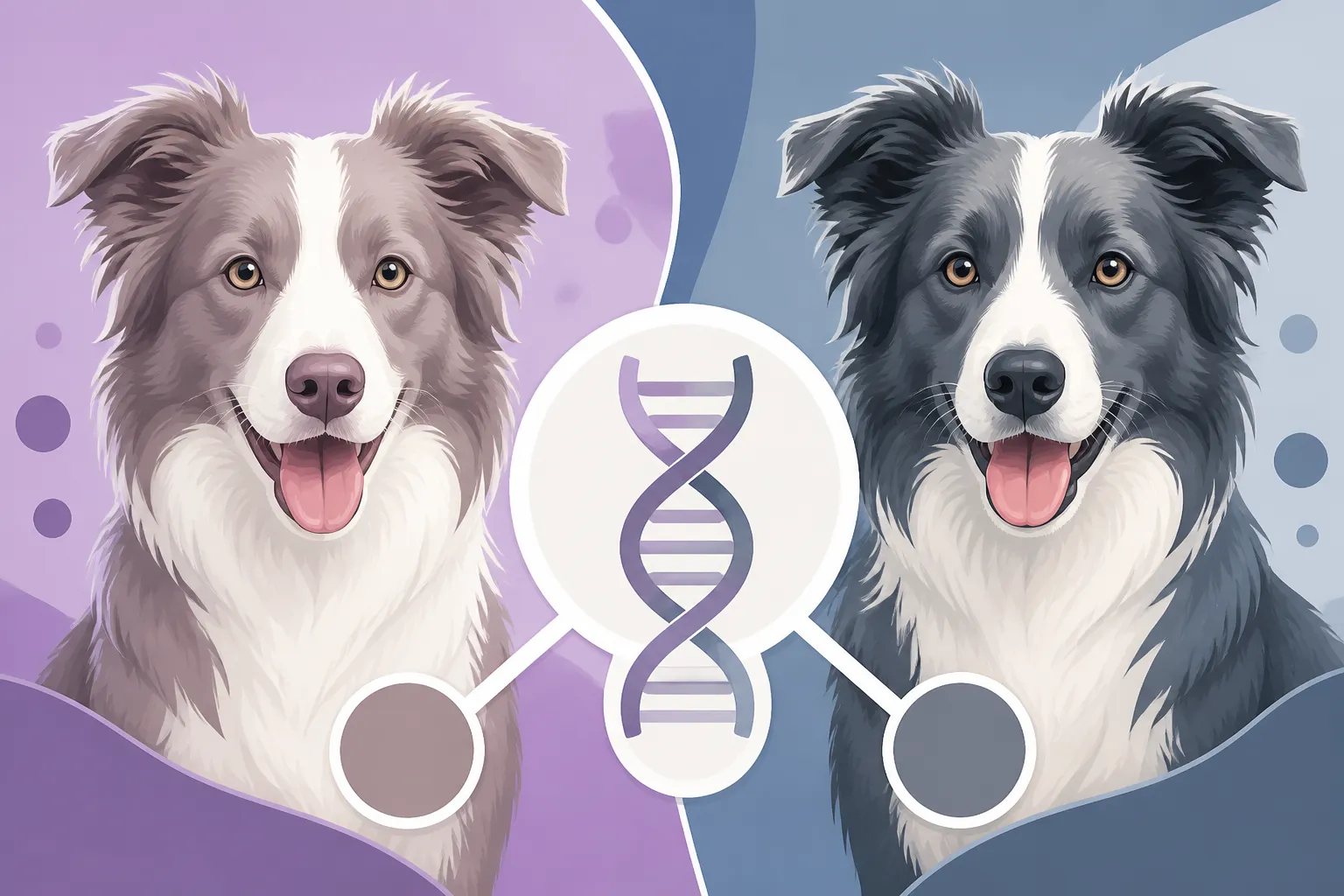
When a Border Collie that would genetically be black (B_) also inherits two copies of the dilute gene (dd), its black pigment is softened into a beautiful blue or grey shade. This color is commonly referred to as slate in Border Collies, though in other breeds, it's often called blue.
A slate Border Collie will typically have a grey-blue coat, ranging from a deep charcoal grey to a lighter, softer grey, sometimes with an almost metallic sheen. Crucially, the dilution affects all eumelanin. This means their nose leather, paw pads, and even eye rims will also be slate grey, not black. Their eyes often appear lighter, frequently a light brown, amber, or even blue, especially as puppies. The contrast with white markings can be truly striking.
Imagine a typically black and white Border Collie, but instead of jet black, all the black areas are a sophisticated, dusky grey. That's your slate! It's important to differentiate this from a merle pattern, which involves mottled patches of color, not an overall diluted solid color. Our article on Merle Border Collies and What It Means explains this distinction in more detail.
When Brown Becomes Lilac: The Isabella Border Collie
Now, let's turn our attention to the even rarer and often breathtaking lilac Border Collie. This color occurs when a Border Collie that would genetically be brown (bb) also inherits two copies of the dilute gene (dd). The already softened brown pigment is further diluted, resulting in a unique, pale, often grayish-brown shade. In some breeds, this color is known as Isabella.
A lilac Border Collie's coat can be described as a warm, often pinkish-grey or a pale, almost dusty chocolate. It’s a softer, lighter version of brown, with a noticeable greyish cast. Just like with slate dogs, the dilution is comprehensive: their nose, paw pads, and eye rims will match their coat color, appearing a pale liver or even a pinkish-grey. Their eyes are frequently lighter, often amber or a striking light blue, which adds to their distinctive appearance.
To visualize a lilac Border Collie, think of a chocolate Border Collie, but then imagine all those rich brown tones have been washed out, leaning towards a muted, almost pastel brown-grey. It's a truly exquisite color that stands out in a crowd.
The Nuance: Telling Slate from Lilac
While both slate and lilac are dilute colors, it's vital to understand they stem from different base pigments. Here's a quick breakdown to help differentiate:
| Feature | Slate Border Collie (B_ dd) | Lilac Border Collie (bb dd) |
|---|---|---|
| Base Color | Black | Brown (Chocolate) |
| Coat Color | Grey, blue-grey, charcoal | Pinkish-grey, pale liver, dusty chocolate-grey |
| Nose/Pads | Slate grey | Pale liver, pinkish-grey |
| Eye Color | Light brown, amber, blue (often as puppy) | Light amber, blue, green |
| Genetic Test | B allele present, D/D or D/d parents | bb present, D/D or D/d parents |
Why these colors are less common
The reason you don't see lilac and slate Border Collies as often as black and white ones comes down to the genetics being recessive. To produce a dilute puppy, both parents must contribute a "d" allele. If either parent is D/D, no dilute puppies can be produced. If one parent is D/d and the other is D/d, only 25% of the litter, on average, will be "dd" and express the dilute color. This makes these colors naturally less frequent in the general Border Collie population, particularly in working lines where color isn't a primary selection criterion.
Visualizing Dilute Border Collies: Appearance and Nuances
When you're looking at a Border Collie and trying to determine if it's slate or lilac, it’s not just about the general shade of the fur. The dilution gene has a profound effect on all areas where eumelanin is produced, creating a very cohesive look. It's about pigment consistency across the board.
Coat, Nose, and Eye Pigmentation: The Tell-Tale Signs
A Border Collie's pigment isn't just in its fur; it's in their skin, their nose, their paw pads, and their eye irises. The dilute gene impacts all of these areas simultaneously.
For a slate Border Collie:
- Coat: As discussed, the coat will be various shades of grey, from light silver to a darker charcoal. This grey often has a bluish undertone, making "blue" a common descriptor for these dogs. The intensity can vary, but it will always be a distinct shade of grey, not black.
- Nose and Paw Pads: This is often the easiest and most reliable indicator. A slate Border Collie will never have a black nose or black paw pads. Instead, these areas will be a coordinating shade of slate grey. Think of the color of a wet slate roof tile. This is a critical distinction, as a dog with a black coat that looks slightly greyish due to sun fading or age will still have a black nose.
- Eyes: Their eyes will typically be lighter than a black Border Collie's dark brown eyes. Common eye colors for slate Border Collies include amber, light brown, or even startling blue eyes, particularly when they are young. Sometimes, their eye rims will also appear grey. This can sometimes lead people to confuse them with merle dogs, which frequently have blue eyes, but the overall coat pattern is key here. Our guide on Eye Color in a Border Collie goes into more depth on this fascinating aspect.
For a lilac Border Collie:
- Coat: The coat will be a soft, often muted brown with a definite greyish or pinkish cast. It's not the rich, deep chocolate of an undiluted brown Border Collie, nor is it the vibrant red of an "ee" red dog. It's a subtle, elegant shade that truly needs to be seen to be fully appreciated.
- Nose and Paw Pads: Just like with slate dogs, the nose and paw pads will match the dilute pigment. A lilac Border Collie will have a pale liver, pinkish-grey, or even a grayish-tan nose and paw pads. Again, this is a clear sign; a brown dog that looks faded will still retain a darker brown nose.
- Eyes: Lilac Border Collies often have equally striking light-colored eyes, ranging from amber to light blue or even a light green. These lighter eye colors complement their unique coat shade beautifully. Their eye rims will also be a pale liver or pinkish-grey.
Common Misconceptions and Distinctions
It's easy to mistake a dilute Border Collie for something else, especially if you're not familiar with the nuances of canine genetics. Here are a few common distinctions:
- Dilute vs. Faded Black/Brown: A black or brown Border Collie's coat can sometimes appear lighter due to sun exposure, poor nutrition, or age. However, their nose and paw pads will remain intensely black or brown. A true slate or lilac Border Collie will always have a dilute-colored nose and pads, regardless of their age or the condition of their coat.
- Dilute vs. Merle: Merle is a pattern, not a solid color. Merle dogs have patches of diluted color interspersed with patches of full-strength color, creating a mottled, marbled effect. They can also have blue eyes and diluted noses. However, a dilute Border Collie (slate or lilac) is a solid color (or bi-color/tri-color with white markings), where the entire base color is diluted uniformly. There are no distinct patches of full-strength pigment on the body. For instance, a blue merle Border Collie would have patches of slate grey and black, while a solid slate Border Collie would be entirely grey where pigment is present.
- Dilute vs. "Red": "Red" in Border Collies typically refers to dogs that are "ee" at the E locus, meaning their eumelanin (black or brown) is completely masked by phaeomelanin. These dogs have yellow, gold, or red coats, but their nose and paw pads are still black or brown. Dilute colors (slate and lilac) are modifications of eumelanin itself, meaning the black or brown pigment is present but softened. They are entirely different genetic pathways.
Understanding these visual cues is crucial for correctly identifying these stunning Border Collie colors. If you’re ever unsure, remember that a genetic test can confirm the presence of the "dd" dilution gene.
Breeding for Dilute Colors: Considerations and Challenges
For Border Collie breeders, the decision to produce dilute colors like slate and lilac involves a deeper understanding of genetics, ethical considerations, and the breed standard. While these colors are undeniably beautiful, focusing solely on color without regard for health, temperament, and working ability can lead to undesirable outcomes.
Genetic Testing for Dilution
Responsible breeders who wish to understand the genetic makeup of their dogs, including their color genes, often utilize genetic testing. A full Border Collie DNA panel can screen for a wide range of traits and potential health conditions, and most of these panels include tests for coat color genes like the B, E, and D loci.
Knowing a dog's D/d status is incredibly valuable:
- D/D (clear): The dog does not carry the dilute gene and cannot pass it on.
- D/d (carrier): The dog carries one copy of the dilute gene and can pass it on to approximately 50% of its offspring. This dog will not appear dilute itself.
- d/d (affected): The dog has two copies of the dilute gene and will express a dilute coat color (slate or lilac, depending on its B locus status). All of its offspring will inherit at least one "d" allele.
Breeders can strategically use this information to plan breedings if they are aiming for specific colors, or more importantly, to understand the genetic potential of their breeding stock. For instance, if a breeder wants to produce a lilac Border Collie, they would need to breed two dogs that are both at least "bb" (brown) and both "D/d" (dilute carriers) or "d/d" (dilute). This ensures the "bb" and "dd" genotypes combine in some of the puppies. Our article on Which DNA Tests a Border Collie Breeder Should Have Run delves into the importance of this type of screening.
Genetic testing has become much more accessible than it once was. You can find reputable labs that offer comprehensive panels, often using a simple cheek swab. The cost of a Border Collie DNA panel is an investment that provides valuable insights into a dog's genetic blueprint.
Health Implications, or Lack Thereof
One of the most important considerations for any breeding program is health. Fortunately, unlike some other coat color genes (such as the merle gene, which can be linked to health issues when two merle dogs are bred together), the dilution gene (dd) itself is not directly associated with known health problems in Border Collies.
Dilute colors like slate and lilac are generally considered to be healthy color variations. Dogs with these coats are not inherently more prone to specific diseases or conditions because of their color. This is excellent news for owners and breeders who appreciate these unique aesthetics without added health worries.
However, a reputable breeder will always prioritize overall health, temperament, and working ability above cosmetic traits like color. They should screen for common Border Collie health concerns such as hip and elbow dysplasia, eye anomalies, and various genetic diseases through a full genetic panel. The unique color is simply a bonus on top of a healthy, well-tempered dog.
The Working vs. Show Split and Color Preferences
In the world of Border Collies, there has historically been a distinct split between working lines and conformation (show) lines. Working Border Collies are bred almost exclusively for their herding ability, intelligence, and temperament. In these lines, color is rarely a selection factor; a good dog is a good dog, regardless of its coat. As a result, you might find a wider range of colors, including dilutes, appearing naturally if the genetics are present.
Conformation lines, on the other hand, breed to a specific written standard that dictates physical appearance, including acceptable coat colors and markings. While slate and lilac are generally accepted colors in many Border Collie breed standards, the emphasis is often on presentation and adherence to specific aesthetic ideals. This might mean that some breeders in conformation lines choose not to focus on or actively breed for dilute colors if they aren't considered "traditional" or if they are harder to achieve consistently within their desired look.
It’s worth noting that the general public's increasing fascination with unique dog colors means there’s a demand for slate and lilac Border Collies. While this can be a positive for appreciation of diversity, it also means prospective owners need to be extra diligent to ensure they are sourcing a puppy from a breeder who prioritizes health and temperament above all else, rather than one simply breeding for a "rare" color.
Living with a Lilac or Slate Border Collie: General Care and Aesthetic Notes
Owning a Border Collie, regardless of its color, means committing to an active, intelligent, and highly driven companion. The care requirements for a lilac or slate Border Collie are identical to those of any other color, but there are a few aesthetic and general considerations to keep in mind.
Standard Border Collie Care Applies
Whether your Border Collie is black and white, tri-color, merle, or a stunning slate or lilac, its core needs remain the same. These dogs require:
- Ample Exercise: We're talking more than just a walk around the block. A Border Collie needs significant physical activity, often two hours or more daily, to stay happy and healthy. This could include running, hiking, agility, or, of course, herding. Our article What a Border Collie Does With Its Whole Day really breaks down their activity needs.
- Mental Stimulation: Their brilliant minds need a job! Puzzle toys, training sessions, scent work, and learning new tricks are crucial to prevent boredom and destructive behaviors. Retailers like Chewy offer a fantastic selection of mental enrichment toys and tools.
- Training and Socialization: Early and consistent positive reinforcement training is essential. These dogs are quick learners but can also learn undesirable habits just as quickly if not guided properly.
- Nutrition: A high-quality diet appropriate for an active breed is paramount. You can find excellent performance dog food options at stores like Chewy.
- Grooming: The type of grooming required depends more on the coat length (rough or smooth) than the color. However, some lighter colored dogs, including dilutes, might show dirt more easily. Grooming a Rough-Coated Border Collie offers detailed advice, which applies to rough-coated dilutes too.
Coat Care and Fading
While the genetics of slate and lilac prevent them from truly "fading" in the sense of their underlying pigment changing, direct and prolonged sun exposure can cause any dog's coat, particularly lighter or dilute colors, to lighten or take on reddish tones. This is not a genetic change but a temporary effect of the sun bleaching the outer layer of the hair shaft.
To keep a dilute coat looking its best, especially if you have a dog with a rich slate or soft lilac, consider:
- Limiting Extreme Sun Exposure: During peak sun hours, providing shade or limiting prolonged outdoor sessions can help maintain the coat's true hue.
- High-Quality Diet: Good nutrition supports healthy skin and coat, ensuring the hair shafts are strong and vibrant. Look for foods rich in omega fatty acids, available from pet supply sources like Chewy.
- Regular Grooming: Brushing helps distribute natural oils, remove dead hair, and can enhance the coat's natural luster.
The Uniqueness of a Dilute Border Collie
Owning a lilac or slate Border Collie often means you'll have a dog that draws attention and admiration. Their unique coloring is truly striking and can be a wonderful conversation starter. While their color doesn't change their fundamental Border Collie nature, it adds an extra layer of visual appeal to an already incredible breed. Just remember, the beauty of these colors is a bonus; the heart and mind of the Border Collie are what truly make them special.
Disclaimer
This article is for general informational purposes only and does not constitute professional advice. Laws, prices and regulations vary by location and change over time. Consult a qualified professional for guidance on your specific situation.