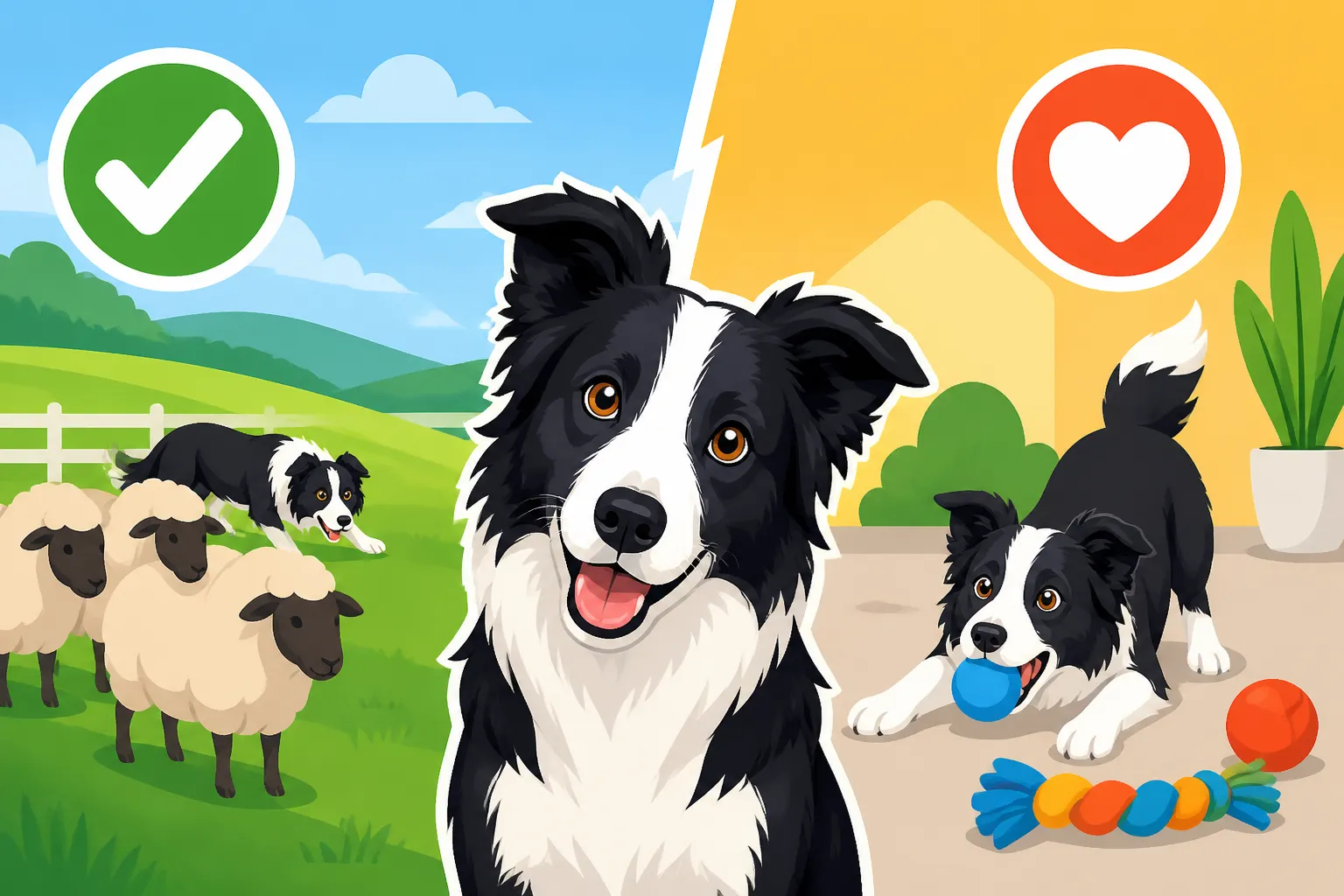
Whether a Border Collie Needs Livestock to Be Happy
A Border Collie does not need sheep, cattle, or a farm to be happy, but it does need more than a quick walk and a bowl of food. The real challenge is giving this intelligent, energetic dog appropriate ways to think, move, learn, and rest. This guide explains what livestock provides, what can replace it, and how to tell whether your dog’s needs are being met.
Does a Border Collie Need Livestock to Be Happy
Livestock is an outlet, not a requirement
Border Collies were developed to work with livestock, and many have strong instincts to watch, approach, gather, and control movement. For a working dog, sheep or cattle can provide a meaningful job that draws on those instincts. But a breed’s history does not mean every individual dog needs access to livestock to have a good life.
Plenty of Border Collies live happily in suburban homes, cities, and families without ever working sheep. What matters is whether their everyday life includes suitable activity, interaction, learning, and downtime. A dog can miss out on the particular experience of herding without being deprived of every opportunity to use its brain and body.
It also helps to separate “needs a job” from “needs livestock.” A Border Collie may thrive on training, scent games, agility foundations, structured play, or practical tasks around the home. These activities are not identical to herding, and not every activity will suit every dog. But they can offer worthwhile ways to engage the dog’s attention and build a satisfying routine. For a broader look at how to plan a dog’s day, see What a Border Collie Does With Its Whole Day.
A yard is not the same as a job
A large yard can be useful, but space alone does not necessarily satisfy a Border Collie. A dog left outside with nothing to do may spend the day patrolling the fence, barking at passersby, chasing shadows, or waiting for someone to engage. From the dog’s point of view, having room to run is not automatically the same as having a purposeful activity.
This is why a small home with thoughtful routines can suit a Border Collie better than a large property where the dog is mostly left to entertain itself. Walks, training, play, sniffing opportunities, and calm time with its people can matter more than acreage. The question is not simply how much space the dog has, but what it gets to do with its day.
That does not mean every Border Collie needs a packed schedule. Constant stimulation can create a dog that is always on alert and struggles to settle. A healthy routine includes activity and deliberate rest, rather than an endless sequence of games. The key is finding a sustainable balance for the individual dog, as discussed in Exercise, Work and What Actually Settles a Border Collie.
What to Offer a Border Collie Without Livestock
Use a mix of physical and mental activities
A brisk walk can be a useful part of the day, but it is rarely the whole answer for an active Border Collie. Scenting, learning a new cue, searching for food, or working through a simple problem can engage the dog in a different way from repetitive running. A short training session in the kitchen, for example, may leave a dog more satisfied than another round of frantic ball throwing.
Try rotating activities rather than relying on one favorite. One day might include a sniff-focused walk and a few minutes of trick training. Another could involve a food search in the yard, a calm outing to a new place, or a beginner class. Rotating the activity gives you room to notice what your dog enjoys without turning every day into a high-intensity workout.
Food enrichment can make ordinary feeding more interesting. You might scatter part of the ration in a safe area, hide a few pieces for the dog to find, or use a suitable puzzle feeder. If a dog gets frustrated or starts chewing unsafe parts, make the activity easier or supervise closely. Retailers such as Chewy carry puzzle feeders and snuffle mats, but a commercial product is not essential; simple, safe food-search games can work too.
Choose activities that fit the dog, not the stereotype
Dog sports can be a rewarding option, but no single sport is a universal substitute for livestock work. Agility, rally, obedience, disc, flyball, and scentwork each ask for different skills and levels of excitement. A dog that loves precise, cooperative training might enjoy obedience, while another may prefer searching for a hidden scent. Start with a beginner-friendly class or low-pressure practice and pay attention to your dog’s comfort.
For some dogs, herding lessons are appropriate even if the household does not own livestock. A qualified instructor can help you determine whether a lesson setting is safe and suitable, and whether your dog can work calmly around stock. The goal should be responsible instruction, not simply letting a dog loose to chase animals. If you are considering that route, Whether a Pet Border Collie Should Learn to Herd can help frame the decision.
You can also give a dog a “gathering” game without using livestock. Teach it to bring a toy to a basket, find a family member in the house, or carry a soft item from one room to another. Keep the task controlled and fun; do not encourage chasing children, cats, wildlife, or moving vehicles. For more ideas, see Giving a Border Collie Something to Gather and Choosing a Sport for a Border Collie.
| Activity | What it offers | A good starting point |
|---|---|---|
| Scent games | Sniffing, searching, and problem-solving | Hide a few treats in easy-to-find places |
| Trick training | Communication and focused learning | Practice one simple behavior in short sessions |
| Food enrichment | A more engaging way to eat | Scatter part of a meal in a safe, clear area |
| Agility foundations | Movement and teamwork | Begin with low-impact skills and an instructor |
| Herding lessons | Carefully supervised stock work | Ask an experienced instructor about suitability |
| Calm exploration | New smells and environments | Choose a quiet route and let the dog sniff |
How to Tell Whether Your Border Collie Is Getting Enough
Look at behavior across the whole day
A Border Collie who is getting suitable activity may still be energetic. The goal is not to make the dog so tired that it collapses, but to help it move between engagement and rest. A dog that can enjoy a walk or training session and then settle in the home is showing a useful ability to switch off.
Signs that the routine may need attention include persistent pacing, repeated barking at small changes outside, destructive behavior, frantic demands for play, or an inability to rest even when the household is quiet. These behaviors can have multiple causes, including stress, discomfort, or lack of sleep, so they should not automatically be blamed on “not enough exercise.” Consider the full picture and contact a veterinarian or qualified behavior professional if the change is sudden, severe, or difficult to manage.
It can help to keep a simple record for a week. Note when your dog sleeps, what activities it does, and when challenging behaviors appear. If the dog becomes unsettled every evening after hours of high-speed fetch, the answer may not be more fetch. It could be a calmer activity, a more predictable routine, or help learning how to settle. Mental Work That Tires a Border Collie Faster offers ideas for engaging a dog without making every activity a race.
Avoid trying to exhaust the dog
It is tempting to respond to every sign of restlessness with longer runs or more ball throwing. But repeatedly increasing intensity can build stamina without teaching the dog how to relax. Some Border Collies become more keyed up after fast, repetitive games, particularly when they are already fixated on the ball or movement.
Instead, use clear beginnings and endings. Before a game, ask for a simple cue such as waiting briefly or making eye contact. End with a consistent signal, put the toy away, and follow with a quiet activity such as a food search or settling on a mat. This gives the dog a predictable transition rather than an abrupt stop that can lead to more barking and demands.
Rest is part of a good routine, not a failure to provide enough stimulation. Puppies, adolescents, and adult dogs all need opportunities to sleep and recover. If your dog becomes increasingly frantic, irritable, or unable to focus as the day goes on, consider whether the schedule is too intense or whether there is enough quiet time.
Building a Livestock-Free Routine That Works
Start with a realistic weekly plan
You do not need to invent a new activity every hour. A repeatable routine is often easier for people and dogs. For example, a weekday might include a sniffing walk, a short training session, a food-search game, and a long period of rest. On another day, you could swap in a class, a new walking route, or a controlled play session.
Make changes gradually. If your dog is used to long periods of fetch, replacing every session overnight with quiet puzzle games may be frustrating. Reduce the most intense activity in manageable steps and introduce alternatives while your dog is still able to think and engage. Keep sessions short enough that your dog can succeed, then build duration or difficulty as appropriate.
A simple weekly plan might look like this:
- Choose a few activities your dog enjoys and can do safely.
- Include both movement and thinking, rather than relying on one kind of exercise.
- Set aside quiet time after active sessions.
- Rotate toys or food-search setups so they stay interesting.
- Review your dog’s behavior and adjust the plan instead of adding activity automatically.
Enrichment does not have to be expensive. A safe cardboard box with loosely arranged paper and a few pieces of kibble can become a supervised sniffing activity for some dogs. If you use bought toys or food puzzles, choose products that fit your dog’s size and chewing style. Chewy is one place owners may look for these supplies, but use care with any item that could be swallowed or damaged.
Make the environment manageable
A Border Collie in an apartment can have a satisfying life, but the household may need to be thoughtful about noise, leash routines, and safe places to practice. A quiet patch of grass, a training class, or a regular sniffing route can be more useful than expecting the dog to burn energy by racing around a small living room. For more on adapting routines to a smaller home, see Living With a Border Collie in an Apartment.
Likewise, living on a farm does not automatically mean a dog should have free access to livestock. Untrained chasing can frighten or injure animals and can put the dog at risk. Keep dogs separated from stock unless a responsible handler is actively supervising and training them. A dog’s interest in sheep is not, on its own, evidence that it knows how to work safely.
If you are deciding whether a Border Collie suits your household, be honest about the time and consistency you can offer. Some dogs are content with moderate, varied activities; others have stronger working drives and need more structured outlets. Individual temperament, health, age, and learning history all matter. The practical question is not whether you can reproduce farm life in a living room, but whether you can provide a safe, engaging routine your dog can live with. Whether Acreage Alone Satisfies a Border Collie and Why People Choose a Border Collie and Then Struggle offer useful perspectives on that decision.
When to seek extra help
If your Border Collie is fixated on movement, persistently herding people or other pets, or unable to settle despite a consistent routine, seek help early. A qualified reward-based trainer or veterinary behavior professional can help identify triggers and create a plan. A veterinarian should also assess behavior changes that appear suddenly, since pain or illness can affect activity, sleep, and irritability.
For dogs that enjoy activities but become over-aroused, a professional can help you choose lower-intensity options, add rest cues, and teach calm transitions. For dogs that seem uninterested or unusually tired, do not assume they simply need more motivation; a health check may be appropriate. Tailoring the plan is often more useful than comparing your dog with a working Border Collie seen online or at a trial.
Disclaimer
This article is for general informational purposes only and does not constitute professional advice. Laws, prices and regulations vary by location and change over time. Consult a qualified professional for guidance on your specific situation.