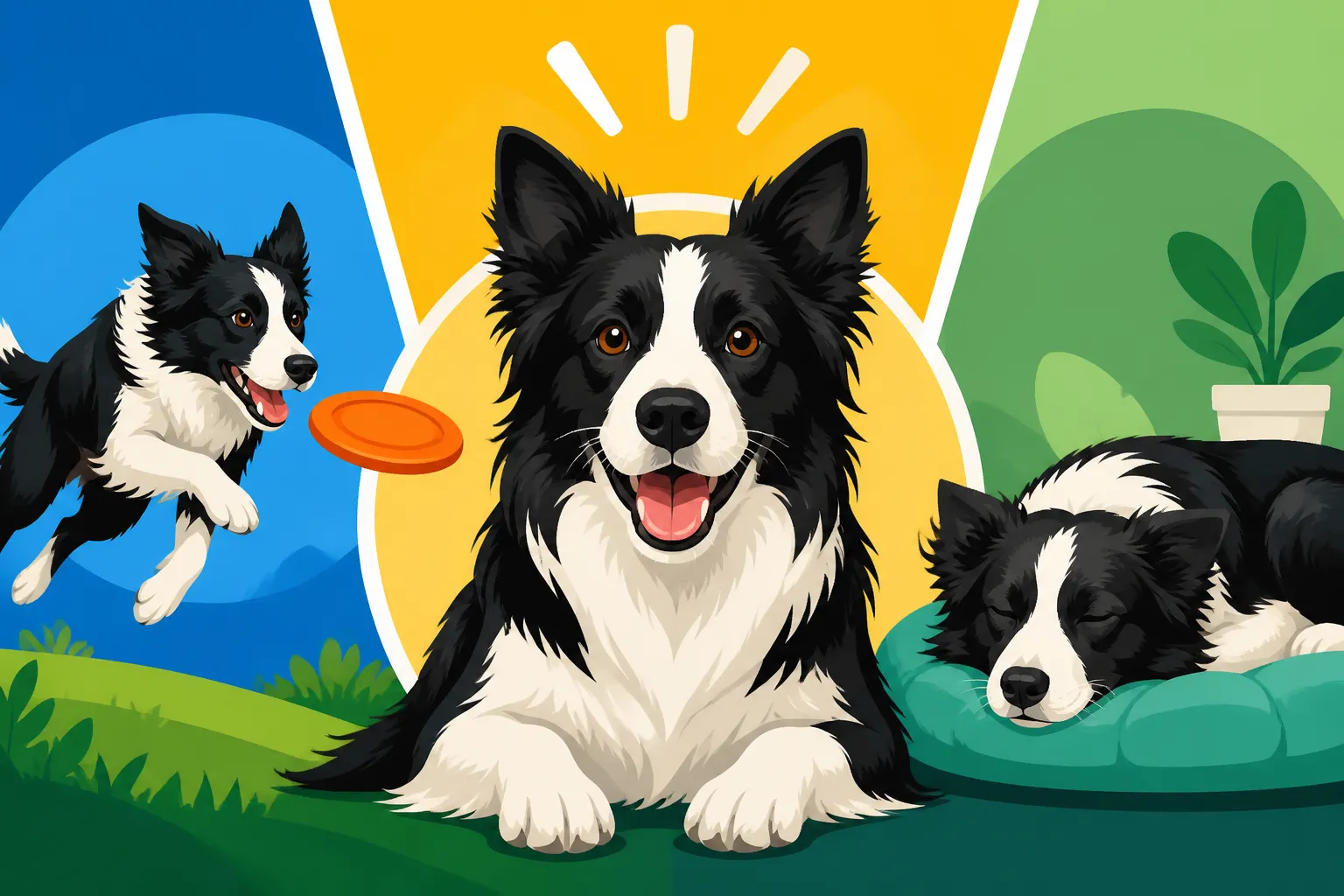
Exercise, Work and What Actually Settles a Border Collie
It's a common story, isn't it? You get a Border Collie, knowing full well they're energetic, and you commit to exercising them. You run them, throw balls until your arm aches, and take them on long hikes. Yet, after all that, you still find yourself with a dog pacing the house, nipping at your heels, barking at shadows, or generally just being on. It's frustrating because you're doing what you think is right, pouring hours into their physical needs, only to realize that pure physical exhaustion isn't actually settling your Border Collie. This guide is going to dive deep into why that happens and, more importantly, what kind of exercise and mental work truly brings peace and contentment to these incredible, intense dogs.
Understanding the Border Collie's Innate Drive
You’ve probably heard it a thousand times: Border Collies are smart and they need a lot of exercise. And while both statements are true, they often lead to a fundamental misunderstanding of what a Border Collie actually needs to be a calm, happy, and settled member of your household. Their drive isn't just about moving their legs; it's about engaging their brilliant, tireless minds.
The Herding Instinct and Its Manifestations
At the very core of every Border Collie, whether they're from champion working lines or bred for conformation, lies the deeply ingrained herding instinct. This isn't just a desire to run; it's a complex set of behaviors designed to control and move livestock. When we talk about a Border Collie's "eye," we're referring to that intense, fixed gaze they use to hold and influence sheep. It's a predatory sequence, but typically without the final "kill" bite, making them incredible partners for managing animals.
This instinct isn't something you can simply exercise away with a long walk. It manifests in their daily lives in various ways: they might "eye" a cat, stalk children, circle people in the park, or even try to gather cars or bicycles. It’s not aggression; it's their genetic programming kicking in. If this instinct isn't given a productive outlet, it often turns inward or onto inappropriate targets, leading to those frustrating behaviors you see at home. A Border Collie isn't built to lie dormant. Their minds are constantly seeking patterns, movement, and opportunities to apply their incredible problem-solving skills. Giving them a simple physical outlet, like endless fetch, can sometimes even exacerbate this drive, conditioning them to be perpetually "on" and seeking that high-intensity reward, rather than teaching them to relax and settle. This is often where the frustration begins for well-meaning owners who find themselves with a dog that seems to have an insatiable need for activity. You're throwing the ball, but they're not just running; they're working, and that work isn't fully satisfying their whole being.
Why Physical Exercise Alone Falls Short
Imagine you're a brilliant chess player. You love the strategic challenge, the mental gymnastics of anticipating moves. Now imagine someone tells you to go for a run every day to satisfy your need for chess. You might get fitter, but your mind would still be craving that intellectual engagement. This is a bit like what happens when we try to settle a Border Collie with only physical exercise. Their bodies might be tired, but their minds are still buzzing, looking for a job to do.
A two-hour walk around the neighborhood, while good for their physical health, might not engage their brain in a meaningful way. They might sniff around, greet a few dogs, but it’s not the complex, problem-solving "work" that their breed was developed for. Think about a sheepdog trial: the dog isn't just running aimlessly. It's reading the sheep, anticipating their movements, responding to its handler's commands, navigating obstacles, and making split-second decisions. That's intense mental work, and it's what truly tires a Border Collie in a profound way, leading to a much more settled dog afterward.
When a Border Collie is physically exhausted but mentally under-stimulated, you might see behaviors like excessive barking, destructive chewing, shadow chasing, or hyper-vigilance. They're trying to find an outlet for that unspent mental energy. It’s like their internal computer is running a hundred programs in the background, constantly searching for an input. This is why Why a Border Collie Cannot Stop on Its Own is such a critical concept to understand for these dogs. They need you to provide the structure and the mental challenge to help them find their "off" switch.
The Critical Role of Mental Stimulation and Work
It's not just about running them until they drop; it's about engaging their minds in ways that challenge and fulfill their innate desires. This is where the magic happens, transforming a hyperactive pup into a content companion.
Structured Training Beyond Basic Obedience
Basic obedience – sit, stay, come – is a fantastic foundation, but for a Border Collie, it's just the appetizer. These dogs thrive on learning complex sequences, differentiating between subtle cues, and mastering new skills. Think about moving beyond simple commands to teaching intricate tricks, scent discrimination, or advanced retrieves. This kind of structured training demands their full mental focus, forcing them to think, process, and problem-solve.
For example, teaching your Border Collie to fetch specific items by name ("bring me the red ball," "get the squeaky pig") is a fantastic mental workout. The famous Border Collie Chaser, who knew over a thousand words, is a testament to their incredible capacity for language and concept learning. Even if your dog doesn't become the next Chaser, dedicating time to teaching them How Many Words a Border Collie Can Learn and associating them with objects around the house is hugely enriching. It’s not just about executing a command; it’s about understanding a concept. Short, frequent training sessions – 10-15 minutes, several times a day – are far more effective at tiring their minds than one long, monotonous session. They require intense concentration and critical thinking, leaving them mentally satisfied.
Consider enrolling in a local dog training class that goes beyond the basics, perhaps an advanced obedience class, trick dog titling, or even a foundation course for a dog sport. The structure, the novelty, and the mental effort involved in these activities can provide a profound sense of purpose for your Border Collie, channeling their intensity into something constructive.
Learning to "Switch On" and "Switch Off"
One of the biggest challenges with a high-drive Border Collie is teaching them to relax. They are often hardwired to be constantly scanning their environment, ready for the next task. This "always on" mentality can lead to restlessness, anxiety, and an inability to settle in the home. Learning to "switch on" for work and then purposefully "switch off" for rest is a crucial life skill.
This isn't just about physical rest; it's about mental quiet. Techniques like "place" training or structured crate time can be invaluable. The goal is to teach your Border Collie that there are times for high-intensity work and times for calm, quiet relaxation. Teaching a Border Collie to Stay on Its Bed is more than just a trick; it's a foundational skill for impulse control and self-regulation. Start with short durations in a designated "place" (a mat, a bed) with a clear verbal cue, rewarding calm behavior. Gradually increase the duration, even as you move around the house.
Another powerful method is engaging in a highly stimulating activity and then immediately transitioning to a quiet, relaxing one. For instance, after a brisk training session, move to a chew toy or a lick mat in their crate. This helps them associate the end of work with a calm activity, signaling that it's time to decompress. The contrast helps reinforce the "off" switch. Without this explicit teaching, many Border Collies will struggle to find that inner peace, even after hours of physical activity. They need your guidance to understand that relaxation is also a valuable state.
Harnessing Their Energy Through Dog Sports
For many Border Collie owners, dog sports become an absolute lifeline. These activities are designed to tap into their natural athleticism, intelligence, and drive, providing structured outlets that truly satisfy their complex needs.
Agility, Flyball, and Disc Dog
These high-octane sports are tailor-made for the Border Collie's athletic prowess and quick thinking.
- Agility: This involves navigating an obstacle course – jumps, tunnels, weave poles, dog walks – in a specific sequence and against the clock. It's not just about speed; it demands incredible focus, body awareness, and a tight working relationship with the handler. The dog has to think several obstacles ahead, adjust its stride, and respond to subtle cues. This complex mental and physical coordination is incredibly tiring and rewarding for a Border Collie. An agility class, even at a beginner level, can teach both you and your dog a tremendous amount about teamwork and communication.
- Flyball: A team relay race where dogs jump over hurdles, trigger a box that shoots out a tennis ball, retrieve the ball, and race back over the hurdles. It's fast, exciting, and demands intense focus and drive. The loud environment and the need for precision make it a significant mental challenge, while the explosive bursts of speed provide an excellent physical workout. It also introduces a social element in a structured way, which can be beneficial for some Border Collies.
- Disc Dog (Frisbee): This sport combines incredible athleticism with precise throwing and catching. Dogs perform choreographed routines, often involving spectacular leaps and catches, all set to music. It requires excellent recall, impulse control, and a strong bond with the handler. The unpredictability of the disc's flight path and the need to adjust on the fly makes it a dynamic mental exercise in addition to a powerful physical one.
These sports offer structured challenges that go far beyond a simple game of fetch, engaging both their body and their incredible mind. You'll find that an hour of intense, focused training in one of these disciplines can often settle a Border Collie far more effectively than several hours of unstructured running.
Nosework and Scent Detection
While many people think of Border Collies as visually driven, their noses are incredibly powerful tools. Nosework, also known as scent detection or K9 Nose Work, taps into their natural instinct to hunt and problem-solve using their sense of smell. This is a quieter, less physically demanding sport, but it provides immense mental stimulation.
In nosework, dogs are trained to find specific target odors (like birch, anise, or clove) hidden in various environments (containers, interiors, exteriors, vehicles). The dog must ignore distracting odors and indicate when they've found the target. The mental energy expended in deciphering scent puzzles is extraordinary. After a good nosework session, a Border Collie will often be happily exhausted, not panting and restless, but calmly tired. This is particularly valuable for older dogs, those recovering from injuries, or when weather conditions prevent more strenuous physical activity. Scentwork for a Border Collie Between Trial Seasons can be an excellent way to keep their minds sharp and engaged even when they're not on the field. Brands like Amazon offer a wide array of beginner nosework kits, including essential oils and scent vessels, making it easy to get started at home.
Urban Herding and Treibball
For those who live in urban or suburban environments and don't have access to livestock, creative alternatives have emerged to satisfy the herding instinct.
- Urban Herding: This typically involves specialized facilities that use ducks or geese, which are easier to manage and don't require vast acreages. It allows dogs to experience the thrill of gathering and moving live animals in a controlled setting. It's a fantastic way to assess and develop their natural herding abilities without the full commitment of working sheep. You might have to travel a bit to find such facilities, but the experience can be profoundly satisfying for a Border Collie.
- Treibball: This is often called "urban herding without the sheep." Dogs learn to herd large exercise balls into a goal using only their nose and body, guided by their handler's cues. It's a fun, low-impact sport that directly mimics the strategic thinking and directional control required in real herding. Dogs learn to push the balls, navigate around them, and bring them to a designated area. It provides a wonderful mental and physical outlet, fulfilling that deep-seated desire to gather and control. It’s also incredibly accessible, requiring minimal equipment (a few large balls) and can be practiced in a park or large yard.
Both urban herding and Treibball offer excellent ways to give your Border Collie a taste of what they were bred to do, providing a constructive and satisfying outlet for their powerful instincts.
Introducing and Managing Real Herding Work
For many Border Collie enthusiasts, the ultimate fulfillment for their dog lies in engaging with livestock. If you have the opportunity, introducing your Border Collie to actual herding can be a transformative experience for both of you.
Instinct Testing and Early Training
Before diving headfirst into herding lessons, it's wise to assess your Border Collie's natural aptitude. An instinct test provides a controlled environment where a trained instructor can observe your dog's reaction to sheep. This isn't about training; it's about seeing if the innate spark is there. Does your dog show interest? Do they try to gather the sheep? Do they exhibit "eye"? Some Border Collies will show strong natural talent, while others, even from working lines, might have a weaker instinct. This initial assessment helps you understand your dog's potential and how to best guide them. The First Time a Border Collie Meets Sheep is a crucial moment, and a good instructor will ensure it's a positive and instructive one.
After an instinct test confirms a promising drive, early training focuses on developing foundational skills. This includes teaching basic commands like "walk up" (move forward), "come bye" (go left, clockwise), and "away to me" (go right, counter-clockwise) while keeping the dog's focus on the sheep. The goal is to gently shape their natural behaviors into controlled, useful actions. Patience is key, as is finding a skilled instructor who understands the nuances of working with different Border Collie personalities. This isn't just about giving commands; it's about teaching the dog how to read sheep and how to use their natural instincts effectively.
Structured Herding Lessons and Environments
Real herding work is a partnership, and it requires careful, structured instruction. Herding lessons typically take place at farms with experienced handlers and trained sheep. These lessons focus on teaching your Border Collie how to read livestock, manage pressure, and respond to your directional commands, often progressing from voice commands to whistle cues.
You'll learn about the "fetch," where the dog gathers the sheep and brings them to you, and the "drive," where the dog moves the sheep away from you. You'll work on controlling their pace, maintaining proper distance, and moving the sheep calmly and efficiently. This isn't about chasing; it's about control and finesse. A good instructor will guide you through each step, helping you understand the subtle cues your dog is giving and how to communicate effectively. The environment is typically a round pen or a small paddock initially, gradually expanding to larger fields as the dog gains confidence and skill.
The mental effort involved in herding is immense. Your Border Collie is constantly calculating, reacting, and problem-solving. This deep engagement is why, after even a short herding session, a Border Collie often comes home profoundly satisfied and ready for a long, deep nap. It taps into their very essence, providing a purpose that few other activities can match. What Happens at a Sheepdog Trial With a Border Collie will give you a glimpse into the advanced skills developed through dedicated herding training, showcasing the incredible partnership between handler and dog.
The Art of "That'll Do"
One of the most important commands a working Border Collie learns is "That'll Do." This command, along with "Lie Down" or "Stop," signals the end of work and the transition to rest. For a breed that is wired to keep going, learning to stop and relax on cue is absolutely vital for their well-being and for living successfully in a human home.
"That'll Do" isn't just a release; it's a mental break. It means the job is over, and it's time to disengage. This command needs to be taught consistently and purposefully, not just at the end of a herding session, but after any focused activity. Finish a training session, give your "That'll Do" command, and then put away the toys or leashes. Reward them for settling down and taking a break. This helps them understand that there's a clear boundary between work and rest.
Without a solid "off" command, a Border Collie can remain in an elevated state of arousal, constantly looking for the next task. This can lead to anxiety, an inability to relax, and general restlessness. Teaching them to "switch off" is as important as teaching them to "switch on" for work. It contributes significantly to a balanced and well-adjusted Border Collie, allowing them to enjoy downtime without constantly seeking stimulation. This skill is critical for any Border Collie, whether they're working livestock or just learning tricks in the living room.
Integrating Daily Mental Challenges and Enrichment
Even if you can't dedicate hours every day to dog sports or herding, there are countless ways to integrate mental stimulation into your Border Collie's daily routine. Small, consistent efforts add up to a significant impact on their overall well-being.
Puzzle Toys and Interactive Feeders
One of the easiest and most effective ways to provide daily mental enrichment is through puzzle toys and interactive feeders. These aren't just for entertainment; they make your dog think to get their food or treats, mimicking the problem-solving and foraging behaviors they would naturally engage in. Instead of simply dumping their meal into a bowl that's devoured in 30 seconds, make them work for it.
There's a vast range of options available:
- Kongs and similar stuffable toys: Fill them with kibble, peanut butter, yogurt, or a mix of wet and dry food, then freeze them. These can keep a Border Collie engaged for a good chunk of time as they work to extract every last bit.
- Snuffle mats: These fabric mats have hidden pockets and folds where you can scatter kibble, forcing your dog to use their nose to find their meal. It's a low-impact form of scent work that is surprisingly tiring.
- Lick mats: Textured silicone mats that you spread soft food onto. The repetitive licking is incredibly soothing and can help reduce anxiety.
- Advanced puzzle toys: These require your dog to manipulate levers, slide panels, or lift pieces to uncover hidden treats. Start with easier puzzles and gradually introduce more challenging ones as your Border Collie gains proficiency.
Amazon is a treasure trove for these types of products, offering everything from beginner-friendly snuffle mats to complex multi-step puzzles. Rotating these toys keeps them novel and interesting, preventing your Border Collie from becoming bored or mastering them too quickly. This simple change can transform mealtime into a valuable mental exercise, contributing significantly to a more settled dog.
Structured Play and Training Sessions
Beyond formal classes, short, structured play and training sessions throughout the day can make a huge difference. These aren't just random games; they have a purpose, clear rules, and a definite beginning and end.
- Retrieve games with rules: Instead of endless fetch, incorporate commands like "wait," "find it," "bring," and "drop." Teach your Border Collie to retrieve specific toys by name or to put them away in a basket. This turns a simple game into a complex problem-solving exercise. Teaching a Border Collie the Names of Its Toys is an excellent way to do this.
- Hide and seek: Have your dog "stay" while you hide in another room, then call them to "find you." This engages their nose and their listening skills.
- Learning new tricks: Dedicate 5-10 minutes a few times a day to teaching a new trick. Whether it's weaving through your legs, bowing, or playing dead, the mental effort involved in learning something new is incredibly stimulating. The fact that The Border Collie That Learns Faster Than You Teach makes them so receptive to this kind of engagement.
- Object recognition games: Lay out several toys and ask your Border Collie to identify and bring you a specific one. Increase the number of objects as they get better.
These short bursts of mental activity, interspersed throughout the day, prevent boredom from setting in and give your Border Collie productive outlets for their intelligence. They break up the monotony of their day and provide consistent opportunities for interaction and learning.
The Power of Place and Crate Training
While we often think of "place" or "crate" training as confinement, for a Border Collie, it can be a sanctuary and a vital tool for teaching them to relax. These methods provide a clear expectation for downtime and help them learn to self-regulate their excitement.
Crate Training: A properly introduced and comfortable crate becomes a den – a safe, quiet space where your Border Collie can retreat and unwind. It teaches them to be calm and independent, and that downtime is part of their routine. This is especially important for puppies and young dogs who struggle to switch off. The key is to make the crate a positive experience, never using it for punishment. Feed meals in the crate, offer high-value chew toys there, and ensure it's a comfortable size.
Place Training: As mentioned before, "place" training teaches your dog to go to a designated spot (a mat, a dog bed) and remain there calmly until released. This is incredibly useful for managing excitement during visitors, meal prep, or when you simply need your dog to settle. It builds impulse control and teaches them that they don't always have to be "on call" for a job. A structured online puppy program, such as the one offered by BAXTER & Bella, often includes detailed modules on effective crate and place training, providing step-by-step guidance for building these essential skills from a young age. By mastering these concepts, you're giving your Border Collie the tools to manage their own energy and find calm, even in a busy household.
Addressing Common Misconceptions and Frustrations
Even with the best intentions, owners of Border Collies often encounter specific challenges and misunderstandings that can hinder their dog's ability to settle. Let's tackle some of the most common ones head-on.
The Myth of "More Exercise is Always Better"
It's a common belief: "My Border Collie is hyperactive, so I need to exercise them more." While their energy needs are high, there comes a point where more physical exercise can actually be counterproductive. This is a critical misconception that can lead to an over-aroused, rather than settled, dog.
Think of it this way: if you constantly push your Border Collie into high-intensity, repetitive physical activities (like endless ball fetching), you might be inadvertently conditioning them for a state of perpetual high arousal. Their bodies become incredibly fit, and their threshold for physical exertion rises. This means they require even more activity to feel tired, creating a vicious cycle. The dog learns that constant motion and high excitement are the norm, making it harder for them to relax when the activity stops. Instead of tiring them out, you might be inadvertently building a canine athlete who is always primed for the next sprint, always on the lookout for the next ball. This is why Why a Fitter Border Collie Needs More can be a frustrating reality for many owners.
What they need isn't just physical exhaustion; it's mental exhaustion. A Border Collie can run for miles and still be mentally buzzing. It's the cognitive effort, the problem-solving, and the focused attention that truly drains their incredible minds. Trying to out-exercise a Border Collie with sheer physical activity is often a losing battle. It's about working smarter, not just harder, and providing a balance of appropriate physical outlets with robust mental challenges.
Recognizing Signs of Under-Stimulation vs. Overtiredness
This is where many owners get stuck. Is my dog acting out because they haven't had enough to do, or because they've had too much and are now overtired and wired? The signs can sometimes look similar, but understanding the difference is key to providing the right solution.
Signs of Under-Stimulation:
- Destructive chewing: Especially on inappropriate items, often out of boredom or frustration.
- Excessive barking: At nothing in particular, at shadows, or just seeking attention.
- Nipping or herding behavior: Trying to "gather" family members, kids, or other pets.
- Pacing or restlessness: Unable to settle in one spot, constantly moving around the house.
- Shadow or light chasing: Obsessively fixating on reflections or light sources.
- Hyper-vigilance: Constantly scanning the environment, reacting to every little sound or movement.
Signs of Overtiredness/Over-arousal:
- "Zoomies" or frantic energy bursts: Especially after intense exercise or late in the day, almost like a toddler who's past their bedtime.
- Nipping or biting that seems out of character: Often an inability to control impulses due to fatigue.
- Difficulty following commands: Mental fatigue makes it hard for them to focus and process instructions.
- Increased reactivity: More easily startled or reactive to environmental stimuli.
- Inability to settle: Similar to under-stimulation, but often accompanied by a more frantic, buzzy energy.
- Puppy-like misbehavior in adult dogs: Acting silly or destructive due to lack of self-control.
If your Border Collie is showing these signs after a long walk or intense fetch session, they might be overtired and over-stimulated. The solution isn't necessarily more running, but rather more structured mental work followed by enforced downtime. A Border Collie thrives on balance – intense focus followed by calm relaxation. Providing Mental Work That Tires a Border Collie Faster can often prevent the cycle of over-arousal that endless physical exercise can create.
When to Seek Professional Guidance
Sometimes, despite your best efforts, your Border Collie's behaviors might still be challenging or even escalate. This is when it's absolutely crucial to reach out for professional guidance. There's no shame in admitting you need help; Border Collies are complex animals, and even experienced owners can face difficulties.
Here are some indicators that it's time to consult a professional:
- Persistent or escalating behavioral issues: Aggression, severe anxiety, extreme reactivity, or destructive behaviors that you can't manage on your own.
- Compulsive behaviors: Excessive spinning, tail chasing, self-mutilation, or intense shadow/light chasing that impacts their quality of life. The Border Collie That Will Not Break Its Stare often indicates a need for intervention.
- Your dog's quality of life is suffering: They seem chronically stressed, unhappy, or unable to relax.
- You feel overwhelmed or at your wit's end: This is a partnership, and if you're feeling constantly frustrated, it's time for an expert to step in and offer a fresh perspective and tailored strategies.
A qualified professional could be a certified professional dog trainer (CPDT-KA), a certified behavior consultant (CBCC-KA), or a veterinary behaviorist (DACVB). Look for individuals with specific experience working with high-drive, intelligent breeds like Border Collies. They can help you identify the root cause of the behaviors, develop a personalized training plan, and teach you advanced handling techniques. They can also rule out any underlying medical conditions that might be contributing to the behavior. Remember, seeking help is a sign of a responsible owner committed to their dog's well-being and happiness. Don't wait until the situation becomes unbearable for you or your dog.
Table: Comparing Types of Border Collie "Work"
To illustrate the different ways we can engage our Border Collies, here's a quick comparison of various types of "work" and their primary benefits.
| Type of "Work" | Primary Engagement | Mental Challenge | Physical Exertion | Key Benefits for Settling a BC |
|---|---|---|---|---|
| Unstructured Physical Exercise (e.g., uncontrolled fetch, long leashed walks) | Body | Low (repetitive, predictable) | High (can lead to endless conditioning) | Good for general fitness, but often leaves mind unsatisfied |
| Structured Training (e.g., advanced obedience, tricks, puzzle toys) | Mind, Body (light) | High (problem-solving, focus, learning concepts) | Low to Moderate (controlled movements) | Deep mental fatigue, builds impulse control, strengthens bond |
| Dog Sports (e.g., Agility, Flyball, Disc Dog) | Mind, Body (intense) | Very High (strategy, rapid decision-making, teamwork) | Very High (explosive, sustained effort) | Optimal balance of physical and mental challenge, builds confidence |
| Scentwork/Nosework (e.g., hidden scent detection) | Mind (nose), Body (light) | Very High (intense focus, methodical searching) | Low (walking, sniffing) | Excellent mental fatigue, builds independence, suitable for all ages/physical conditions |
| Herding/Treibball (e.g., working sheep, herding balls) | Mind, Body (moderate-intense) | Very High (instinctual problem-solving, reading animals/balls, handler communication) | Moderate to High (sustained movement, quick turns) | Deep satisfaction of innate instincts, profound mental and physical engagement |
| Structured Downtime (e.g., crate training, place command, chew toys) | Mind (relaxation), Body (rest) | Moderate (impulse control, self-regulation) | Very Low (calm, resting) | Teaches "off-switch," reduces anxiety, builds resilience |
As you can see, simply getting their bodies moving is just one piece of the puzzle. The most settled Border Collies are those whose minds are consistently engaged and challenged, leading to a profound and lasting contentment. This holistic approach is what truly allows them to thrive in our homes.
Disclaimer
This article is for general informational purposes only and does not constitute professional advice. Laws, prices and regulations vary by location and change over time. Consult a qualified professional for guidance on your specific situation.