How Chaser Learned a Thousand Toy Names
A dog who can fetch a toy by name sounds like a charming party trick, but Chaser’s story was more than that: she learned the names of an extraordinary number of objects through patient, structured play. This guide explains how her training worked, what researchers found, and what Border Collie owners can realistically take from it without expecting every dog to become Chaser.
Who Chaser Was and What She Learned
The Border Collie behind the famous vocabulary
Chaser was a Border Collie trained by psychologist John Pilley. She became well known for learning the names of more than a thousand toys and retrieving a requested object from a group. Her story is often repeated as proof that Border Collies are exceptionally intelligent, but the important detail is how carefully her abilities were taught and tested.
Chaser’s learning was built around play and repeated interaction with familiar objects. Her toys were given individual names, and those names were used consistently as she was asked to find or bring the corresponding item. Over time, she showed that she could distinguish many named objects rather than simply responding to a general cue like “get the toy.”
That difference matters. A dog may learn that “ball” means “pick up whatever is nearby,” while Chaser was asked to select a particular item among many. Her performance is a remarkable example of object-label learning, but it should not be mistaken for proof that every Border Collie naturally understands words in the same way a person does. For a broader look at what intelligence tests can and cannot tell us, see What Border Collie Intelligence Actually Measures.
A large vocabulary is not the same as human language
Chaser’s ability to connect spoken labels with objects is impressive, but a large vocabulary alone does not establish that a dog understands language as humans do. Dogs can learn that a sound predicts an action, object, person, or outcome. They also pay close attention to routines, gestures, tone, and context, all of which can support accurate responses.
Chaser’s work attracted attention because researchers examined more than whether she could fetch a familiar toy on cue. They also tested how she responded to combinations of object names and action words. This helped distinguish memorized routines from more flexible learning. Even so, her results are best described carefully: she demonstrated sophisticated word-object learning and responsiveness to certain verbal structures, not human-style grammar or conversation.
That distinction is useful for everyday owners, too. A Border Collie who brings a leash when you say “walk” may be responding to the word, your movement toward the door, the time of day, or a combination of cues. The response can still be meaningful and well learned without requiring us to assume the dog interprets the situation exactly as a person would. For more on the debate around canine language, see Whether Chaser Understood Grammar.
How Chaser Learned the Names of Her Toys
Naming toys through repeated, meaningful play
Chaser’s training did not depend on handing her a long list of words and expecting her to memorize them. The names were linked to real objects during ongoing interaction. A toy could be presented, named, played with, and requested again, giving the word a clear and consistent association. The play itself helped keep the lesson rewarding and relevant.
This is a practical point for anyone trying to teach a dog toy names at home. A short, enjoyable session is usually more useful than repeating a label until the dog is tired or disengaged. Start with one distinctive toy. Say its name as your dog looks at or handles it, then reward the dog for choosing or bringing it when asked. If the dog guesses incorrectly, make the task easier rather than repeating the cue louder or faster.
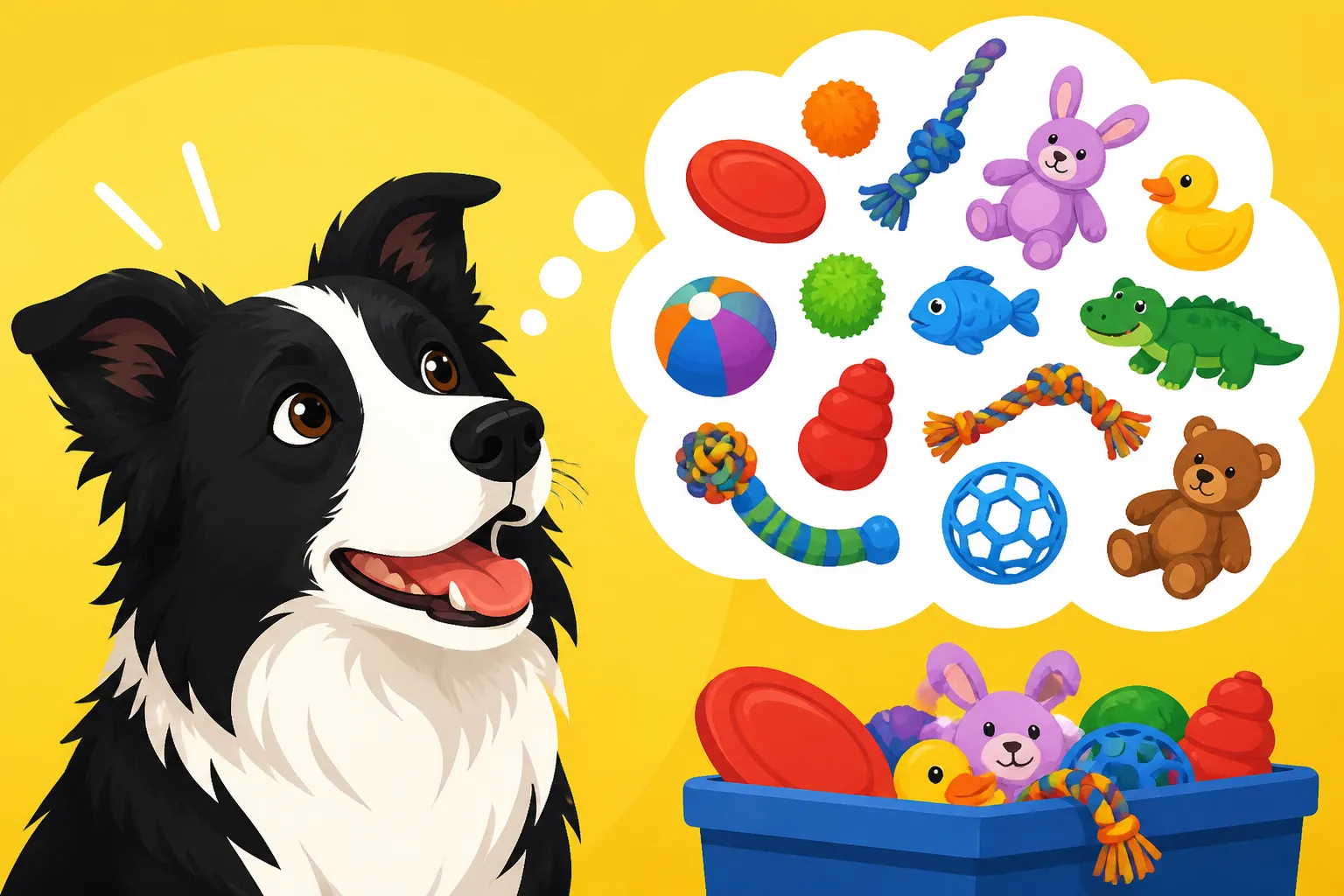
The toys need to be easy to tell apart. A red rubber ball and a blue plush duck are easier to distinguish than two nearly identical tennis balls. If you are browsing options at a retailer such as Chewy, focus on variety in shape, texture, and size rather than buying a large pile of toys all at once. A few clearly different objects make it easier to see whether the dog is learning the label or simply choosing by appearance.
Learning many objects without turning play into a test
Once a dog reliably recognizes one toy, you can introduce another. Keep the objects distinct, give each a consistent name, and practise in a calm setting before placing several choices together. If your dog is confused, go back to one toy or offer a choice between two. The goal is to build understanding gradually, not to see how many names you can fit into one session.
A simple routine might look like this:
- Choose one toy with a distinctive appearance.
- Say its name while showing it to your dog.
- Play briefly, repeating the name naturally.
- Put the toy down and ask for it by name.
- Reward a correct choice with play, praise, or another reward your dog enjoys.
- Add a second toy only after the first name is reasonably familiar.
- Practise choosing between the two, then change the toys’ positions.
Consistency matters more than making the lesson elaborate. If a family uses three different names for the same toy, the dog has a harder job. Decide together whether the object is “fox,” “plush fox,” or “squeaky,” and use that label consistently. As a toy wears out, replace it thoughtfully: when comparing potential replacements at Chewy or elsewhere, choose something close enough in shape and texture that the familiar name still makes sense to your dog.
What “learning a name” can mean
A dog’s accurate response to a word can come from more than one kind of learning. The dog may recognize the object’s label, notice a familiar routine, follow a person’s gaze, or respond to subtle body language. Those abilities are not failures; they are part of how dogs communicate and learn. But if you want to test whether the name itself is becoming meaningful, vary the setup gently.
For example, ask for the named toy when it is in a different place, or have another person make the request while standing neutrally. Keep the task fair. Avoid staring at the correct item or turning your shoulders toward it, since your dog may be reading those cues instead of relying on the spoken name. This connects with the broader topic of What a Border Collie Reads in a Handler's Body.
If your dog gets an answer wrong, do not assume the dog is being stubborn or has forgotten everything. The toy may look similar to another, the room may be distracting, or the cue may not yet be strong enough without your usual gestures. A quick return to an easier choice keeps the exercise enjoyable. For more ideas on introducing labels through everyday play, see Teaching a Border Collie the Names of Its Toys.
What Researchers Tested Beyond Toy Names
Choosing a named object from a group
A central part of Chaser’s work was her ability to retrieve a particular toy from a larger set. That is different from responding to a cue when only one object is available. If a person says “get the ball” while holding a ball and no other toys are present, the dog has little need to distinguish among objects. Offering multiple choices makes the request more informative.
Researchers also looked at whether Chaser could respond to an object name when the toy was unfamiliar or when the situation changed. Testing under varied conditions helps researchers ask whether a response is tied to a single memorized sequence. It is still important not to overstate what any one test proves: a dog can use several clues at once, and no single exercise can explain every part of how the dog reached the answer.
At home, you can make a gentle version of a choice task by placing two familiar toys a short distance apart and asking for one by name. Switch their positions between turns. If the dog consistently selects the right item without you pointing or leaning toward it, that is encouraging evidence that the label is becoming useful. Stop while the dog is still engaged, rather than turning each session into a long examination.
Learning through exclusion
Chaser also showed an ability associated with learning by exclusion: when faced with a known object and a new object, she could use a new label to identify the unfamiliar item. In simple terms, if she already knew one toy’s name and heard a different name while choosing between that toy and an unfamiliar one, she could infer that the new name referred to the new object.
This is a powerful way for learners to solve problems, but it does not mean a dog will always understand a new word from one exposure. A dog’s success may depend on the setup, prior experience, attention, and the clarity of the choices. At home, it is better to treat a one-time correct guess as an interesting moment rather than proof that the label is permanently learned.
For owners, the useful lesson is to give dogs opportunities to make sensible choices. If you introduce a new toy, let your dog inspect it and hear its name in a relaxed context. You can then see whether the dog begins to connect the sound with the object over several short sessions. If you need to replace a toy, a product listing at Chewy may help you check the size and material before choosing, but the learning itself comes from clear, repeated interaction—not from the toy’s brand or price.
What Border Collie Owners Can Take From Chaser’s Story
Build a small, useful vocabulary at your dog’s pace
Chaser’s achievements can inspire owners without setting an unrealistic benchmark. Most dogs do not need hundreds of toy names. A handful of reliable labels can be fun and practical: “ball,” “leash,” a favourite toy’s name, or the name of a familiar household item. Some Border Collies pick up these associations quickly; others may need more practice or may simply be less interested in naming games.
Keep the activity low-pressure. If your dog is excited by movement, a brief retrieve may be rewarding. If the dog prefers food, a small treat may help. If the dog loses interest after a few turns, finish and try again another time. Quick learning is not a contest, and a dog who needs more repetitions is not less connected to you. The related guide How Few Repetitions a Border Collie Needs explores why learning speed varies.
It can also help to make the task easier before making it harder. Begin with one object, then two; practise in a quiet room before trying in the yard; and use toys that look different from each other. If your dog is struggling, reduce distractions and reward attention. For dogs who are eager to work but have trouble settling afterward, toy-name games should be one small activity within a balanced routine, not an invitation to keep stimulating the dog indefinitely. Exercise, Work and What Actually Settles a Border Collie discusses that balance in more depth.
Keep the goal enrichment, not a genius test
Border Collies are often described as the smartest breed, but that label can create pressure for both dog and owner. Intelligence is not one single ability, and learning toy names is only one narrow measure. A dog’s welfare depends on sleep, security, movement, social connection, and opportunities to use its senses—not on how many words it can identify.
A naming game can provide mental engagement when it is enjoyable and well matched to the dog. It can also become frustrating if a person keeps increasing the difficulty after the dog has lost interest. Watch the dog rather than the score: relaxed body language, willingness to re-engage, and an eager return to the game are better signs than an impressive number of labels. For a wider discussion of the breed’s reputation, see Why the Border Collie Is Called the Smartest Breed and Whether a Border Collie Is Really the Smartest Breed.
It is perfectly reasonable to keep a small set of toys for these games and rotate them so the dog does not have to choose from a cluttered pile. When a toy becomes damaged, remove it if loose pieces could be swallowed. If you are looking through Chewy or a local shop for a replacement, check that the toy’s size and construction suit your individual dog and supervise play when needed. The point is not to recreate Chaser’s exact setup; it is to give your dog a clear, safe, and rewarding chance to learn.
Chaser’s story is memorable because it shows what patient training and careful observation can reveal about a dog. Her accomplishments do not mean every Border Collie should know a thousand names, or that a dog’s intelligence can be reduced to vocabulary. They show how much a dog may learn when words are connected to meaningful experiences, the task is made clear, and learning remains enjoyable.
Disclaimer
This article is for general informational purposes only and does not constitute professional advice. Laws, prices and regulations vary by location and change over time. Consult a qualified professional for guidance on your specific situation.