What a Border Collie Reads in a Handler’s Body
A Border Collie may respond to a shoulder turn, a glance, or a pause before you have said a word. That can feel uncanny when you meant to stand casually, then frustrating when your dog races off as you try to give a cue. This guide explains the body signals Border Collies notice, why mixed signals cause confusion, and how to make your own movement easier to understand.
Why a Border Collie Watches Your Body
Movement can speak before a cue does
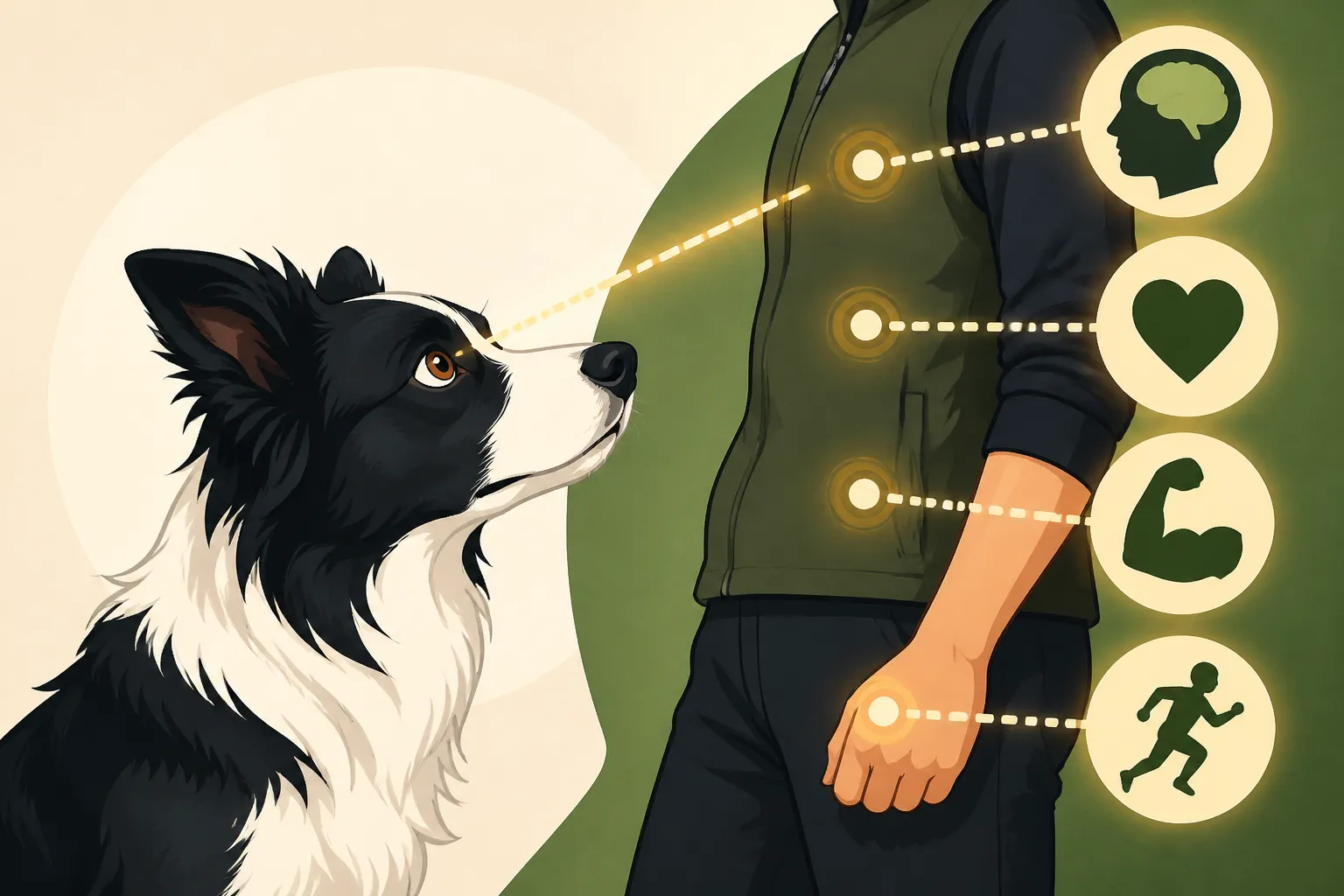
Dogs pay close attention to movement, and Border Collies are especially quick to notice small changes in a person’s posture and direction. A step toward a gate, a turn of your shoulders, or a hand moving toward a pocket can all suggest what may happen next. Your dog is not necessarily interpreting these movements as a human would. Rather, it is learning which details tend to predict an opportunity, instruction, or change in activity.
This can be useful. If you shift your weight toward a gate and your dog moves ahead of you, it may have learned that this posture usually comes before leaving the yard. It can also be inconvenient: you might lean forward to reach for a dropped leash, only to find your dog has already launched into motion. The dog’s response may look disobedient, even though your movement has become a cue through repetition.
Gaze and head position can matter, too. A direct look, a quick glance toward a toy, or turning your face toward a doorway may attract your dog’s attention. Some Border Collies also use a focused gaze of their own when they are anticipating movement or trying to influence what happens next. For more context on that intense expression, see The Border Collie Stare and Where It Comes From and The Eye That Sets a Border Collie Apart.
Your posture can change what a cue means
A spoken cue does not arrive in isolation. Your dog hears the word while also watching how you stand, where you face, how quickly you move, and what your hands are doing. If those signals point in different directions, the dog may respond to the clearest or most familiar one rather than the word you intended.
Imagine asking your dog to stay while you lean forward, turn toward the door, and reach for the handle. Your voice says “stay,” but your body may resemble the beginning of a departure routine. A dog that rises may not be choosing to ignore you. It may be responding to a pattern you have unintentionally rehearsed many times.
This is one reason a dog can perform a behavior beautifully in one setting and seem to forget it in another. In the kitchen, you may stand squarely in front of your dog with a treat ready. On a walk, you might give the same cue while twisting around, holding a leash, and looking toward a cyclist. The word is familiar, but the picture has changed. A Border Collie may need practice understanding that the cue means the same thing across those different pictures.
The Body Signals Border Collies Commonly Notice
Direction, balance, and the space around you
Your shoulders and feet often reveal where you are about to go. If your chest faces a path while your feet point another way, your dog may watch your whole posture and wait for the clearer movement. A turn of the torso, a step to one side, or a change in your pace can all be meaningful, especially when your dog is already alert and expecting an activity.
Balance matters because weight shifts usually precede movement. When you rock forward, your dog may anticipate that you are about to walk, throw a ball, or open a gate. When you stop abruptly, the sudden change can draw attention or prompt a stop of its own. Around sheep or other moving animals, a handler’s position and approach can influence how a dog moves and how much pressure it applies. This is a skilled, context-dependent interaction—not a reason to use body pressure without appropriate instruction.
Space can also carry information. A person stepping toward a dog may invite movement, block a route, or feel threatening, depending on the dog and situation. Turning sideways and softening your stance may make an interaction feel less intense. If your dog crouches, freezes, or stares, look at the whole situation rather than assuming it is simply being stubborn. Why a Border Collie Crouches and Stares explores how that posture can show up in different contexts.
Hands, pockets, and the familiar training setup
Hands become powerful signals because they often predict rewards, toys, leash handling, or physical guidance. If a treat appears from your right pocket every time your dog sits, your dog may start watching that pocket more closely than listening to the cue. A hand moving over the dog’s head can also have a different effect from a hand held low and still, even if you use the same spoken instruction.
This is not a flaw in the dog. It is ordinary learning. If a particular gesture reliably comes before food or play, the dog will notice the pattern. The practical challenge is to avoid letting a gesture accidentally become the only prompt your dog understands. For example, if you want your dog to lie down on a verbal cue, say the cue before making your usual downward hand motion. Gradually make the hand signal smaller, then try the word without the gesture in a quiet setting.
When rewards are part of your training, make them easy to access without turning every reach into a clue. A treat pouch can help keep rewards close at hand; if you already shop at Chewy, you may find it convenient to compare pouch styles there with those at a local pet supply shop. The point is not the particular retailer or pouch. It is to keep your hands calm and your reward delivery consistent enough that your dog can learn the behavior rather than simply follow the visible food.
| What you do | What your dog may notice | A clearer option |
|---|---|---|
| Lean forward while asking for a stay | A familiar signal that movement is about to begin | Stand neutrally, give the cue, then release deliberately |
| Turn your shoulders toward the door | A possible invitation to follow | Face your dog when giving the cue, then turn after the response |
| Reach toward a pocket before a recall | The hand movement may predict a reward more than the word | Give the recall cue first, then reach for the reward after your dog responds |
| Repeat a cue while stepping backward | Your movement may become the strongest prompt | Practice the cue with small, consistent movements before adding distance |
| Stare at your dog while asking for a settle | Sustained attention may keep the dog alert | Relax your gaze and reward quiet behavior without hovering |
How to Make Your Signals Easier to Read
Build one clear picture at a time
Start in a quiet place where your dog can focus without competing distractions. Choose one behavior, such as coming to you or settling on a mat, and decide what you want your body to do when you give the cue. Keep your feet, shoulders, hands, and voice as consistent as you reasonably can.
Give the cue once, then allow your dog a moment to respond. If you immediately repeat the word, wave your hands, lean forward, and step toward the dog, it becomes difficult to know which part helped. It can also teach the dog to wait until the cue has been repeated or reinforced with a gesture. If your dog is unsure, make the task easier rather than adding a flurry of signals.
For example, when teaching a mat settle, begin close to the mat and use a calm, repeatable routine. Reward your dog for moving onto it and for relaxing there, then add duration gradually. Avoid leaning over the dog or repeatedly pointing at the mat if your goal is for the verbal cue to become meaningful. Settling a Border Collie on a Mat offers a related look at building calm behavior in a way that does not depend on constant prompting.
Separate the cue from the movement that follows it
Sometimes you need to move while your dog is responding. That is a useful skill, but it is easier to teach after your dog understands the cue in a simpler setup. First practice while standing still. Then add a small movement, such as turning your head or taking one step, and reward the response. Increase the challenge slowly so the dog can learn that the cue still matters when your body changes.
A recall is a good example. If you call your dog only while running backward with open arms, those actions may become part of the recall picture. That may work in some situations, but it can leave you without a dependable response when you cannot move that way. Practice the cue in safe, controlled settings with varied but modest body positions. Reward the return generously, and use a long line where needed to prevent a rehearsal of running off. For more on building reliability around movement and distractions, see Building a Border Collie Recall Against Moving Things.
If your dog is learning at speed, resist the temptation to add more repetitions just because it seems clever. A dog may quickly memorize a pattern without understanding the cue in a new context. Short sessions with small changes often show more than many repetitions in exactly the same spot. How Few Repetitions a Border Collie Needs and The Border Collie That Learns Faster Than You Teach are useful related reads on learning and practice.
When Body Reading Becomes Confusing
Notice when your dog is responding to the wrong part
A useful way to troubleshoot is to change one detail at a time. If your dog sits only when you bend at the waist, try standing more upright while giving the same cue. If it comes only when you clap, try the verbal cue without clapping in a quiet space. If it waits reliably until you turn toward the door, practice the stay while you make a small, different movement.
Keep the setup easy enough that your dog can succeed. If you remove a familiar gesture and immediately add distance, noise, other dogs, and a moving toy, a missed response tells you very little. Break the challenge into pieces: first change your stance, then add a little distance, then practice somewhere slightly busier. This careful progression helps distinguish confusion from distraction, overexcitement, or a cue that has not yet been taught in that context.
Watch for signs that the dog is struggling rather than simply choosing not to respond. It may hesitate, look repeatedly between your face and hands, offer a different behavior, or become more excited as you repeat yourself. Pause, simplify the task, and reward a clear attempt. If your dog’s behavior changes suddenly, or you see signs of fear or discomfort, consider health and welfare factors as well as training.
Keep movement and exercise from becoming constant pressure
A Border Collie that watches its person closely can become highly responsive, but that does not mean it needs to be directed every moment of the day. Constantly pointing, calling, waving toys, and asking for behaviors can leave some dogs keyed up rather than settled. Clear communication includes knowing when not to give another cue.
Use a predictable end to activities. A release word, a calm walk back to the car, or a quiet rest on a mat can help mark the transition from work to downtime. Build pauses into play and training rather than letting every movement from you signal that the next exciting event is about to start. The broader balance between activity and rest is covered in Exercise, Work and What Actually Settles a Border Collie and Why Walking a Border Collie Is Not Enough.
Equipment can support a routine, but it cannot replace clear teaching. A leash or long line can help you manage distance safely while practicing; if you are choosing one, Chewy is one possible place to look alongside local retailers, with attention to fit, condition, and your dog’s needs. A tug toy can be useful for rewards in some training plans, and Chewy may also be a convenient option if you are already ordering pet supplies there. Whatever you use, keep the reward out of sight when possible and deliver it after the behavior, so your dog learns what earned it rather than simply tracking the object.
A Border Collie reading your posture is not necessarily trying to outsmart you. It is noticing patterns and responding to the details that have mattered before. When you make your cues and movements more consistent, then gradually practice them in varied situations, you give your dog a clearer job: attend to the cue you intended, not just the hand, shoulder, pocket, or hurried step that happened to come with it.
Disclaimer
This article is for general informational purposes only and does not constitute professional advice. Laws, prices and regulations vary by location and change over time. Consult a qualified professional for guidance on your specific situation.