Reading Trial Wins on a Border Collie Pedigree
A Border Collie pedigree full of trial wins can look impressive, but a long list of ribbons does not tell you everything about the dog behind the names. The useful questions are who handled the dog, what kind of trial it competed in, how consistently it performed, and whether its qualities fit your home or working plans. This guide explains how to read those records without mistaking success for a guarantee.
What a trial win on a pedigree actually tells you
A sheepdog trial is a practical test of a dog’s ability to move sheep in a controlled way under a handler’s direction. The details differ between organizations and events, but a run commonly involves the dog gathering sheep, bringing them toward the handler, and completing one or more tasks such as driving, shedding, or penning. To understand what a win represents, it helps to know what the course asks a dog to do. The Border Collie in Sheepdog Trials offers useful background on the setting and purpose of these competitions.
A win belongs to a dog-handler team
A trial result is not a score for the dog in isolation. It reflects the dog’s instincts, training, steadiness, and responsiveness, as well as the handler’s timing, judgment, and partnership with that particular dog. A gifted dog may look ordinary with a handler who is still learning, while a skilled handler can help a capable dog show its strengths.
That matters when you see a celebrated name in a pedigree. Ask whether the dog earned its record with one handler over many seasons, or whether the result came in a short period with a particularly experienced partner. Neither situation makes the dog’s achievement less real, but the context helps you understand what the record can and cannot show about inherited ability.
A trial record also tells you about performance in a particular environment: the sheep, field, course, weather, and competition. A win on a challenging course may be especially informative, but the pedigree alone rarely explains those conditions. If you are considering a puppy, ask the breeder what the dog was like to live and work with outside the competition field, too.
Different stages and tasks reveal different strengths
A dog’s result may come from a nursery or novice class, an open class, or another division used by the organization running the event. These labels are not interchangeable, and rules can vary. A win in a young-dog class may show promise and good training, but it does not necessarily mean the dog has demonstrated the same experience or consistency as a seasoned open competitor.
Look at the type of course and the parts of the run the dog handled well. A long, controlled gather can highlight balance and the ability to work at a distance. Driving tests whether the dog can move sheep away from the handler in a useful line. A shed or pen asks for careful control in close quarters. The Outrun a Border Collie Runs at a Trial, What Judges Score on a Border Collie's Lift, and The Shed and Pen at the End of a Border Collie's Run explain why different portions of a course call for different skills.
A single win is a snapshot. A pattern of strong performances across different fields, sheep, and conditions can offer a more rounded picture. Still, even a consistent record describes what a dog has done, not exactly what every puppy in its family will do.
Trial names and titles need their own context
Pedigrees may show event names, placements, titles, abbreviations, or shorthand added by a breeder or registry. Do not assume every abbreviation means the same thing across countries or organizations. If an entry is unclear, ask who awarded the title, what class it refers to, and whether it records a win, a qualification, or another kind of achievement.
It is also worth distinguishing a trial result from a registered title. Some pedigrees list a dog’s competition accomplishments in a separate notes section; others include formal titles or abbreviations after a registered name. A title can be useful evidence, but it does not replace checking the underlying record where that information is available.
How to read the names and results in a pedigree
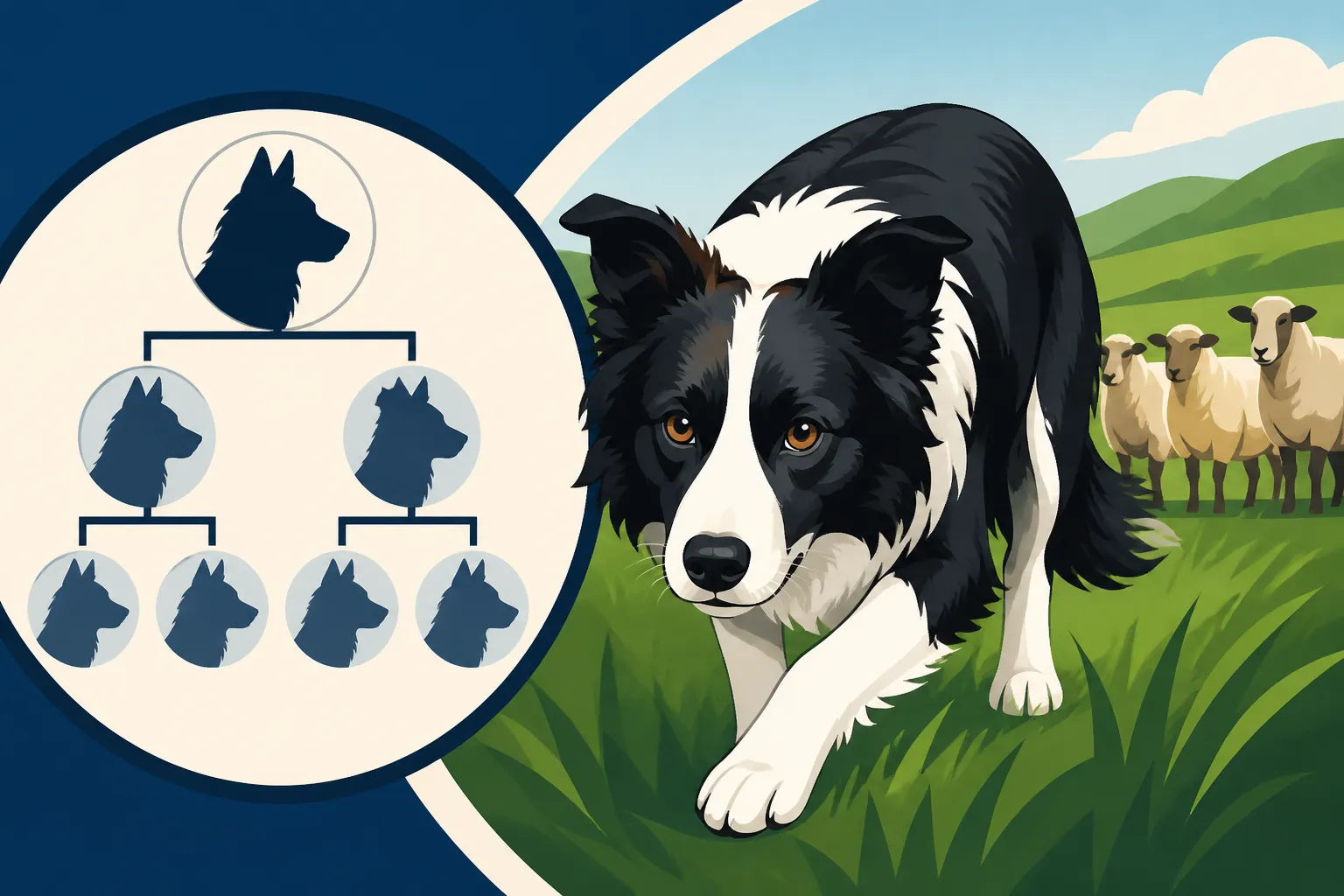
A pedigree shows relationships across generations. It may list the sire and dam, grandparents, and more distant ancestors, sometimes alongside trial records, health results, or breeder notes. Start with the dogs closest to the puppy rather than scanning for the biggest name on the page. The Working and Show Split in Border Collies can help explain why different breeders may prioritize different qualities when selecting dogs.
Start with the parents, then follow the family pattern
Look first at the puppy’s sire and dam. What work have they done? Have they competed themselves, or are their records mainly represented through their relatives? A parent’s direct record gives you information about that individual, while the records of grandparents and siblings may suggest patterns across a family.
Then look sideways, not only upward. Littermates and half-siblings can sometimes tell you more about how traits appear within a family than a famous ancestor several generations back. Ask the breeder what the close relatives are like in everyday work and home life: are they confident, biddable, thoughtful, easily excited, or difficult to settle? Practical descriptions are more useful than simply hearing that a dog is “full of drive.”
Here is a hypothetical example. Suppose a puppy’s grandsire won a major trial, but neither parent has been worked or assessed on sheep. That ancestor’s record is relevant, but it does not establish how the puppy’s parents behave or what they may pass on. By contrast, parents with modest competition records may still be useful breeding dogs if their working ability, temperament, and health suit the breeder’s goals.
Separate individual fame from repeated evidence
A celebrated dog can appear repeatedly in a pedigree because it had many offspring or because its descendants were bred widely. That repeated appearance may be meaningful, but it is not the same as several independent lines of evidence. If the same ancestor appears in multiple places, ask how closely related the parents are and why the breeder chose that pairing.
A pedigree with multiple trial-winning relatives can suggest that working ability has been valued in the family. It does not prove that every descendant will have the same style, stamina, confidence, or ease of training. Inherited traits are shaped by many genes, and development, training, health, and experience all matter.
Try to get concrete descriptions. “There are lots of champions” is less useful than “both parents have worked stock, the dam is calm in a busy yard, and her adult offspring have shown good control at a distance.” A breeder who knows the family should be able to explain what they were trying to preserve and what differences they see between relatives.
Read results as a timeline, not a trophy count
When records are available, note the dog’s age, the years it competed, the number and type of events, and whether the results were spread over time. A dog that places well repeatedly over several seasons may have demonstrated consistency. A single high finish can still be an impressive achievement, but it provides less information about performance across changing conditions.
Consider the difference between “won once” and “regularly completed demanding courses at a high level.” The second description raises further questions: how many events, what level of competition, and were the results achieved with one handler or several? The aim is not to dismiss any accomplishment. It is to understand the evidence behind it.
Results can also be affected by factors that a pedigree does not capture: an injury, a handler’s schedule, limited access to trials, or a dog’s suitability for a particular kind of course. A short record may reflect circumstances rather than lack of ability. Ask open questions before drawing conclusions.
| Pedigree detail | What it may suggest | What to ask next |
|---|---|---|
| A parent’s own trial results | The parent has been tested in competition | What kind of work and courses were involved? |
| Several successful close relatives | Working ability may be valued across the family | How do the relatives differ in temperament and style? |
| One famous ancestor | A notable dog appears in the lineage | How close is the relationship, and what did the parents inherit in practice? |
| A title or abbreviation | A recognized achievement may be recorded | Which organization awarded it, and what does it mean there? |
| Few or no results | The dog may not have competed, or records may be incomplete | Has it been worked or assessed outside trials? |
What trial success does not guarantee
Trial records can be valuable, especially when you are choosing a working prospect. But they are only one part of the decision. A pedigree cannot promise that a puppy will become a trial winner, suit a particular job, or fit comfortably into a household. Whether a Pet Border Collie Could Ever Trial is a helpful reminder that potential and competitive outcome are different things.
A successful ancestor does not guarantee a successful puppy
Puppies inherit a mix of traits from both parents, and littermates can differ substantially. One may be highly responsive and quick to learn; another may be more independent or intense. Even when working ability is strongly valued in a family, the particular combination of traits in one puppy is not predictable from a list of wins alone.
The environment matters too. A young dog needs suitable exposure, thoughtful training, physical development, and opportunities to learn around stock. An owner who wants a companion may not have the time, facilities, or interest to develop a dog for competition. A puppy with working-line ancestry may still have needs that are challenging in a busy home, whether or not it ever sees sheep.
That is why it is worth asking what the breeder expects from the litter. Are the puppies being placed primarily as working prospects, sport dogs, or companions? What kind of home does the breeder believe will suit each puppy? A clear, realistic answer is more useful than a promise that a puppy will “be just like” a famous ancestor.
Trial wins do not tell you everything about temperament or health
Competition results can show that a dog performed under pressure, but they do not provide a complete picture of its behavior at home, around unfamiliar people, or in ordinary daily routines. Ask about how the parents settle after work, respond to handling, and cope with noise, travel, or changes in routine. A dog that is brilliant on stock may still need a very structured home.
Likewise, trial success is not a substitute for health information. Ask what health testing is relevant to the family and request the actual results rather than relying on general assurances. Which Test Results a Border Collie Breeder Should Show can help you prepare questions, and The Border Collie Genetic Panel and What It Screens explains why genetic screening is only one part of a broader health picture.
If a seller emphasizes wins but avoids questions about health, temperament, or the dogs’ daily lives, pause. A pedigree is a starting point for discussion, not proof that a breeding decision was responsible. You can also ask what support is available if the dog’s needs turn out to be different from what you expected.
Questions to ask before choosing a puppy
The most useful conversation combines the pedigree with the breeder’s firsthand knowledge. A careful breeder should be able to talk about the dogs as individuals, explain the purpose of the pairing, and help you decide whether the litter matches your plans. Buying a Border Collie From a Trial Handler's Kennel and What a Border Collie Breeder's Contract Usually Requires offer related considerations when assessing a breeder and the arrangements around a puppy.
Ask for specifics about the record
Instead of asking only whether the parents or grandparents have won, ask for the event names, classes, dates, and results. If records are not printed on the pedigree, ask where they can be checked. Find out whether the dogs competed themselves or whether the accomplishments belong to their relatives.
You might ask: “Which result are you most proud of, and what made that run difficult?” or “How did the dog perform across more than one season?” These questions invite detail. A knowledgeable handler can often explain the dog’s strengths and limitations, such as a strong outrun but less experience in close work.
Also ask what the breeder values beyond the scoreboard. A dog may be selected for soundness, stock sense, composure, or a particular style of working, even if its competition record is limited. Those choices should make sense in light of the breeder’s goals and the kind of puppy you want.
Match the pedigree to your own plans
Be honest about what you want the dog to do. If you have sheep and plan to train regularly, trial records may help you identify families with proven working ability, but you will still need instruction and a realistic development plan. If you want a family companion, ask whether the breeder has placed related dogs in similar homes and what their everyday needs are.
A pedigree packed with accomplished working dogs may be exciting, but it can also point toward a dog that needs structured activity and clear boundaries. That does not make the dog unsuitable for a non-farm home; it means you should ask how the family’s drive and intensity are managed in practice. A large yard alone does not answer that question.
Before deciding, compare the pedigree with the puppy’s observed behavior, the parents’ temperaments, health information, and the breeder’s guidance. A trial win is a useful clue, not a verdict. The strongest choice is the dog whose likely needs and qualities fit the life you can genuinely provide.
Disclaimer
This article is for general informational purposes only and does not constitute professional advice. Laws, prices and regulations vary by location and change over time. Consult a qualified professional for guidance on your specific situation.