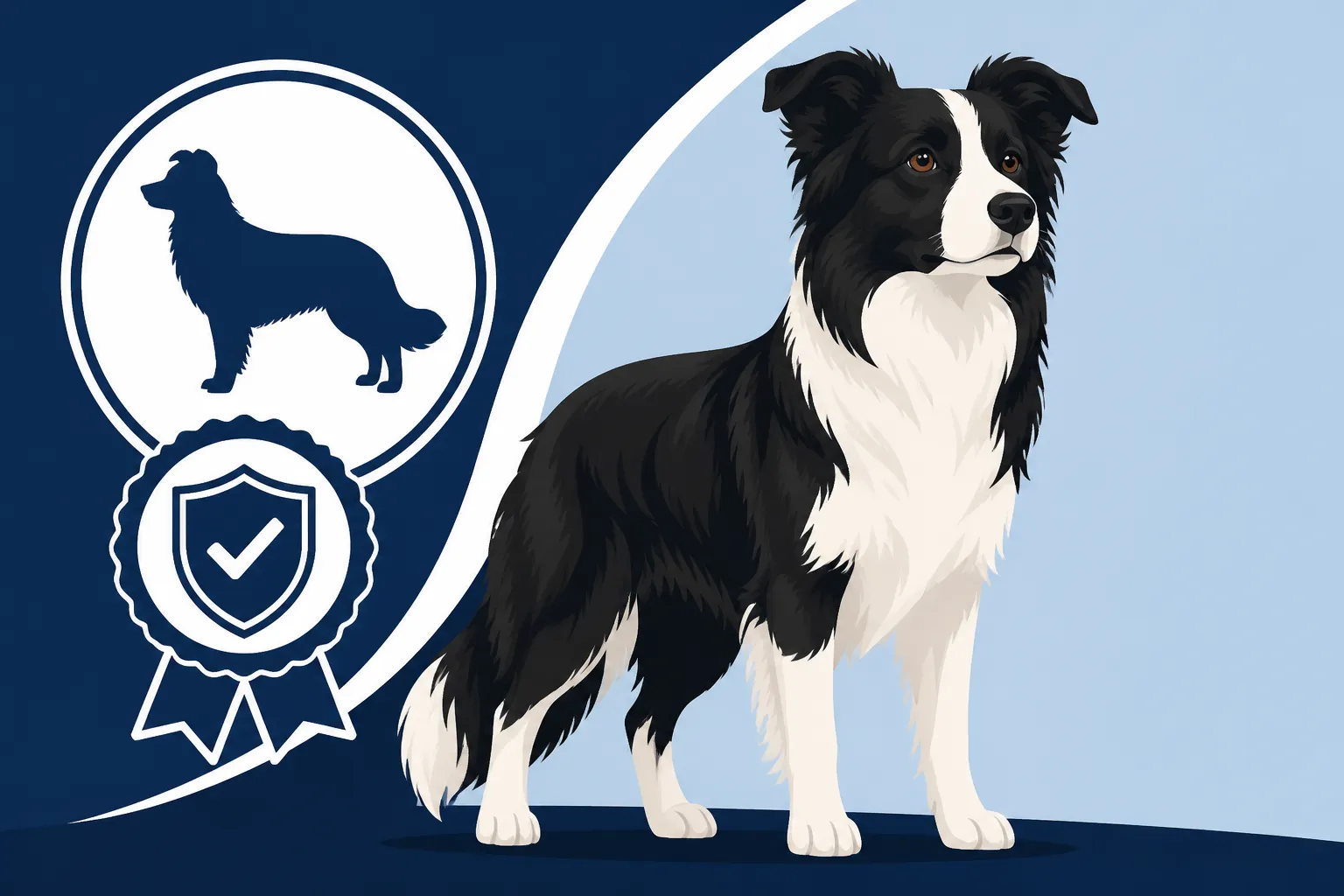
What the AKC Standard Says a Border Collie Is
When you first fall in love with the idea of a Border Collie, you likely envision a blur of black and white, intensely focused on a flock of sheep, or perhaps leaping gracefully over agility obstacles. Many people, myself included, are surprised to learn there's an official "standard" for the breed, laid out by organizations like the American Kennel Club (AKC), which defines what an ideal Border Collie looks like in the show ring. This can be a bit of a head-scratcher, as Border Collies are so synonymous with their work. If you're wondering what criteria the AKC uses to describe this remarkable breed, and how that might differ from the rough-and-tumble working dog we often picture, you've come to the right place. This guide will meticulously unpack the AKC standard, giving you a detailed understanding of its nuances and what it truly means for our clever companions.
The Journey to AKC Recognition and Its Impact
The Border Collie's path to formal recognition by the American Kennel Club was anything but smooth. For decades, the breed existed primarily as a working partner on farms and ranches, its value measured purely by its ability to gather and control livestock. The idea of judging these dogs on their appearance felt, to many, like a distraction from their true purpose.
A Contentious Debut: The 1995 Decision
The decision by the AKC to grant full recognition to the Border Collie in 1995 was met with significant resistance from a large segment of the working Border Collie community. For generations, these dogs had been bred exclusively for their herding ability, intelligence, and stamina, with little to no regard for a standardized physical appearance. Their health and temperament were, of course, important, but always in the context of their job. The thought of breeders suddenly prioritizing aesthetics – the length of a feathering, the set of an ear, the exact shade of a coat – over these critical working traits was deeply alarming.
Many working dog enthusiasts feared that the introduction of a conformation standard would lead to a dilution of the breed's core instincts. They worried that breeding for looks in the show ring would inadvertently breed out the very drive, "eye," and biddability that made the Border Collie the world's premier sheepdog. They had seen what happened to other working breeds once they entered the show ring, often leading to a divide where show lines no longer possessed the intense working capability of their ancestors. This wasn't just a minor disagreement; it was a fundamental clash over the identity and future of the breed. For a deeper dive into this historical moment, you can read about The 1995 AKC Decision on the Border Collie.
The intensity of this concern led to a significant split within the Border Collie community. Organizations like the American Border Collie Association (ABCA) stood firm in their commitment to registering dogs based solely on working ability and proven lineage, explicitly prohibiting the registration of dogs with AKC conformation titles. This wasn't merely about paperwork; it was a philosophical statement, designed to safeguard the breed's working heritage. The ABCA, among others, felt that recognizing a show standard would compromise the very essence of the Border Collie. The arguments and concerns of the working community are well-documented in pieces like Why Working Breeders Fought AKC Recognition. It highlighted a chasm between two very different visions for the breed.
Navigating Two Standards: Working vs. Conformation
Today, we effectively operate with two distinct "standards" for Border Collies. On one side, you have the informal, performance-driven standard of the working dog world, where a dog's value is determined by its ability to manage livestock with skill, precision, and tireless effort. This "standard" is fluid, passed down through generations of handlers, and constantly refined in the crucible of real-world work and competitive sheepdog trials. There's no written document defining the perfect "working look," only the proven ability in the field.
On the other side is the written, aesthetic-focused AKC standard, which meticulously describes the physical characteristics deemed ideal for the breed. While the AKC standard does acknowledge the Border Collie's working heritage and describes a dog built for activity, its primary method of evaluation is visual, focusing on how closely a dog conforms to a set of physical ideals in a static pose and a structured gait. A dog that excels in the show ring might have beautiful structure and a lovely temperament, but not necessarily the intense "eye" or profound stock sense required for top-level herding. Conversely, a phenomenal working dog might possess a slightly different ear set or a less "showy" coat that wouldn't necessarily place well in conformation.
This divergence means that prospective owners often need to consider which "standard" aligns with their goals. If you're looking for a dog to compete in sheepdog trials or work livestock on a farm, you'll likely seek out breeders who prioritize working lines and register their dogs with organizations focused solely on performance. These breeders will emphasize proven working pedigrees and instinct tests. However, if your interest lies in other dog sports like agility, obedience, or simply a well-structured, intelligent companion, then an AKC-registered Border Collie from a breeder focused on the conformation standard and companion dog sports might be a perfect fit. Both types of dogs are still Border Collies, but their breeding priorities, and thus their specific traits, can lean in different directions.
General Impression and Temperament Defined
When a Border Collie enters the show ring, the judge's first impression is paramount. The AKC standard begins by describing this overall picture, emphasizing both the physical silhouette and the intrinsic character that defines the breed. It’s about more than just individual parts; it’s about the harmonious whole.
The Overall Athletic and Intelligent Silhouette
The AKC standard paints a picture of a Border Collie as a "well-balanced, medium-sized dog of athletic appearance, displaying style and agility, and demonstrating stamina, with a keen and intelligent expression." This is the core impression judges are looking for. It's not about being overly large or bulky; rather, it’s about a sleek, powerful build that suggests capability for sustained effort and quick, agile movements. Think of a marathon runner crossed with a gymnast – ready to go, and able to do so efficiently.
This initial impression is critical because it sets the stage for the rest of the evaluation. Judges want to see that quintessential Border Collie "essence" even before the dog takes a single step. The dog should look alert, ready, and eager, with intelligence shining in its eyes. The body should be presented in a way that implies both grace and resilience, reflecting its history as a tireless worker. The standard outlines an animal that, even when standing still, conveys a sense of controlled power and mental acuity. It's the first thing that strikes you – that seamless blend of physical prowess and undeniable brainpower. The standard specifies a height range, with males typically 19-22 inches at the shoulder and females 18-21 inches. A Border Collie that is either substantially undersized or oversized would be considered a fault in the conformation ring, as it deviates from this athletic ideal.
Despite the necessary focus on appearance in the show ring, the AKC standard firmly anchors these physical descriptions in the breed's historical role. It states that the structure should "suggest" and allow for the dog to perform its original work – that of gathering and controlling sheep. While show dogs aren't tested on actual sheep, their physical build should embody the functional requirements of such demanding work. This means a body that's built for endurance, quick turns, and sustained movement over varied terrain. Every aspect of the physical description, from the depth of chest to the angle of the shoulders, is ultimately linked to this functional ideal. To learn more about what this athletic build entails, read The Athletic Build a Border Collie Standard Describes.
The Border Collie Temperament: Keen, Alert, and Receptive
Beyond the physical, the AKC standard dedicates significant attention to the Border Collie's temperament, which is, arguably, the breed's most defining characteristic. The standard describes the ideal temperament as "keen, alert, responsive, and intelligent." These words resonate deeply with anyone who has ever owned or worked with a Border Collie. This breed's mind is always active, always observing, always trying to figure out its environment and its handler's intentions.
For a show dog, this translates into a specific set of behaviors in the ring. The dog should be confident and self-possessed, never showing aggression towards people or other dogs. Equally important, it should not be excessively shy or nervous. A dog that cowers, shies away from the judge, or exhibits undue fear would be penalized, as this indicates a deviation from the desired stable and confident disposition. The ideal show Border Collie is biddable and cooperative, willing to work with its handler, and able to maintain its composure amidst the bustling environment of a dog show. It should exude an eager-to-please attitude, reflecting its innate desire to collaborate.
While a working Border Collie might exhibit an intense, almost obsessive focus on sheep, the show ring calls for a slightly different manifestation of their intelligence. The show dog needs to be intelligent enough to understand and respond to its handler's cues, to stand attentively for examination, and to perform its gait patterns with precision. The underlying mental sharpness is a common thread that runs through both working and show lines; it's just expressed in different contexts. A Border Collie, regardless of its primary role, thrives on mental stimulation, something that can be provided through engaging toys, training sessions, or even interactive feeders that you might find on Chewy. Their keen intellect requires an outlet, and the temperament described in the AKC standard ensures they are receptive to such endeavors.
Ideal Structure: From Nose to Tail
The AKC standard meticulously details the Border Collie's physical structure, breaking down the ideal characteristics from its intelligent gaze to its powerful hindquarters. Each element is described with an eye towards both aesthetic balance and functional efficiency.
Head, Eyes, and Ears: The Expression of Intelligence
The head of a Border Collie, as outlined by the AKC standard, is one of its most expressive features. It should be "moderate in width, with a distinct, but not exaggerated, stop." The muzzle should taper slightly to a strong nose, which can be black or, in blue or brown dogs, match the coat pigment. A weak or snipey muzzle would be considered undesirable, as it suggests a lack of power in the jaw. The overall impression of the head should be one of refinement without fragility, reflecting the breed's intelligence.
The eyes are perhaps the most captivating aspect of the Border Collie's head, often described as the "window to their soul." The AKC standard specifies that they should be "oval in shape, of moderate size, set well apart, and normally brown in color." However, for merle-colored dogs, one or both eyes may be blue, or flecked with blue, which is acceptable. The expression of the eyes is paramount: it should always be "intelligent, alert, keen, and eager." This is where the Border Collie's famous "eye," or intense stare, truly comes through, even in a non-working context. A dull or distant expression would be a significant fault, as it would contradict the very essence of the breed. For a deeper understanding of variations, you can look into Eye Color in a Border Collie.
The ears of a Border Collie are also quite distinctive and contribute significantly to its alert appearance. The standard describes them as being "of medium size, set well apart, and carried either erect or semi-erect (half-pricked)." It's interesting to note that this allows for a degree of variation, meaning that whether a Border Collie's ears stand straight up like a German Shepherd's or fold slightly at the tip like a Collie's, both are acceptable within the standard. This flexibility reflects the historical diversity within working lines. Regardless of the exact carriage, the ears should be mobile and responsive, further emphasizing the dog's keen awareness of its surroundings.
Body Build: A Frame for Endurance
Moving from the head, the AKC standard describes a body built for both strength and agility, providing a functional framework for the breed's demanding work. The neck should be "of good length, strong and muscular, slightly arched and tapering from the shoulders to the head." This strong neck allows for fluid movement and the ability to carry out various tasks. It should flow smoothly into the shoulders, which are "well laid back," providing the necessary angles for efficient reach and drive in movement.
The topline of the Border Collie is another critical structural element. The standard calls for a "level back, broadening slightly over the loins." This level topline, when combined with a strong, muscular loin, provides the power and flexibility needed for quick turns and sustained effort. The chest should be "deep and moderately broad," with well-sprung ribs that extend well back. This depth and spring of rib are crucial for providing ample lung capacity, allowing the Border Collie to maintain high levels of activity without tiring quickly. However, the chest should not be so broad as to impede agility, striking a balance between power and maneuverability.
The hindquarters are described as "broad and muscular, with the croup sloping gracefully to the tail." This musculature provides the powerful drive necessary for a working dog. The forelegs and hindlegs should be straight and parallel when viewed from the front or rear, with good bone. The feet are "oval in shape, with deep, well-padded pads and strong, close-knit toes," essential for gripping varied terrain. Finally, the tail is "moderately long, set low, and ideally carried low, sweeping upward slightly when the dog is excited or working, but never carried over the back." This low-set tail contributes to the overall balanced silhouette and reflects the dog's relaxed, yet alert, posture when focused. Every aspect of the body's construction, from the strong neck to the well-padded feet, speaks to a design for enduring and athletic performance.
Coat and Color Guidelines
One of the most visually striking aspects of the Border Collie is its coat, which comes in a variety of colors and two distinct textures. The AKC standard details both, emphasizing protection from the elements and a certain aesthetic harmony.
Rough and Smooth: The Two Acceptable Coats
The AKC standard officially recognizes two coat types for the Border Collie: the "rough" coat and the "smooth" coat. Both types are double coats, meaning they have a soft, dense undercoat that provides insulation against cold and heat, and a coarser outer coat that offers protection from rain, snow, and brush. This double layer is essential for a dog historically exposed to varied weather conditions while working outdoors.
The "rough" coat is perhaps the most widely recognized Border Collie look. It is described as being "of medium length, with feathering on the forelegs, thighs, and chest, and a moderate mane or ruff around the neck." This coat gives the dog a slightly shaggy, yet still tidy, appearance. The hair should be dense and resistant to the weather, never soft, silky, or woolly, which would compromise its protective qualities. While this coat requires regular grooming, especially during seasonal shedding, it's not meant to be excessive or prone to matting if cared for properly. Many owners find brushes and grooming supplies from Chewy helpful for maintaining this beautiful coat.
In contrast, the "smooth" coat is considerably shorter, being "short all over, but still dense and weather-resistant." While lacking the extensive feathering of the rough coat, it still possesses a protective undercoat. Some smooth-coated Border Collies may have a slight amount of feathering on their legs or tail, but it is much less pronounced. The smooth coat is often favored by working handlers in certain climates or types of terrain, as it can be easier to keep clean and free of burrs and debris. The AKC standard is clear that neither coat type is inherently preferred over the other in the show ring; judges are looking for the quality and correct texture for the specific coat type presented. Both rough and smooth coats are equally valid representations of the breed, reflecting the practical needs of working dogs in different environments. For more on these differences, check out The Rough and Smooth Border Collie Coats.
Permissible Colors and Markings
The Border Collie comes in a surprising array of colors, and the AKC standard embraces this diversity, with one crucial stipulation: "any color or combination of colors is permissible, with the exception that white should not predominate." This means that while black and white is the iconic image of the breed, you'll also find Border Collies in red and white, blue and white, sable, brown, tricolor (black, white, and tan), and merle patterns, among others. The richness and variety of colors add to the breed's appeal.
The standard also addresses white markings. Typically, these markings appear as a blaze on the face, a collar around the neck, a chest patch, white on the legs and feet, and a white tip on the tail. These patterns are common and aesthetically pleasing. However, the caveat "white should not predominate" is significant. Dogs with an excessive amount of white, especially over the body, would be considered a fault in the conformation ring. Historically, too much white, particularly in merle dogs, was sometimes associated with deafness or vision issues, although modern genetic understanding has refined this. From a practical working perspective, a dog that was predominantly white might also have been harder to spot against sheep or in snowy conditions, making it less desirable for shepherds.
Merle patterns, such as blue merle or red merle, are beautiful and sought after by many, but they come with specific considerations. The AKC standard recognizes merle as an acceptable color. However, responsible breeders, whether focusing on conformation or working ability, are acutely aware of the genetic risks associated with breeding two merle dogs together (known as double merle breeding), which can result in severe health problems, including profound deafness and blindness. While the AKC standard itself doesn't explicitly forbid double merle breeding, it's a critical ethical consideration for all breeders. Understanding these patterns and the responsibilities they carry is vital for anyone interested in the breed. You can learn more about this in Merle Border Collies and What It Means. The diversity of colors is part of the Border Collie's charm, but ensuring ethical breeding practices remains paramount.
Movement and Gait: The Working Dog's Signature
For a breed built for tireless work, movement is not just an aesthetic feature but a testament to its functional design. The AKC standard places immense importance on the Border Collie's gait, describing how it should cover ground efficiently and with grace.
The Effortless, Free-Flowing Trot
The AKC standard describes the ideal Border Collie gait as "free, smooth, and tireless." This is the cornerstone of how a Border Collie should move. Picture a dog covering vast distances over varied terrain, needing to conserve energy while maintaining speed and control. Its movement should be economical, with no wasted motion, allowing it to work all day without undue fatigue. This translates into a specific way the dog covers ground at a trot.
When a judge assesses gait in the show ring, they are looking for several key elements. The dog should move with good "reach" in the front, meaning its forelegs extend well forward without high-stepping or paddling. Simultaneously, there should be powerful "drive" from the rear, pushing the dog forward smoothly. The back should remain firm and level, with no bouncing or rolling, indicating a strong topline and core. The overall impression should be one of seamless, ground-covering motion, as if the dog could go on forever. Any choppiness, stiffness, or lumbering movement would be considered a significant fault, as it would compromise the dog's ability to perform its original work. This efficient movement is a hallmark of the breed's functional design, crucial for a dog whose historical role required traversing miles of rugged landscape.
At faster speeds, such as a brisk trot, the Border Collie exhibits a characteristic known as "single tracking." This means that as the dog increases its pace, its legs converge towards a central line beneath its body, with the paw prints eventually falling into a single line. This isn't a fault; rather, it's a sign of efficiency and balance. It allows the dog to maintain stability and conserve energy, particularly important when navigating uneven ground or making quick directional changes. The standard emphasizes that the dog should move with "agility and precision," demonstrating quickness in turning and an ability to change pace instantly. While the show ring can only capture a fraction of this dynamism, the underlying structure that enables such fluid and powerful movement is what the AKC standard aims to describe. For more insights into how a Border Collie's movement is evaluated, delve into The Border Collie Gait a Judge Watches.
Precision and Agility in Motion
Beyond just the steady trot, the AKC standard for the Border Collie inherently values precision and agility in motion, even if these traits aren't tested in a sheep field within the conformation ring. The structure of the dog, as described, is designed to facilitate quick changes of direction, bursts of speed, and the subtle shifts in balance needed to maneuver livestock. While a conformation show typically focuses on the trot, the ideal physical form should suggest a dog capable of much more dynamic movement.
Judges are looking for a dog whose construction allows for flexibility and responsiveness. For example, well-angulated shoulders and hindquarters contribute to both powerful drive and the ability to pivot rapidly. A strong, flexible back and loin allow the dog to coil and spring, essential for flanking sheep or dodging a kick. The compact, well-padded feet provide excellent traction and shock absorption, vital for maintaining grip on diverse surfaces. While a judge isn't going to ask a show Border Collie to weave through cones or drop to a lie-down at a gallop, they are evaluating the physical blueprint that makes such feats possible.
The Border Collie's movement should reflect its intelligent nature. There's an inherent "purpose" in its gait; it's not merely moving, but moving with intent. Even in the show ring, the dog's focus and responsiveness to its handler contribute to the overall impression of a capable and agile animal. This innate desire to work and respond carries through to their physical presence. Whether performing in the show ring or enjoying an active life at home with plenty of space to stretch their legs and chase a favorite toy from Chewy, a Border Collie's movement is a beautiful display of its heritage. The standard strives to ensure that the physical conformation supports this rich history of tireless, agile performance.
Faults and Disqualifications in the Show Ring
No dog is perfect, and every breed standard includes a section on faults and disqualifications. These are deviations from the ideal that can impact a dog's placement in the show ring, or in severe cases, prevent it from competing at all. For the Border Collie, these often relate back to structure, temperament, or characteristics that would impede its working ability.
Common Faults That Affect Placement
In the conformation ring, judges meticulously compare each dog to the written AKC standard. Dogs that exhibit certain deviations, even minor ones, will typically be penalized to varying degrees. These are known as "faults" and can lead to a lower placement or no placement at all, depending on their severity. Many of these faults relate directly to the dog's ability to perform its historical function.
Common structural faults include things like "steep shoulders" (where the shoulder blade is too upright), which can restrict front reach and lead to a short, choppy gait. "Straight hocks" (insufficient angulation in the rear leg) can reduce drive and power, making the dog less efficient. "Weak pasterns" (the wrist area of the front leg) can affect stability and lead to fatigue. Other structural issues like being "cow-hocked" (hocks turning inward) or "bow-legged" (legs curving outward) can compromise movement and potentially lead to soundness problems over time. All these structural deviations are considered faults because they detract from the athletic, efficient build of the ideal Border Collie. For those curious about how these faults specifically impact a dog's chances in the ring, Where a Border Collie Loses Points in the Ring offers detailed examples.
Temperamental faults are equally important. While the Border Collie is known for its keen intelligence and eagerness, extreme shyness, fearfulness, or overt aggression are considered serious faults. A dog that snaps at a judge, attempts to bite, or completely shuts down in the ring cannot be properly evaluated and deviates severely from the desired stable and confident disposition. Similarly, excessive hyperactivity or an inability to be controlled by the handler would also be penalized, as the standard calls for a responsive and biddable temperament. Additionally, coat and color faults can include a predominantly white coat, incorrect coat texture (e.g., a silky or woolly coat rather than the proper dense, weather-resistant outer coat), or a single coat lacking the protective undercoat. While perhaps not as critical as a structural flaw that impacts movement, these still represent a departure from the breed ideal.
Disqualifying Factors
Disqualifications are the most severe penalties in the show ring, immediately removing a dog from competition. These are typically traits or conditions that are considered so far outside the breed standard that they represent a fundamental flaw in the dog's health, temperament, or breed type. They are non-negotiable and absolute.
One set of disqualifications relates to severe structural abnormalities that would make a dog unsound or indicate serious health issues. For male dogs, cryptorchidism (the absence of one or both testicles from the scrotum) is a disqualifying fault. Similarly, severe bite problems, such as a dramatically overshot or undershot bite, are disqualifications because they impede the dog's ability to grasp and hold, which is crucial for a working breed, and can indicate underlying skeletal deformities. While some minor bite variations might be faults, severe ones are disqualifying.
Temperament can also lead to disqualification. Any dog exhibiting extreme aggression towards people or other dogs, or extreme shyness that renders it unmanageable or unsafe in the ring, will be immediately disqualified. The AKC standard emphasizes a stable, intelligent, and keen temperament, and any dog demonstrating a severe departure from this ideal cannot be considered representative of the breed. This ensures that only dogs with sound minds, as well as sound bodies, can achieve championship status. Furthermore, significant deviation from the specified height range (typically 18-22 inches for males and 18-21 inches for females) can also be a disqualification if the dog falls too far outside these limits. This reinforces the breed's medium-sized, athletic build as a core component of its identity.
Living Up to the Standard: More Than Just a Ribbon
While the AKC standard provides a detailed blueprint for the ideal Border Collie in the show ring, for most owners, "living up to the standard" means something much broader. It encompasses health, happiness, and fulfilling the unique needs of this exceptional breed.
The Health and Longevity Implications
A well-structured Border Collie, one that closely adheres to the AKC standard for conformation, should theoretically be a healthier and more sound dog over its lifetime. Correct bone angles, strong joints, and proper muscle development all contribute to a dog that moves efficiently and is less prone to certain types of injuries or skeletal problems, such as hip and elbow dysplasia. For a breed as active as the Border Collie, soundness of body is paramount for a long and comfortable life, whether on the trial field or in a family home.
Responsible breeding, regardless of whether it's for the show ring or working lines, always places health at the forefront. Breeders who adhere to the AKC standard are expected to conduct extensive genetic health testing on their breeding stock to screen for inherited conditions common in Border Collies. This includes screening for hip and elbow dysplasia, Collie Eye Anomaly in a Border Collie Puppy (CEA), and various other genetic markers through a The Border Collie Genetic Panel and What It Screens. Conformation is an important piece of the puzzle, as a structurally sound dog is often a healthy dog, but genetic health clearances provide additional assurance against inherited diseases. A dog might have a perfect topline, but if it carries genes for a debilitating condition, it's not truly living up to the standard of health we all want for our dogs.
Ultimately, owning a Border Collie is a commitment to its overall well-being. This goes beyond its conformation to a written standard. It means providing a high-quality diet (you can find excellent performance dog foods at Chewy that cater to their energy needs), ensuring they receive ample mental and physical exercise, and regular veterinary care. A dog with excellent conformation still needs proper nutrition, preventive care, and a loving environment to thrive. The goal of any good standard, at its heart, is to promote a dog that is not only beautiful but also robust, resilient, and capable of a full, healthy lifespan.
The Border Collie in a Pet Home: A Different Standard?
Let's be realistic: while the AKC standard is fascinating and important for breeders and exhibitors, the vast majority of Border Collies live as cherished family pets. For these dogs and their owners, the "standard" takes on a much different meaning. It's less about the angle of a hock or the exact shade of a coat, and far more about temperament, trainability, overall health, and their ability to integrate happily into a human household.
In a pet home, a Border Collie's success is measured by its ability to be a loving, well-adjusted companion. Is it good with children (if raised with them and properly supervised)? Does it get along with other pets? Is it happy, confident, and responsive to its family? These are the real-world standards that matter most to pet owners. A dog that might not win ribbons in the conformation ring because of a slightly soft ear set or a less-than-perfect topline can still be the most incredible, intelligent, and devoted companion an owner could ever wish for. Their profound desire to work and please, their boundless energy, and their sharp minds are what truly define them for a pet owner, not their adherence to a physical ideal.
It's crucial for prospective Border Collie owners to understand that regardless of whether their dog comes from show lines or working lines, the fundamental needs of the breed remain the same. They require immense mental and physical stimulation, consistent training, and a patient, engaging owner. Understanding What a Border Collie Does With Its Whole Day and providing appropriate outlets for their intelligence, such as puzzle toys or regular training sessions, is far more important than if its tail carriage is perfect for the show ring. Whether you source their high-energy food from Chewy or a local specialty store, ensure it meets the demands of an active, intelligent dog. The true success of a Border Collie in a pet home isn't measured by a judge's score card, but by the wag of its tail, the gleam in its intelligent eyes, and the deep bond it forms with its human family.
Disclaimer
This article is for general informational purposes only and does not constitute professional advice. Laws, prices and regulations vary by location and change over time. Consult a qualified professional for guidance on your specific situation.