Telling a Border Collie From an Australian Shepherd
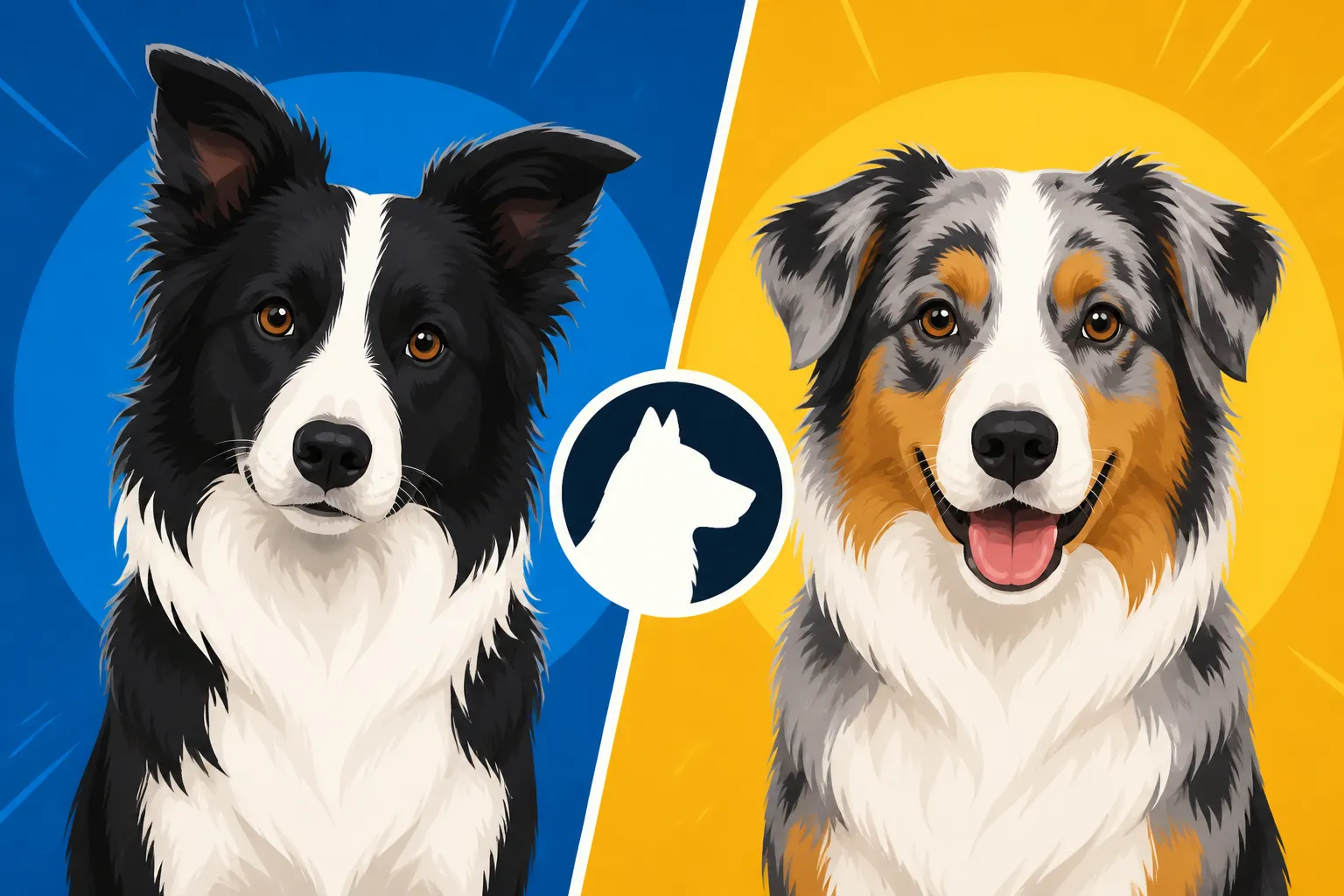
A black-and-white dog with a long coat and bright eyes can look like either a Border Collie or an Australian Shepherd, and color alone rarely settles the question. This guide explains the practical differences in build, coat, tail, movement, and working style, while showing why appearance can mislead when dogs are mixed, unusually marked, or simply outside the breed stereotype.
The clearest physical differences between the breeds
Build, size, and outline
Border Collies and Australian Shepherds overlap in size, so height or weight by itself is not a dependable way to identify one. Both are athletic herding dogs, and both can look lean, muscular, and ready to move. Individual dogs also vary with sex, age, fitness, and breeding line. A fit Border Collie may look lighter and rangier than an Aussie, but a stockier Border Collie or a slim Australian Shepherd can blur that distinction.
Look at the dog’s overall outline rather than one measurement. Border Collies often appear somewhat longer-legged and finely balanced, with a clear sense of reach and agility. Australian Shepherds are commonly more substantial through the bone and body, with a compact, sturdy appearance. These are tendencies, not rules: working lines in either breed may have a practical, athletic look that differs from the show-ring ideal.
A helpful comparison is how the dog carries itself while standing and moving. A Border Collie may seem especially light on its feet, with a low, intent posture when watching movement. An Aussie may look more solid and compact, though it can be just as quick and athletic. For a better sense of the Border Collie’s traditional shape, compare the dog with The Athletic Build a Border Collie Standard Describes. Breed standards describe ideals, not guarantees about every individual.
Coat, color, and markings
Both breeds come in more than one coat type and color pattern. Border Collies may have a rough coat with feathering or a shorter, smoother coat. Australian Shepherds usually have a medium-length coat, often with feathering around the legs, chest, and tail. Coat length alone is not a sure identifier: a smooth-coated Border Collie can look quite different from the familiar long-coated picture of the breed, while an Aussie’s coat can vary in fullness.
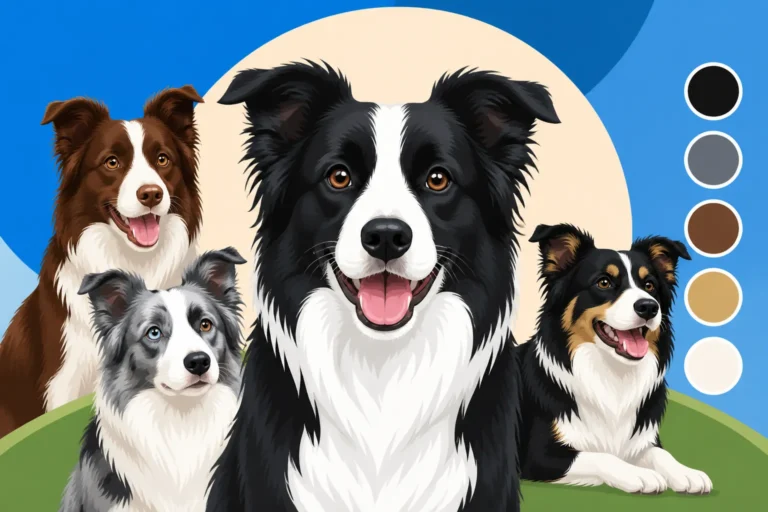
Black and white is strongly associated with Border Collies, but it is not exclusive to them. Border Collies can also be red and white, tricolor, merle, and other colors. Australian Shepherds are often recognized in blue merle, red merle, black, or red patterns, frequently with white markings and copper points. But a merle coat does not prove a dog is an Aussie, and a black-and-white coat does not prove it is a Border Collie. For a broader look at the range, see Border Collie Colors and Coat Types and Black and White and the Other Border Collie Colors.
Eye color can add to the confusion. Either breed may have brown, blue, or differently colored eyes, and eye color varies within the breeds. Merle patterning can be associated with blue eyes or eyes of different colors, but it is not a breed-specific shortcut. Likewise, white collars, facial blazes, and tan points appear in more than one combination. The striking blue-eyed dog in a photo may be memorable, but it does not offer a reliable answer on its own.
Tails and ears
The tail can be a useful clue, provided you know the dog’s history. Border Collies usually have a naturally long tail, often with a white tip, that may hang low when the dog is relaxed and rise during movement or excitement. Australian Shepherds may have a naturally bobbed tail, a naturally long tail, or a shortened tail. In places where tail docking has been practiced, a short tail may reflect human intervention rather than inherited tail length.
That means a short tail does not automatically identify an Australian Shepherd, and a long tail does not rule one out. A Border Collie can also have tail carriage that changes with mood and activity, so a single snapshot may not show its typical posture. If a dog’s background is unknown, tail shape should be treated as one clue among several rather than a deciding test.
Ears are similarly variable. Border Collies can have erect, semi-erect, or dropped ears; Australian Shepherds commonly have ears that fold forward, but individual ear carriage varies. Puppy ears can change as the dog grows, and excitement may alter how they sit. A dog with upright ears is not automatically a Border Collie, just as folded ears do not confirm an Aussie. Consider the whole dog, not a single feature.
| Feature | Border Collie tendency | Australian Shepherd tendency | Why it is not definitive |
|---|---|---|---|
| Overall outline | Often appears rangy, balanced, and light on its feet | Often appears compact and sturdy | Individual builds and breeding lines vary |
| Coat | Rough or smooth, with different lengths and feathering | Usually medium length, often feathered | Coat length and fullness overlap |
| Common patterns | Often black and white, but many colors occur | Merle, black, and red patterns are familiar | Both breeds can share colors and markings |
| Tail | Usually naturally long | May be naturally bobbed or long, or shortened | A short tail may be natural or docked |
| Ears | Erect, semi-erect, or dropped | Often folded forward, but variable | Ear carriage changes with age and attention |
Behavior and working style
How each breed may respond to movement
Both breeds were developed as herding dogs, so watching, controlling, and responding to movement can be part of everyday life. A Border Collie may focus intensely on a moving object, lower its body, and use a sustained stare. That distinctive style is closely associated with the breed, but the intensity varies between individuals. The Eye That Sets a Border Collie Apart explains why the focused gaze is such a familiar part of the breed’s working image.
Australian Shepherds are also capable, responsive herding dogs. They may show strong interest in movement, be quick to learn routines, and need thoughtful outlets for their energy. But not every Aussie herds, and not every Border Collie performs the classic crouch-and-stare. Training, early experience, temperament, and the dog’s individual history all matter. A dog that circles children, chases bikes, or fixates on a ball may be showing an instinctive or learned behavior, not giving you a simple breed label.
Daily life can make these differences easier to notice, but it can also muddy the picture. A Border Collie trained for agility may be calm between turns, while an Australian Shepherd with little enrichment may seem constantly busy. Breed tendencies are not a substitute for observing the actual dog. If you are trying to understand a pet’s needs, What Border Collie Intelligence Actually Measures and What a Border Collie Takes Out of Your Week offer useful context about the demands often associated with Border Collies.
Energy, learning, and settling at home
People often describe both breeds as smart and energetic, but “smart” does not mean effortless. A quick learner may pick up useful cues rapidly—and may also learn how to open a gate, demand another game, or anticipate the next step in a household routine. These dogs usually benefit from a combination of physical activity, mental work, and practice settling rather than an endless schedule of high-speed exercise.
Border Collies are widely known for intense focus and responsiveness, particularly in work and dog sports. Australian Shepherds are also trainable, attentive, and athletic, and many form close bonds with their households. Neither breed is automatically a good fit simply because someone has a large yard. A yard does not teach calm behavior, provide meaningful interaction, or prevent a dog from rehearsing habits such as fence-running and chasing.
Think about the life you can offer, not just the breed’s reputation. Can you provide consistent training, suitable activity, and quiet time? Are you prepared to manage chasing around joggers, livestock, or children? If you are comparing the two for a family, Border Collie or Australian Shepherd for a Pet Home can help frame the decision around everyday fit rather than looks. It is also worth reading Why People Choose a Border Collie and Then Struggle before assuming that a clever, athletic dog will naturally adapt to any routine.
Why identification can be difficult
Mixed breeds and individual variation
A dog may resemble both breeds because the breeds share a herding background and many physical traits. A mixed-breed dog might inherit a Border Collie-like face, an Aussie-like coat, and a tail that points in neither direction. Even purebred dogs do not all match the familiar images people have in mind. Puppies can be especially hard to identify because their adult coat, build, and ear carriage are still developing.
Photos add another layer of uncertainty. Camera angle can make a dog look taller or stockier, and a thick coat can disguise its outline. A curled or raised tail may appear shorter than it is. Lighting can change how merle or red coloring looks. If you are identifying a dog from a picture, look for several traits across different views—standing, moving, and relaxed—rather than relying on one close-up.
History can be more useful than appearance. Ask where the dog came from, whether its parents are known, and whether it has registration or breeder records. If a breeder claims a puppy is a specific breed, ask what documentation supports that claim and what health information is available. Which Test Results a Border Collie Breeder Should Show and The ABCA and Its Working Registry provide helpful background when you are trying to understand Border Collie records and breeder information.
When a DNA test may help
A canine DNA test may offer clues about a mixed-breed dog’s ancestry, but it is not a replacement for reliable records or a veterinary assessment. Results should be interpreted as estimates, especially when a dog has a complex background or ancestry from breeds with similar traits. A DNA test also cannot tell you exactly how much exercise a particular dog needs, predict every behavior, or guarantee that the dog will match a breed stereotype.
If you are considering a test, first ask what question you want answered. Are you curious about ancestry, checking for certain inherited health risks, or trying to understand a dog’s likely adult size and needs? These are different goals, and not every test is designed to answer all of them. Read the product details carefully, including what the test examines, how samples are collected, and how results are explained. If browsing a pet retailer such as Chewy, check the current product listing rather than assuming every kit offers the same type of information.
Chewy may be one place to look when comparing pet products, but the retailer is not the source of a dog’s pedigree, and a shopping listing cannot confirm that a particular dog is purebred. Before ordering a test through Chewy or another retailer, review the kit provider’s description and make sure its stated purpose matches your question. If the issue is a health concern, discuss the dog’s symptoms and testing options with a veterinarian instead of relying on a breed guess or a consumer ancestry result.
Choosing and caring for the dog in front of you
Match the individual, not the label
Whether the dog is a Border Collie, an Australian Shepherd, or a mix, the important question is how its needs fit your home. Ask about its daily routine, experience with other animals, comfort around children, response to unfamiliar places, and ability to settle after activity. If you are adopting an adult dog, observe how it behaves in ordinary situations—not only during an exciting meet-and-greet.
For a puppy, ask the breeder or rescue what is known about the parents and the puppy’s early environment. Look for straightforward answers about health history and behavior, not just a compelling story about intelligence or color. If a puppy’s breed identity is central to your decision, request documentation and understand what it can and cannot establish. Appearance-based guesses are particularly unreliable when puppies are young or mixed.
A dog’s needs also change over time. A young, energetic dog may need structured training and help learning to rest; an older dog may need gentler activity and more attention to comfort. If you are considering a Border Collie, The Kind of Home a Border Collie Settles In can help you think through lifestyle fit. If you are weighing a different herding breed, keep the same practical questions in view rather than assuming the breed name alone will predict the experience.
A simple way to assess a dog
When you meet a dog whose breed is uncertain, take a calm, structured look instead of trying to solve the puzzle instantly. Notice its frame, coat, tail, and ears, but also watch how it moves and recovers after excitement. Ask whoever knows the dog best about its routine and history. If a specific breed claim matters—for example, because of a breeder agreement or planned sport—seek records rather than relying on visual clues.
A useful checklist is:
- Observe the whole outline. Look at the dog’s proportions and movement, not just its height or weight.
- Check coat and markings together. Remember that colors and patterns can overlap between breeds.
- Ask about tail history. Find out whether a short tail is believed to be natural or was shortened.
- Watch behavior in context. A stare, chase, or burst of energy is not a definitive breed test.
- Request records if breed identity matters. Pedigree information and breeder documentation are more useful than confident guesses.
- Choose care based on the individual. Adjust training, activity, and veterinary care to the dog you have.
If you are buying supplies while sorting out a dog’s background, focus on what the dog needs now—such as a secure lead, grooming tools suited to its coat, and enrichment appropriate to its age. Chewy and other pet retailers can be useful for comparing product descriptions, but a product choice should not depend on whether the dog is ultimately identified as one breed or the other. The best match is the one that fits the dog’s size, coat, health, and behavior.
Disclaimer
This article is for general informational purposes only and does not constitute professional advice. Laws, prices and regulations vary by location and change over time. Consult a qualified professional for guidance on your specific situation.