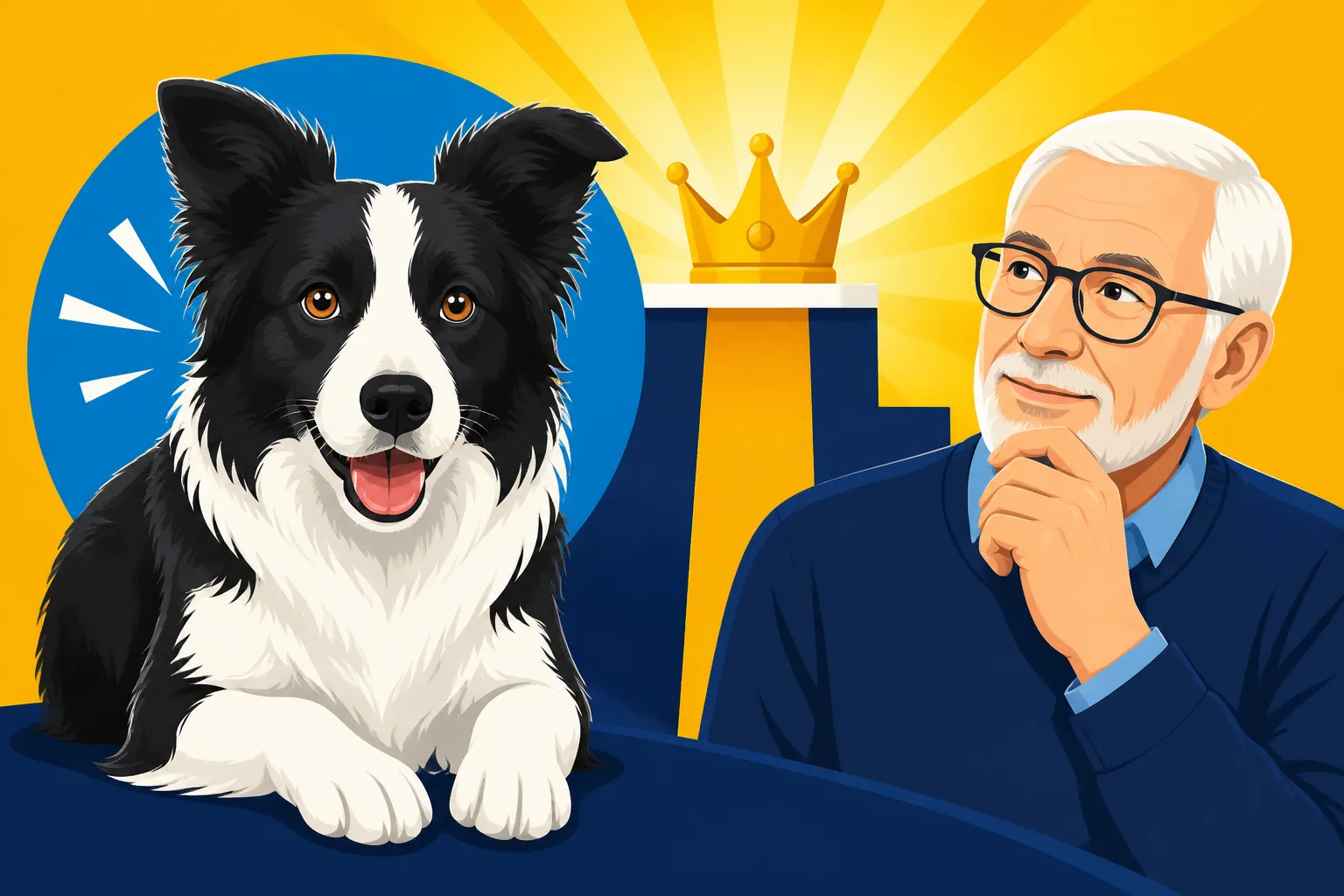
Why Stanley Coren Put the Border Collie First
A Border Collie can learn a new cue astonishingly quickly, but that is only part of the reason Stanley Coren ranked the breed first. His list focused mainly on working and obedience intelligence, not every kind of canine ability. This guide explains how he built the ranking, what it says about Border Collies, and what it does not prove about an individual dog.
What Stanley Coren Meant by Dog Intelligence
Three different kinds of canine ability
In The Intelligence of Dogs, psychologist Stanley Coren described canine intelligence as having several parts. Instinctive intelligence refers to abilities a dog was bred to perform, such as herding, retrieving, or guarding. Adaptive intelligence describes how well a dog learns from experience and solves problems independently. Working and obedience intelligence concerns how readily a dog learns from people and follows trained cues.
Those categories can overlap, but they are not interchangeable. A Border Collie’s instinctive herding ability, for example, may show up in the way it watches movement, circles livestock, and responds to a handler’s signals. Its adaptive intelligence might appear when it figures out how to open a gate or changes its approach after a training exercise fails. Its working and obedience intelligence is closer to what Coren’s ranking measured: learning commands and responding to them reliably.
This distinction matters because “smartest dog” sounds like a single, settled score. It isn’t. A dog could be excellent at solving a household puzzle and inconsistent about coming when called. Another might follow a familiar cue beautifully but need help adapting when a routine changes. Coren’s framework is useful precisely because it separates these different kinds of ability instead of pretending they are all the same.
For a closer look at the breed’s abilities and the limits of common intelligence claims, see What Border Collie Intelligence Actually Measures. It helps put Coren’s ranking into context: the first-place spot points to a particular strength, not a universal guarantee that every Border Collie will excel at every mental task.
Why obedience learning became the focus
Coren gathered information from obedience judges about how quickly different breeds tended to learn new commands and how reliably they responded to a familiar command. That makes the ranking useful for discussing trainability, but it also gives the results a clear boundary: it reflects observations made in an obedience setting, rather than a comprehensive test of every dog’s mind.
The method favors dogs who notice human cues, learn a requested behavior, and repeat it on cue. Border Collies are often very attentive to people, and many have a strong working partnership with a handler. Those traits can make them particularly impressive in formal training, where the human gives a signal and the dog is expected to respond in a specific way.
There is a practical reason this can feel striking to owners. A Border Collie may connect a hand movement, a spoken word, and a familiar routine after relatively little practice. But quick learning can go in directions an owner didn’t intend, too. A dog might learn that barking makes the ball appear, or that staring at the kitchen counter sometimes earns attention. Intelligence does not automatically mean “easy to live with”; it means the dog is likely to learn from what happens around it.
Why the Border Collie Ranked First
Learning commands quickly and responding reliably
Coren’s top-ranked group was described as learning a new command in very few repetitions and responding to a familiar cue with high reliability. These were broad breed-level descriptions drawn from judges’ experience, not promises about every dog or a guarantee that a particular puppy will master a skill on a fixed schedule.
Border Collies are a natural fit for this kind of measure. Many are keenly tuned to their handler’s posture, voice, and movement. During training, that attentiveness can help a dog pick up patterns quickly: a verbal cue may be paired with a hand signal, a change in body position, or the start of a familiar activity. The dog is not simply memorizing a word; it is learning a whole set of signals and consequences.
Still, speed of learning is not the same as perfect behavior in every setting. A dog that sits promptly in the kitchen may struggle to do so near sheep, cyclists, other dogs, or a busy agility course. Distraction, excitement, stress, and the dog’s history all affect whether a cue works in the moment. Owners often find that a Border Collie learns the behavior faster than it learns to use that behavior calmly everywhere.
A working background built around communication
The Border Collie’s traditional work offers a helpful way to understand its reputation. Herding requires more than running after sheep. A dog must respond to a handler’s direction, adjust its position, and influence livestock without turning every movement into a chase. That work asks for attention, timing, and a close working relationship between dog and person.
This does not mean that every Border Collie is born knowing formal commands, or that a pet dog needs access to sheep to be fulfilled. It does help explain why people often see the breed as exceptionally responsive in training. The same sensitivity that makes a dog quick to notice a handler can also make it quick to notice movement in the environment. A jogger passing the yard, children racing across a room, or a ball rolling under a chair may attract intense attention.
The breed’s working history is not the whole explanation, either. Individual temperament, early experiences, health, motivation, and training methods shape what a dog can do. A thoughtful comparison of working and show-bred dogs is available in The Working and Show Split in Border Collies. Whatever a dog’s background, a useful training plan builds on its interests without assuming that every Border Collie will have identical drive or focus.
How to Read Coren’s Ranking Without Overclaiming
A ranking is not a complete measure of intelligence
A ranked list is easy to remember, but it can flatten a complicated subject. Coren’s first-place result does not establish that every Border Collie is more capable than every dog of another breed. It does not measure all forms of independent problem-solving, emotional sensitivity, scent work, social understanding, or breed-specific skill. Nor can a breed ranking predict exactly how one dog will behave at home.
The ranking also reflects the task used to make the comparison. If the question is how readily dogs learn and obey human-given commands, a highly trainable breed may stand out. If the question changes to how well a dog follows a scent trail, works independently at a distance, or makes decisions without human direction, the useful comparison may change as well.
That is why it’s better to read Coren’s result as “Border Collies performed exceptionally well in the kind of working and obedience intelligence being discussed” than as “Border Collies are objectively best at everything.” For more on where the familiar breed rankings come from, see Where the Border Collie Ranks Among Breeds and Whether Obedience Rankings Measure a Border Collie's Mind.
A smart dog can still be a challenging dog
Fast learning can be a joy when you are teaching a recall, a settle cue, or a new trick. It can be less charming when a dog discovers that pacing gets a reaction, that a gap in the fence leads to an adventure, or that a household routine has a predictable loophole. A Border Collie’s ability to notice patterns can make consistency especially important.
Owners sometimes assume that a clever dog needs nonstop activity. In practice, simply adding more intense exercise can create a fitter dog who expects even more running. Many dogs benefit from a balanced routine that includes sniffing, short training sessions, appropriate play, downtime, and predictable rest. A calm “off switch” is a skill to teach, not a trait that intelligence automatically supplies.
If you are weighing the breed’s brainpower against everyday demands, Why People Choose a Border Collie and Then Struggle and Whether Border Collie Intelligence Makes It Harder to Own explore the gap between an impressive learner and a dog whose needs fit your household. That distinction is worth considering before choosing a breed, not just after a young dog has learned to open the baby gate.
| What is being considered | What it means | Example with a Border Collie |
|---|---|---|
| Instinctive intelligence | Ability linked to the work a breed was developed to do | Watching livestock and responding to movement |
| Adaptive intelligence | Learning from experience and solving a new problem | Finding another route when a familiar path is blocked |
| Working and obedience intelligence | Learning and responding to cues from people | Picking up a trained cue and following it in a familiar setting |
| Individual temperament | A particular dog’s personality, confidence, and motivation | One dog may love repetition while another loses interest quickly |
| Real-world reliability | Whether a learned behavior holds up amid distractions | Coming when called away from a ball or moving livestock |
What Owners Can Take From the First-Place Result
Use quick learning to build useful habits
If your Border Collie picks up cues quickly, use that ability to teach more than tricks. A reliable recall, a “leave it” cue, calm waiting at doors, and settling on a mat can make everyday life safer and less stressful. Keep early practice simple: teach the cue in a quiet place, reward the response you want, and gradually add distractions rather than expecting the dog to manage a difficult situation right away.
A common scenario is a dog that knows “come” perfectly in the living room but ignores it at the park. That does not necessarily mean the dog is being stubborn. The cue may not yet be well established around exciting distractions, or the reward may not compete with what is happening nearby. Practicing at increasing distances from distractions, using a long line where appropriate, and rewarding a prompt response can help build reliability without putting the dog in a situation where it is likely to fail.
Mental work can also be simple and low-pressure. Ask the dog to find a hidden treat, practice a short sequence of familiar cues, or learn the names of a few toys. If you need training objects or food puzzles, a retailer such as Chewy can be one place to look; choose items that suit the dog’s size, chewing style, and supervision needs rather than assuming a complicated toy is automatically better. For more ideas, What a Border Collie Reads in a Handler's Body explores the subtle human signals dogs may notice during interaction.
Match enrichment to the dog in front of you
No ranking can tell you which activity a particular dog will enjoy. One Border Collie may thrive on scent games; another may prefer structured obedience or a sport introduced gradually. A dog with a strong interest in movement may need careful management around traffic, wildlife, and children. Start with safe activities, watch how your dog responds, and ask a qualified trainer or veterinarian for guidance if behavior or health concerns arise.
It also helps to separate productive enrichment from constant stimulation. A dog does not need to be entertained every waking minute to be mentally satisfied. Short, purposeful sessions with breaks can be more useful than hours of repetitive play, especially if the dog becomes overexcited or has trouble settling afterward. If your dog finds puzzle toys rewarding, Chewy may offer a convenient way to browse options, but rotate activities and supervise new items so that play stays safe and engaging.
Most of all, treat the first-place ranking as a reason to be thoughtful, not intimidated. A responsive dog can learn wonderful household skills, but it also learns from the family’s everyday habits. Reward calm behavior, make cues clear, provide appropriate outlets, and protect time for rest. Coren’s ranking celebrates the Border Collie’s trainability; good ownership turns that trainability into a relationship that works for both dog and person.
Disclaimer
This article is for general informational purposes only and does not constitute professional advice. Laws, prices and regulations vary by location and change over time. Consult a qualified professional for guidance on your specific situation.