Taking Weight Off a Border Collie Without Cutting Work
It's incredibly frustrating, isn't it? You have a Border Collie, a dog renowned for its boundless energy and need for a job, and yet, despite all the running, fetching, and mental gymnastics, you're noticing they're carrying a little too much weight. It feels like a paradox, a betrayal of the breed's very nature. The last thing you want to do is cut back on their beloved activities, because you know an under-worked Border Collie is a recipe for chaos. This guide is here to help you navigate that delicate balance, showing you how to trim down your active Border Collie safely and effectively, all while keeping their zest for life and work intact.
Unraveling Why Your Border Collie Gained Weight
It's easy to assume that a dog as active as a Border Collie would just naturally stay lean, but the reality can be quite different. Sometimes, even with all their running, small factors can add up, leading to unwelcome weight gain.
The Hidden Calories in an Active Life
We often see our Border Collies tearing around, working stock, or excelling in agility, and we think, "Wow, they must be burning a massive amount of calories!" And while it's true they burn more than a sedentary lapdog, it's astonishingly easy to overestimate their energy expenditure and, crucially, underestimate their caloric intake. Think about it: a few extra kibbles at each meal, a handful of high-value training treats during a session, or even a couple of "just because" chews throughout the day can quietly push them into a caloric surplus. That enthusiastic fetch session that felt like a marathon to you might only burn a fraction of the calories you imagine. It's not always about sheer activity level; it's about the precise balance. We love to reward our dogs, and our Border Collies certainly earn their keep, but those little rewards add up faster than we realize.
Metabolism and Age-Related Changes
Just like us, a Border Collie's metabolism isn't a static thing. It can shift and slow down as they age, even if their activity level seems to remain high. A dog that was a lean, mean working machine at two years old might start to put on a few pounds by five or six, even on the same diet and exercise routine. This can be particularly true if they've had an injury layoff, even a short one, which can disrupt their routine and lead to muscle loss and fat gain. Genetics also play a part; some lines are simply more prone to carrying extra weight than others. It's a subtle creep, often unnoticed until you suddenly realize their waist isn't quite as tucked as it used to be. Understanding these shifts is key to making appropriate adjustments. For more on adjusting food with life changes, check out Adjusting a Border Collie's Food in the Off Season.
The Impact of "Snacks" and Human Food
Ah, the siren song of the snack! Whether it's a piece of cheese dropped from the counter, a leftover crust from your sandwich, or even a dental chew given daily, these "extras" are often the biggest culprits in Border Collie weight gain. Many owners diligently measure their dog's meals but completely overlook the caloric contribution of treats and human food. A single slice of processed cheese can contain a surprising amount of calories, and a few bits of steak from dinner might be equivalent to a whole meal's worth of kibble for a dog. Our Border Collies are masters of the soulful gaze, convincing us they are absolutely starving, and it's hard to resist. But even healthy-seeming human foods, like a slice of apple or a banana, contain sugars and calories that need to be factored into their daily intake. It's not about denying them entirely, but about being mindful and making informed choices.
Accurately Assessing Your Border Collie's Body Condition
When you're trying to manage your Border Collie's weight, relying solely on the number on the scale can be misleading. A more holistic approach involves understanding their body condition, which gives you a clearer picture of their health.
Beyond the Scale: Understanding Body Condition Score (BCS)
The scale tells you pounds, but the Body Condition Score (BCS) tells you about fat and muscle distribution, which is far more indicative of health. For a high-drive, athletic breed like a Border Collie, a lean, fit physique is crucial for joint health and overall performance.
Here's how to assess your Border Collie's BCS:
- Ribs: Gently run your hands along their sides. You should be able to easily feel their ribs without pressing hard, like feeling the knuckles on the back of your hand. If you can see their ribs clearly without feeling for them, they might be too thin. If you have to press firmly to feel them, or can't feel them at all, they're likely carrying too much weight.
- Waist: Look down at your dog from above. There should be a distinct "tuck" or hourglass shape behind their ribs. If they look like a straight line from chest to hips, or bulge out, they're overweight.
- Abdominal Tuck: View your dog from the side. Their abdomen should tuck up, not hang low or be straight.
- Spine and Hip Bones: You should be able to feel their spine and hip bones with moderate pressure, but they shouldn't protrude sharply.
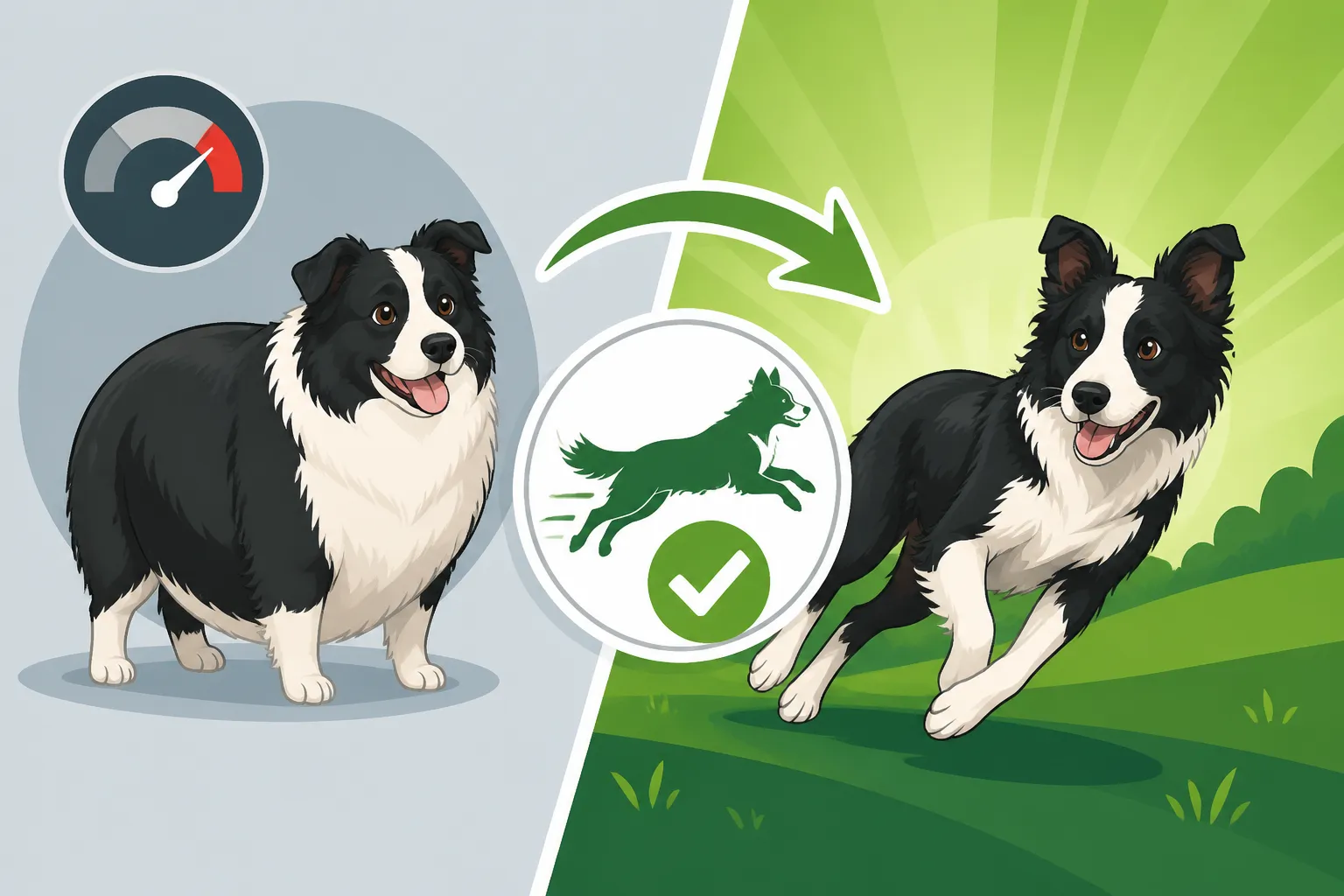
Many vets use a 9-point scale, where 1 is emaciated and 9 is obese, with 4-5 being ideal. An ideal Border Collie should look lean and athletic, not chunky or "solid." For more on what an ideal athletic build looks like, consider reading The Body Condition a Sport Border Collie Carries.
The Importance of Regular Monitoring
Weight loss is a journey, not a sprint, especially with an active Border Collie. Regular monitoring is absolutely key to success and to prevent plateaus or accidental over-restriction. Don't just check once a month; aim for weekly or bi-weekly checks. This involves a combination of weighing them on a reliable scale (your vet's scale is often the most accurate) and performing a hands-on BCS assessment.
Keep a log. Note down their weight, your BCS observations, and any changes in their energy levels or coat condition. This objective data helps you track progress, celebrate small victories, and identify early if something isn't working. It also helps you spot trends – maybe they lost weight steadily for three weeks, then plateaued, signaling it's time for a slight adjustment. Without this consistent monitoring, it’s easy to get discouraged or make assumptions that aren't quite accurate.
Simplified Body Condition Score Guide for Border Collies
To help you visualize what an ideal and less-than-ideal Border Collie might feel and look like, here's a quick guide:
| Category | Ribs | Waist (Top View) | Abdominal Tuck (Side View) | General Appearance |
|---|---|---|---|---|
| Too Thin (BCS 1-3) | Easily visible, no fat cover, sharp to touch | Severe hourglass, prominent hip bones | Marked tuck, almost hollow | Bones prominent, minimal muscle, appears gaunt, no energy |
| Ideal (BCS 4-5) | Easily felt without pressing hard, minimal fat cover | Distinct hourglass, visible tuck behind ribs | Good tuck-up, athletic and lean | Athletic, muscular, graceful, energetic, body contours visible |
| Overweight (BCS 6-7) | Difficult to feel without firm pressure, moderate fat cover | Straight or slight bulge, waist less obvious | Less pronounced tuck, flatter belly | Heavier build, slight fat deposits, slower, less defined muscle |
| Obese (BCS 8-9) | Cannot feel ribs, thick fat cover | No waist, broad back, bulging | Sagging abdomen, no tuck | Very heavy, significant fat deposits, waddling gait, reluctance to move, labored breathing |
Remember, your Border Collie should be in that "Ideal" range. It's what allows them to perform their best and helps protect their joints from unnecessary strain.
Strategic Dietary Adjustments for Sustainable Weight Loss
Putting an active Border Collie on a diet requires a careful hand. You can't just slash their food intake, or you'll end up with a high-energy dog whose drive is dulled, and whose body isn't getting the fuel it needs for muscle maintenance and overall health.
Calculating a Realistic Caloric Deficit
This is where your veterinarian or a canine nutritionist becomes your best ally. They can help you determine a safe and effective starting caloric intake. A common approach is to aim for a 10-20% caloric reduction from their current intake, or to calculate their ideal body weight and feed them for that weight. Drastic cuts might lead to quick weight loss initially, but it's often unsustainable, can result in muscle loss rather than fat loss, and will definitely leave your Border Collie feeling perpetually hungry and possibly irritable.
A Border Collie in full work burns a significant amount of calories, sometimes upwards of 1500-2000 kcal per day, depending on size and intensity. Reducing this by a few hundred calories slowly and steadily is much better than cutting it in half. For example, if your dog currently eats 1800 kcal/day, aiming for 1500-1600 kcal/day might be a good starting point. This ensures they still have enough energy to perform their tasks and maintain muscle mass, which is crucial for their athletic lifestyle. Always discuss these calculations with a professional to ensure they're appropriate for your specific dog. The Calorie Load a Working Border Collie Burns provides more insight into their energy needs.
Choosing the Right Food and Portions
Once you have a caloric target, selecting the right food and ensuring accurate portions are paramount.
- Weight Management Formulas: Many reputable brands offer specific "weight management" or "light" formulas. These foods are typically lower in calories, fat, and often higher in fiber to help dogs feel full. Look for ingredients that emphasize lean protein and complex carbohydrates.
- Fresh Food Options: Consider fresh food services like Ollie. These can offer precise portion control and often use whole, less processed ingredients, which can be beneficial. Because you're often getting exact, pre-portioned meals based on your dog's specific needs, it takes a lot of the guesswork out of calorie counting.
- Accurate Measuring: This cannot be stressed enough! Don't eyeball it. Use a kitchen scale to weigh out kibble or use standard measuring cups that you've confirmed for accuracy. A "cup" can vary widely depending on how densely you pack it or the size of your scoop. Even a small difference of 10-20 extra grams of kibble per meal can add up to hundreds of extra calories over a week, sabotaging your weight loss efforts.
Remember, the goal is nutrient-dense food that provides satiety without excess calories. Feeding a Border Collie That Works Two Hours a Day delves further into feeding an active dog.
Smart Snacking and Training Rewards
This is where many well-intentioned diets falter! Training treats and rewards are essential for Border Collies, who thrive on working with their handlers. However, those little pieces of jerky or cheese can pack a caloric punch.
- Low-Calorie Alternatives: Swap high-calorie treats for low-calorie, healthy options. Small pieces of steamed green beans, baby carrots, cucumber, or apple slices (without seeds) make excellent rewards. They're crunchy, satisfying, and very low in calories.
- Smaller Portions: If you're using commercial treats, break them into tiny, pea-sized pieces. Your Border Collie doesn't need a whole biscuit to acknowledge good work; often, the praise and the act of receiving a treat are just as motivating as the size of it.
- Using Daily Ration: Designate a portion of their daily kibble allowance as training treats. This ensures all treats are accounted for within their overall caloric budget. You can find a wide variety of low-calorie treats and healthy snack alternatives on sites like Chewy, making it easier to stock up on smart choices.
- Verbal Praise and Play: Don't underestimate the power of enthusiastic verbal praise, a quick game of tug, or a short burst of fetch as a reward, especially if your dog is highly toy or praise-motivated.
Incorporating Puzzle Feeders and Slow Bowls
Border Collies are incredibly intelligent and love a challenge. Mealtimes can be more than just gulping down food; they can be an opportunity for mental enrichment, which helps with satiety and slows down consumption.
- Extending Mealtime: Puzzle feeders, snuffle mats, and slow-feeder bowls make your Border Collie work for their food. This extends mealtime from a 30-second devour-fest to 10-15 minutes of engaging activity. The extended eating time helps them feel more satisfied with a smaller portion, as their brain registers the effort and duration.
- Mental Stimulation: These tools tap into their natural problem-solving abilities. A Border Collie thrives on mental work, and using a puzzle feeder turns a mundane meal into a mini-training session. This can help reduce boredom, which sometimes manifests as begging or seeking extra food.
- Reducing Bloat Risk: Slowing down eating can also reduce the risk of bloat, a serious condition that can affect deep-chested dogs.
- Variety is Key: Rotate different types of puzzle feeders to keep things interesting. You can find a vast selection of these items on platforms like Amazon, offering everything from simple maze bowls to more complex interactive toys that dispense kibble gradually.
Optimizing Activity Without Compromising Performance
The beautiful thing about a Border Collie is their drive to work. The challenge, when they're overweight, is how to leverage that drive for weight loss without putting undue strain on their joints or burning them out.
Maximizing Mental Engagement
Remember, a tired mind is often more effective than just a tired body, especially for a Border Collie. You don't always need high-impact physical exercise to burn calories and satisfy their need for "work."
- Scent Work: This is fantastic for Border Collies! It's low-impact, highly engaging, and taps into their natural instincts. Hide treats (using their daily food ration) or specific scents around the house or yard and have them find them. Just ten minutes of intense nose work can be as tiring as a good run.
- Complex Trick Training: Border Collies excel at learning new things. Teach them multi-step tricks, sequence commands, or even names of toys. This focused mental effort requires concentration and burns mental calories. Trick Training a Border Collie Indoors offers great ideas.
- Advanced Obedience: Work on perfecting stays with distractions, distance work, or proofing commands in new environments. These activities demand significant mental focus and self-control.
- Structured Play: Instead of endless, mindless fetch, incorporate structured play sessions that include commands like "wait," "find it," and "leave it." This makes play more mentally taxing.
Mental exercise prevents boredom, which can sometimes lead to destructive behaviors or persistent food seeking. It satisfies their need to "work" without adding physical stress.
Adjusting Intensity, Not Duration
When your Border Collie is carrying extra weight, certain high-impact activities might be detrimental to their joints. Instead of cutting back on their overall time spent exercising, think about how they're exercising.
- Varied Terrain: Instead of just flat walks, introduce varied terrain. Gentle hills (uphill is great for building hindquarter muscle, downhill is harder on joints, so start slowly), sand, or grassy fields require different muscle groups and more effort than pavement.
- Short Bursts of Intensity: If your Border Collie is used to long, intense sessions, break them up. Instead of one long, high-speed fetch session, do several shorter ones with more rest in between. This still gets their heart rate up but gives their joints a break.
- Swimming: This is an absolute gem for overweight Border Collies! Swimming is non-weight bearing, provides excellent cardiovascular exercise, and builds muscle without impact. Many Border Collies adore the water. Find a safe lake, pool, or even a dog-friendly hydrotherapy center.
- Leash Walking with Purpose: Even leash walks can be optimized. Practice heel work, incorporate quick stops and starts, or walk routes with more turns. It makes the walk more engaging and works different muscles.
- Avoid Overdoing It: It's crucial not to push an overweight dog too hard too fast. They might be eager, but their body isn't conditioned for it yet. Listen to their breathing, watch for signs of fatigue, and build up intensity gradually. For guidance on how far your dog should run, you can refer to How Far a Border Collie Should Run in a Day.
Incorporating Low-Impact Exercise
The key to exercising an overweight Border Collie is to prioritize activities that are gentle on their joints while still raising their heart rate and building muscle. Excess weight puts immense strain on hips, elbows, and knees, predisposing them to conditions like Hip Dysplasia in a Border Collie That Runs All Day or Cruciate Tears in a Border Collie.
- Controlled Leash Walks: While it might sound basic, a brisk, consistent walk on a leash, especially on varied surfaces like grass or dirt trails, is excellent for cardiovascular health and building endurance. It’s a great foundation before adding more intense activities.
- Gentle Hill Work: As mentioned, gentle inclines are fantastic for building hindquarter strength without the high-impact stress of jumping or sudden turns. Start with very short, gradual hills and increase as your dog's fitness improves.
- Hydrotherapy or Swimming: Beyond being a fun activity, professional hydrotherapy in a heated pool with an experienced therapist is invaluable for dogs needing to lose weight, recovering from injury, or managing joint issues. The buoyancy of the water supports their weight, allowing them to move freely and build muscle without gravity's impact.
- Agility Foundations (No Jumps): Many agility exercises, like weave poles or tunnel work, can be done at ground level or with very low contacts, providing mental engagement and body awareness without the strain of jumping. Focus on precision and control.
- Mindful Play: Engage in games that encourage movement but avoid sudden stops, high jumps, or intense, repetitive fetching that can exacerbate joint issues. Think about rolling a ball and having them retrieve it at a jog, rather than a full sprint.
The goal is consistent, moderate activity that gets them moving and burning calories safely, protecting those precious joints.
Consistent Monitoring and Troubleshooting Roadblocks
Losing weight is rarely a straight line, especially for a Border Collie who constantly tests boundaries! You'll hit plateaus, encounter frustrations, and sometimes feel like you're not making progress. Consistent monitoring and knowing how to troubleshoot are essential.
Keeping Detailed Records
You might feel a bit like a scientist, but believe me, keeping detailed records is your secret weapon in this weight loss journey. Don't just rely on memory; grab a notebook or use a simple spreadsheet.
What to record:
- Food Intake: Every single gram of kibble, every treat (even those tiny bits of carrot!), and any human food. Note the time and quantity. This helps you ensure you're sticking to your calculated caloric target.
- Exercise: Detail the type, duration, and intensity of all activity. Was it a brisk 30-minute walk, 15 minutes of scent work, or a 45-minute sheep session? Note how your dog responded – were they energetic, did they seem tired?
- Weight & BCS: Record their weight (ideally weekly) and your Body Condition Score assessment. Take photos every couple of weeks from the same angles (top, side) to help visualize subtle changes that the scale might not capture immediately.
- Observations: Any changes in energy, coat condition, stool quality, or behavior. Sometimes, a dog on a diet might seem a bit grumpier or more persistent for food.
This meticulous record-keeping allows you to see patterns, objectively evaluate what's working and what isn't, and make informed adjustments. If your Border Collie isn't losing weight, you can look back at the data and identify potential culprits – perhaps those "tiny" treats were more frequent than you thought, or the exercise wasn't quite as intense.
When Progress Stalls: Plateaus and Frustrations
You've been so diligent, watching every calorie, logging every walk, and then… nothing. The scale doesn't budge. The waist tuck isn't tucking any further. This is a plateau, and it's absolutely normal, but incredibly frustrating!
- Re-evaluate Caloric Intake: Sometimes, as a dog loses weight, their metabolic rate adjusts. What was once a deficit might now be their maintenance level. It might be time to slightly reduce calories again (e.g., another 5-10% reduction), but always consult your vet before making significant changes.
- Increase Mental Work: If physical activity is maxed out or limited, ramp up the mental challenges. Introduce new tricks, try more complex puzzle feeders, or extend scent work sessions. Mental effort burns calories and provides satisfaction.
- Vary Exercise: Is your Border Collie doing the exact same walk every day? Their body adapts. Introduce new routes, different types of terrain, or mix in some swimming. Cross-training challenges different muscle groups and can kickstart metabolism.
- Be Patient: Sometimes, a plateau is just that – a temporary stall. Stick with the plan for another week or two before making drastic changes. Consistency often wins out.
- Consult Your Vet (Again): If a plateau lasts for more than a few weeks despite your best efforts, it's definitely time for another vet visit. There could be an underlying medical condition (like hypothyroidism, which can cause weight gain and lethargy) that's hindering weight loss. Yearly Bloodwork for a Border Collie can sometimes reveal these issues.
The Role of Your Veterinary Team
Your veterinarian is your most important partner in your Border Collie's weight loss journey. They are not just there for emergencies; they are your resource for preventative care and managing health challenges.
- Initial Assessment and Goal Setting: Your vet can accurately assess your dog's current BCS, help you set a realistic target weight, and calculate a safe and effective caloric intake. They can also rule out any underlying health conditions that might be contributing to weight gain or making weight loss difficult.
- Monitoring and Adjustments: Regular check-ups allow your vet to monitor progress, adjust the diet plan as needed, and ensure your Border Collie is losing weight at a healthy rate. They can also provide guidance on safe exercise protocols, especially if your dog has existing joint issues.
- Addressing Medical Issues: Conditions like hypothyroidism, Cushing's disease, or even certain medications can cause weight gain. Your vet can perform diagnostic tests to rule these out or manage them effectively.
- Nutritional Guidance: Vets often have access to specialized prescription weight loss diets that are designed to promote satiety while reducing calories. They can also offer expert advice on commercial foods or home-cooked options.
- Ongoing Support: They're there to answer your questions, alleviate your concerns, and provide encouragement when you feel disheartened. Don't hesitate to reach out if you're struggling or have new observations. If your Border Collie is a sport dog, you might even consider consulting a specialist sports vet. Whether a Border Collie Needs a Sports Vet is a good resource for this.
Weight management for a Border Collie, especially one that needs to maintain its working drive, is a commitment. It requires patience, consistency, and a partnership with your vet. But seeing your Border Collie regain their lean, athletic physique, moving with grace and enthusiasm, is an incredibly rewarding experience that will prolong their healthy, happy life.
Disclaimer
This article is for general informational purposes only and does not constitute professional advice. Laws, prices and regulations vary by location and change over time. Consult a qualified professional for guidance on your specific situation.