Fitting a Border Collie With a Long Line
One of the biggest struggles Border Collie owners face is the paradox of their incredible intelligence and intense drive: they are brilliant, but that brilliance often means they develop their own ideas about what's important, especially when a tantalizing scent or a fleeting movement grabs their attention. A reliable recall often feels like a distant dream, leaving many feeling tethered to leashes or fenced yards. This guide is dedicated to helping you bridge that gap, showing you how a long line can be a game-changer for building a safe, dependable recall and giving your highly-driven Border Collie the freedom they crave.
Understanding the "Why" Behind the Long Line for Your Border Collie
Let's be honest, trying to get a Border Collie to come back when they've locked onto something can feel like talking to a brick wall. It's not personal, it's just pure, unadulterated instinct. Understanding why a long line is so crucial for this breed starts with appreciating their unique genetic makeup and behavioral patterns.
The Border Collie's Innate Drive and Recall Challenges
Border Collies were bred for centuries to work independently and intensely, often at great distances from a shepherd. Their job required them to focus with unwavering concentration on livestock, making split-second decisions and ignoring everything else. This incredible "eye" and drive are what make them phenomenal working dogs and fantastic athletes, but it also means their attention, once captured, is incredibly difficult to redirect. When your Border Collie suddenly takes off after a squirrel, a leaf blowing in the wind, or even just a particularly interesting smell, they're not being disobedient; they're simply fulfilling a deep-seated instinct to pursue and control.
For many owners, this translates to a frustrating and sometimes dangerous reality. You might feel like you can never truly trust your dog off-leash, leading to anxiety about walks in open spaces. The fear of them bolting into traffic, chasing wildlife across a field, or attempting to "herd" other dogs or people is a very real, valid concern. Conventional short-leash training just doesn't prepare them for the real-world distractions they encounter when given more space. A long line acknowledges this powerful drive and offers a way to train within it, rather than constantly fighting against it. It's about providing the necessary safety net while allowing them to experience the world more fully. Why a Border Collie Cannot Stop on Its Own is a concept many owners struggle with, and the long line helps manage that.
Bridging the Gap Between Leash and Off-Leash Freedom
Think of the long line as a temporary bridge. It’s not just an extra-long leash; it’s a vital training tool that allows your Border Collie to experience a greater degree of freedom and distance from you in a controlled manner. This is especially important for breeds like Border Collies that often thrive on having space to move and explore, but cannot safely be given complete off-leash freedom right away.
The long line serves several key purposes. Firstly, it's a safety net. If your Border Collie ignores your The Emergency Word a Border Collie Must Know or gets too engrossed in a scent trail, you have a physical way to intervene without having to chase them down. This reduces stress for both you and your dog, making training sessions more positive. Secondly, it allows you to practice and reinforce your recall command in increasingly distracting environments without the high stakes of a truly off-leash scenario. You can let them roam, sniff, and explore, then call them back, and if they hesitate, a gentle tug on the line can prompt them. This consistent, low-pressure reinforcement builds their understanding that "come" means returning to you, even when there are tempting distractions. It empowers you to build trust and confidence in your dog's ability to respond, while also giving your Border Collie the chance to learn how to manage their impulses over greater distances. This measured approach is crucial for high-drive dogs and is far more effective than simply hoping they'll "figure it out" off-leash.
Choosing the Right Long Line for Your Border Collie
The right long line isn't just about length; it's about material, durability, and how it feels in your hands. A flimsy or ill-suited line can be more of a hazard than a help, especially with a strong, fast-moving Border Collie.
Length, Material, and Durability Considerations
When you're choosing a long line, consider your environment and your training goals. Long lines typically come in lengths from 15 feet to 50 feet, sometimes even longer.
- 15-20 feet: Great for smaller parks, yards, or starting out in mildly distracting environments. It's easier to manage and less likely to tangle.
- 30 feet: A fantastic all-around length for open fields, larger parks, and more advanced recall training. It offers significant freedom while still being manageable.
- 50 feet+: Excellent for really letting your Border Collie stretch their legs in very open, safe areas where distractions are minimal. However, these longer lines can tangle easily, get caught on brush, and are harder to handle quickly.
As for material, you'll primarily find two popular options:
- Nylon: Often lighter and more affordable. However, nylon can absorb water, get dirty easily, and if it runs through your hand quickly, it can cause rope burns. It also tends to knot and tangle more readily.
- Biothane: This material is a coated webbing that looks and feels a bit like leather but is incredibly durable, waterproof, and easy to clean. It doesn't absorb odors or get muddy, and it's less prone to tangling. While usually a bit more expensive upfront, its longevity and ease of use often make it a worthwhile investment, especially for a dog that will be using it frequently and in various conditions. Many serious dog trainers prefer biothane for its superior performance and reduced risk of rope burn.
Regardless of the material, always look for robust hardware – a strong swivel clip that won't rust and can withstand the sudden pull of a Border Collie. Avoid thin, flimsy lines that could snap or cut your hands. Durability is paramount when you have a powerful dog on the other end.
Where to Purchase Your Long Line
You have several good options when it comes to purchasing a long line. For a wide selection and competitive pricing, online retailers like Amazon are a popular choice. You can find various lengths, materials, and price points, and reading customer reviews can help you assess durability and suitability for a high-energy dog. Just make sure to check the description carefully to ensure the material and hardware are up to the task.
Specialized pet supply stores, both brick-and-mortar and online, often carry higher-quality or more niche options, particularly those made from biothane. These stores cater to dog trainers and enthusiasts, so they might offer brands known for their robust construction. If you're looking for a specific type of long line, such as one designed for working dogs or specific weather conditions, these specialized retailers can be a great resource. While you might not find a "Border Collie" branded long line, you'll be looking for ones designed for strong, active dogs. Organizations like BAXTER & Bella, which focus on puppy training and development, often recommend specific gear and might even offer their own versions or recommendations based on their extensive experience with active breeds. Don't hesitate to check out their resources for gear recommendations too!
| Feature | Nylon Long Line | Biothane Long Line |
|---|---|---|
| Durability | Good, but can fray over time | Excellent, highly resistant to wear and tear |
| Weather Impact | Absorbs water, can get heavy and muddy, slow dry | Waterproof, easy to clean, quick dry |
| Grip/Feel | Can cause rope burn if pulled fast, may be slippery when wet | Comfortable grip, less risk of rope burn |
| Tangle Factor | More prone to tangling and knotting | Less prone to tangling due to smooth coating |
| Maintenance | Requires washing, can retain odors | Wipes clean easily, odor resistant |
| Cost | Generally more affordable | Higher upfront cost, but excellent value |
Fitting and Introducing the Long Line Safely
The actual fitting and initial introduction of the long line are critical steps. Doing this incorrectly can be uncomfortable or even dangerous for your Border Collie, and it can set back your training efforts. Safety is always the priority.
Attaching the Line and Harness Selection
This is perhaps the most important rule when using a long line with a Border Collie (or any dog): NEVER attach a long line to a flat collar. A sudden, strong jerk on a long line, which is designed to allow significant momentum, can cause severe neck injuries, tracheal damage, or even whip-lash related trauma to your dog. Their neck simply isn't designed to withstand that kind of force.
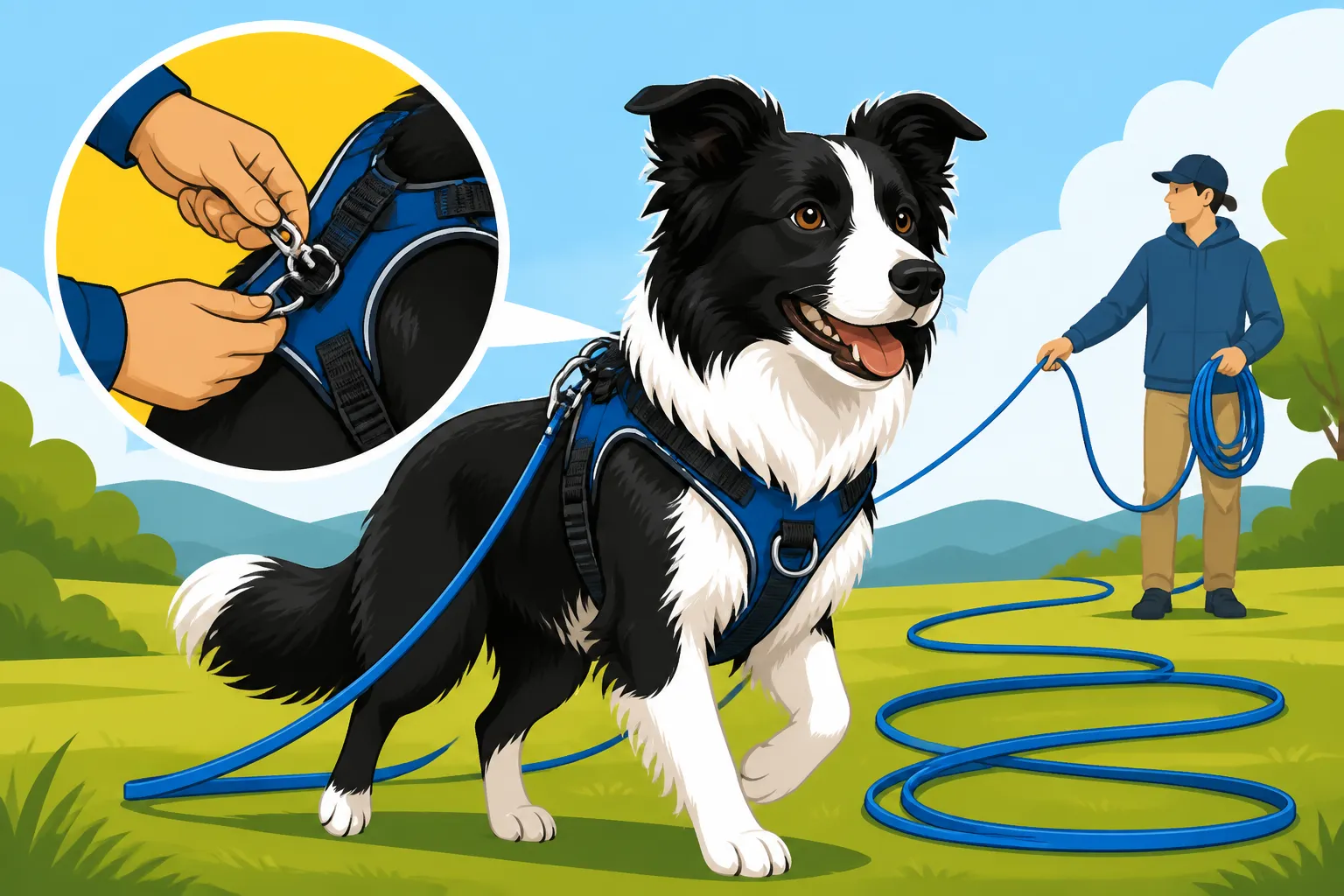
Instead, always attach your long line to a well-fitting harness. There are several types of harnesses, and for long line work, a back-clip harness is generally preferred. This style connects the line to a ring on your dog's back, distributing pressure across their chest and shoulders if they hit the end of the line. A front-clip harness, while excellent for redirecting pulling on a regular leash, can sometimes cause the long line to tangle under their legs more easily during long-line movement.
Ensure the harness fits snugly but comfortably, allowing for a full range of motion. You should be able to slide two fingers underneath all the straps. Check for chafing points, especially in the armpit area, after the first few uses. A comfortable harness means your Border Collie can move freely and enjoy their extended freedom without discomfort. Remember, this harness will be worn for potentially long periods during training, so comfort and proper fit are essential. Hip and Elbow Scores in a Border Collie reminds us of the importance of protecting their joints and structure, and a good harness helps prevent injury.
Initial Introduction and Handling Techniques
Introducing the long line should be a positive, low-stress experience. Start in a quiet, familiar, and distraction-free environment, like your own backyard. Let your Border Collie wear the harness for a few minutes first, associating it with positive things like treats or praise. Then, attach the long line and simply let them drag it around for a short period, supervised. This helps them get used to the feel and weight of the line without any pressure from you.
When you start holding the line, never wrap it around your wrist or hand. If your Border Collie suddenly bolts, it could yank your arm or cause severe rope burns. Instead, gather the line loosely in folds, allowing it to slide through your gloved hand (gardening gloves or specific dog-handling gloves are highly recommended for grip and protection) if your dog runs. Practice letting the line slide, then gently gathering it up as your dog slows. The goal is a smooth, controlled handling, not a sudden stop.
Start with short sessions, focusing on positive reinforcement. Call your dog, and as they come, reel in the line gently if needed, giving treats and praise as soon as they reach you. Make it a game. The more positive experiences your Border Collie has with the long line, the more readily they'll accept it as part of their training routine. Gradually increase the duration and introduce very mild distractions as your dog builds confidence.
Training Your Border Collie with the Long Line
The long line is a powerful tool for shaping behavior and building confidence in your Border Collie. It's not just about stopping them from running away; it's about active, engaged training.
Building a Rock-Solid Recall
This is where the long line truly shines. For a Border Collie, a reliable recall isn't just a convenience; it's a safety imperative. Start your recall training in a somewhat enclosed area, like a park with light distractions or a large field. Let your Border Collie roam to the end of the line, sniffing and exploring. Then, in an upbeat, happy tone, use your consistent recall command – "Come!" or "Here!" – and immediately crouch down, making yourself inviting.
If your Border Collie hesitates or gets distracted, gently reel in the line while continuing to encourage them. The line acts as a subtle reminder, a physical nudge without punishment. The moment they start moving towards you, praise them lavishly. When they reach you, jackpot them with high-value treats (think cooked chicken, cheese, or their favorite soft rewards) and enthusiastic praise. Don't immediately clip them back on a short leash and go home; this teaches them that coming to you ends the fun. Instead, reward, then release them to go explore again. Repeat this many, many times in each session.
Gradually introduce more distractions: a person walking by, another dog at a distance, a favorite toy placed a few feet away. Always ensure you're setting your dog up for success. If they're struggling, reduce the distraction level. The long line allows you to intervene before they completely blow you off, preventing them from practicing ignoring you. This consistent positive reinforcement, coupled with the gentle physical guidance of the line, is the foundation for a truly reliable recall. If you're struggling, structured programs like those offered by BAXTER & Bella can provide step-by-step guidance on recall, often incorporating long-line techniques. You'll find that Building a Border Collie Recall Against Moving Things is much easier with the safety of a long line.
Developing Impulse Control and Boundaries
Border Collies are naturally impulsive. Their herding drive means they often react quickly to movement – a cyclist, a jogger, a passing car, or another dog. The long line is invaluable for teaching them to temper these instincts and respect boundaries in the real world.
When you see your Border Collie about to lunge or fixate on something, use your verbal cues like "Leave It" or "Wait." If they ignore you and start to move, you can use the long line as a gentle physical prompt. A quick, light tension on the line, followed by immediate release when they disengage or look back at you, can interrupt the unwanted behavior. It's about redirection, not punishment. Reward them heavily for choosing to disengage and reorient towards you.
For example, if your Border Collie typically barks or lunges at passing cars, the long line allows you to keep them at a safe distance from the road while still giving them enough rope to feel like they have some freedom. As a car approaches, give your "Leave It" command. If they respond, praise and reward. If they start to fixate, a gentle check on the line helps break their attention, allowing you to redirect them. This repeated, consistent practice with the long line teaches them that you are their guide, and listening to you leads to good things, even when their instincts are screaming otherwise. It's a crucial step in preventing problems like The Border Collie That Runs the Fence at Traffic or Calling a Border Collie Off Livestock if they live near a farm.
Progressing to Off-Leash Freedom Eventually
The goal of long-line training isn't necessarily to keep your Border Collie on a long line forever. For many, it's a stepping stone to earning true off-leash freedom in appropriate environments. How do you know when you're ready to start phasing out the long line?
Look for consistent, enthusiastic recall even when distractions are present and varied. Your Border Collie should be choosing to come back to you quickly and happily, not just because the line forces them. They should also be demonstrating good impulse control, responding to "Leave It" or "Wait" commands reliably, and checking in with you regularly without you having to prompt them. You should feel a genuine sense of trust and confidence in their responsiveness.
When you feel ready, start with very short periods of off-leash time in a highly secure, distraction-free area, like a fully fenced park that you know is empty. Keep the long line clipped to their harness, but let it drag on the ground. This provides a safety net if you need to quickly step on the line to intervene. Gradually increase the duration of off-leash time and slowly introduce controlled distractions. Always be prepared to go back to the long line if your dog struggles or if you're entering a new, less predictable environment.
It's important to be realistic: some Border Collies, due to their exceptionally strong herding instincts and prey drive, may never be completely safe to be off-leash in unfenced, uncontrolled public areas. And that's absolutely okay! A lifetime on a long line is far better than the potential dangers of an unreliable off-leash dog. The long line itself provides a wonderful balance of freedom and safety, allowing your Border Collie to enjoy extensive exercise and mental stimulation, which are key to their overall well-being and fulfilling What a Border Collie Does With Its Whole Day.
Disclaimer
This article is for general informational purposes only and does not constitute professional advice. Laws, prices and regulations vary by location and change over time. Consult a qualified professional for guidance on your specific situation.