Night Vision in a Border Collie
Border Collie night vision relies on rod cells and a reflective tapetum lucidum layer behind the retina to detect motion.

Border Collie night vision relies on rod cells and a reflective tapetum lucidum layer behind the retina to detect motion.

Border Collie eye exams and DNA tests differ because physical assessments check current health while genetic tests reveal hereditary mutations.

Recessive genetics explain how two clear Border Collies inherit one mutated allele each to produce puppies with a condition.

Collie Eye Anomaly in Border Collies involves genetic mutations, choroidal hypoplasia, and whether this congenital condition causes blindness.
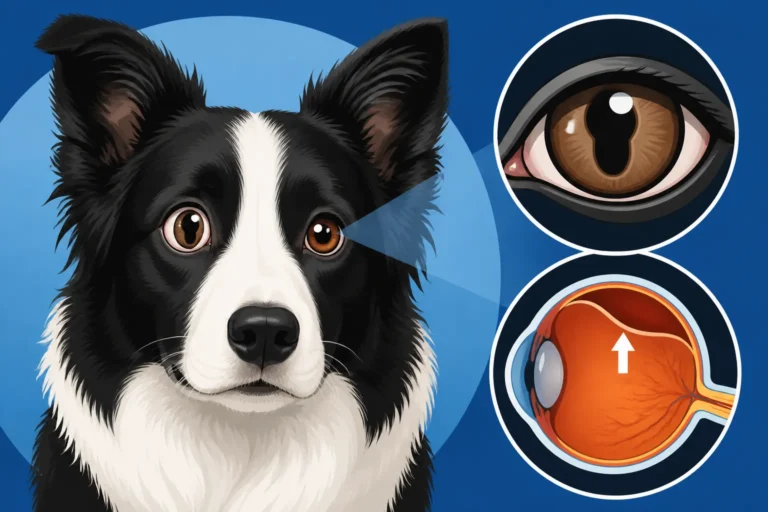
Border Collie coloboma is a congenital eye defect linked to collie eye anomaly, optic disc malformation, and retinal detachment risks.

Mildly affected Border Collies with Choroidal Hypoplasia have normal vision because the congenital eye condition does not worsen.

A choroidal defect in a Border Collie stems from an inherited NHEJ1 gene mutation affecting the crucial retinal tissue layer.

Border Collie litter eye exams by veterinary ophthalmologists detect inherited conditions like Collie Eye Anomaly at six to eight weeks.

Current research locations and neurological causes of Border Collie Collapse, a condition causing sudden exercise-induced physical instability in dogs.

Border Collie Collapse and seizures have distinct symptoms, triggers, and recovery times that owners can easily identify.