Whether a Thin Border Collie Is Underfed or Just Fit
It's a common sight for Border Collie owners: you look at your dog, all legs and angles, and a little voice in your head wonders, "Are they too thin? Am I feeding them enough, or is this just… them?" Many of us worry we're somehow failing our active, energetic companions, especially when we see other breeds carrying more visible flesh. This guide is here to help you understand the unique physique of the Border Collie and confidently determine whether your lean dog is indeed healthy and fit, or if it might be time to adjust their care.
The Border Collie Physique: Built for Work, Not for Bulk
Border Collies are renowned for their incredible athleticism, intelligence, and tireless work ethic. These aren't couch potato dogs designed to carry extra weight; they're finely tuned machines built for speed, agility, and endurance in demanding environments. Thinking about their history, chasing sheep across hilly, often cold and rugged terrain all day, every day, makes you understand why a lean, muscular body is not just desirable but essential for their performance and well-being.
Understanding the Working Dog Standard
When we talk about a "working dog standard," we're really talking about a dog whose body is optimized for a specific, physically demanding job. For a Border Collie, that means a sleek, powerful frame with minimal body fat, allowing for maximum efficiency in movement. Unlike some breeds where a heavier, more substantial build is part of their aesthetic or historical role, a Border Collie benefits from being light on its feet. A layer of insulating fat might be great for a sled dog, but for a dog that needs to sprint, stop on a dime, and change direction instantly, every extra ounce is a hindrance. Their structure supports quick bursts of energy followed by sustained periods of moderate activity, all requiring a streamlined physique. This is often quite different from what we might consider "normal" for a more sedentary companion breed, which often carries a bit more padding.
The Importance of a Defined Tuck and Ribs
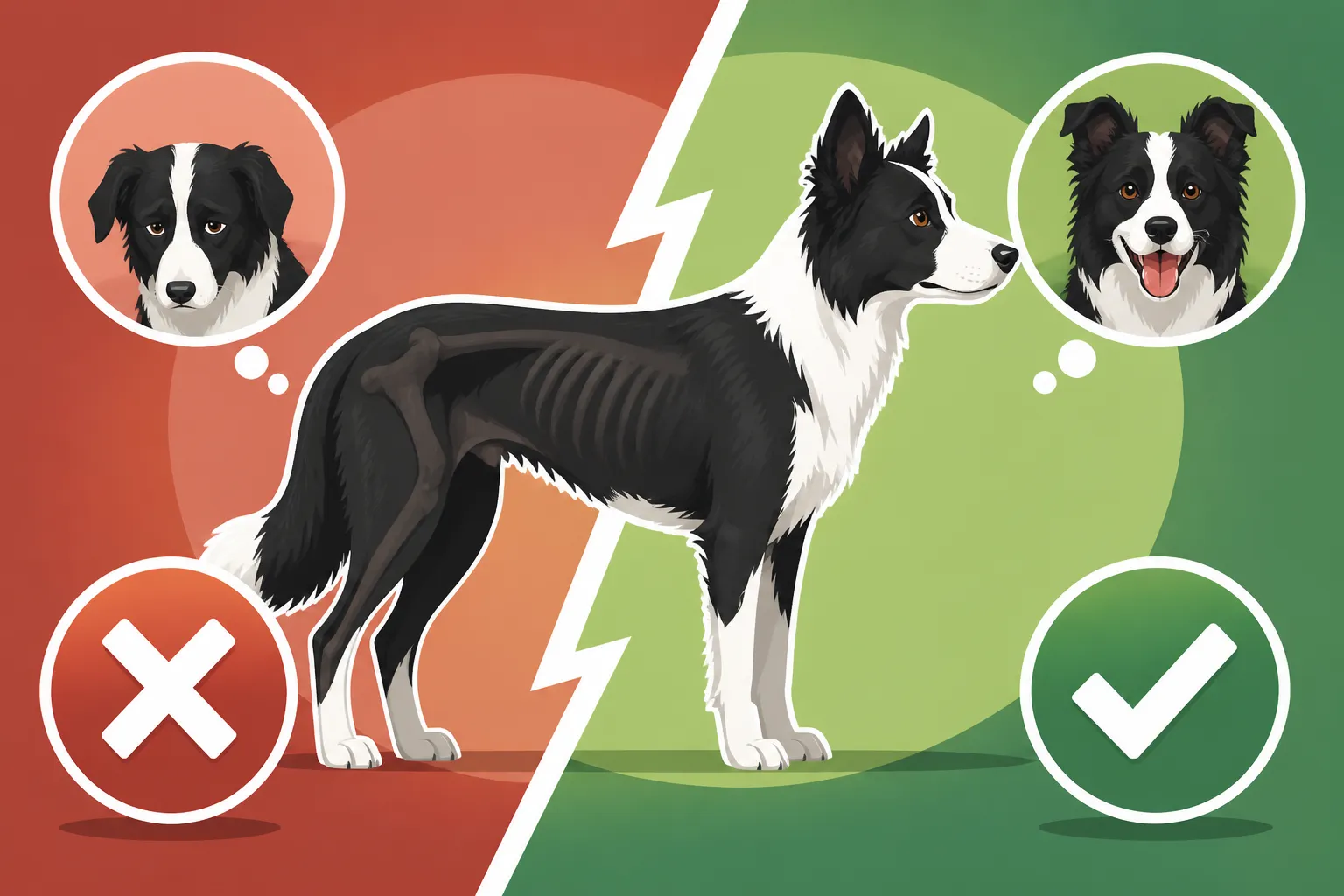
A healthy, fit Border Collie should appear lean and athletic. When you look at your dog from the side, you should notice a distinct "tuck" in their abdomen, meaning their belly should rise up from their ribcage towards their hind legs rather than hanging flat or sagging. This isn't just about aesthetics; it indicates a good muscle-to-fat ratio. From above, you should see a clear waistline behind their ribs, tapering in.
When you run your hands along their sides, you should be able to easily feel their ribs, almost like feeling the knuckles on your hand, but not see them protruding sharply without any effort on your part. You should also be able to feel their hip bones and the top of their spine with light pressure. The key is feeling them easily, not having them stick out so much that they look like sharp points or give the impression that there's no muscle or fat covering them at all. This level of leanness is often what causes owners to worry, but it’s often a sign of peak physical condition for a working-line Border Collie. The question isn't whether you can feel them, but how easily and how sharply they present. It's a delicate balance; too much padding and they're carrying unnecessary weight, too little and it could indicate a problem. This ideal is part of The Body Condition a Sport Border Collie Carries and is crucial for their performance. You'll often find that Whether Working Border Collies Run Lighter is a common observation among handlers.
Signs of a Truly Underfed Border Collie
While a lean Border Collie is usually a healthy one, there are definite signs that indicate your dog might actually be underfed or suffering from an underlying health issue. It's important to distinguish between a naturally fit dog and one that is genuinely struggling to maintain its weight.
Beyond Just Visible Ribs: Other Red Flags
If your Border Collie is truly underfed, you'll typically notice more than just prominent ribs. A truly underfed dog will often exhibit a significant loss of muscle mass, particularly over their spine, hips, and shoulders. Their hindquarters might look sunken, and their topline could appear bony and sharp. You might also notice a dull, dry, or brittle coat that lacks luster, sometimes accompanied by excessive shedding. Their eyes might seem sunken or lack their usual sparkle, and their overall demeanor could change dramatically.
Instead of their typical boundless energy and enthusiasm, an underfed Border Collie might become lethargic, sleeping more than usual, showing disinterest in their favorite activities like a game of fetch or a herding session. They might seem weaker or tire quickly. Some underfed dogs become ravenously hungry, constantly seeking food, while others, paradoxically, might become finicky or lose their appetite if an underlying health issue is the cause. These cumulative signs, rather than just visible ribs, are what truly signal a problem.
Digestive Issues and Nutrient Absorption
Sometimes, a Border Collie isn't necessarily underfed in terms of the quantity of food, but rather isn't absorbing the nutrients from the food it consumes. Persistent digestive issues like chronic diarrhea, frequent loose stools, or regular vomiting can be major red flags. If food is passing through their system too quickly or if their digestive tract isn't functioning optimally, they simply can't extract the necessary calories and nutrients. This can lead to weight loss even if they're eating what seems like an appropriate amount.
Conditions such as inflammatory bowel disease, exocrine pancreatic insufficiency, or even parasites can interfere with nutrient absorption. One such specific condition is Cobalamin Malabsorption in a Border Collie, which can lead to a deficiency in Vitamin B12 and significant weight loss. If you notice any consistent digestive upset along with weight loss, it's crucial to consult your veterinarian. They can perform tests, including a thorough physical exam as part of The Annual Exam a Border Collie Needs and potentially Yearly Bloodwork for a Border Collie, to pinpoint the cause and recommend appropriate treatment or dietary changes. Don't just assume it's "just how they are" if these other symptoms are present.
Assessing Your Border Collie's Body Condition Score
One of the most objective ways to determine if your Border Collie is at a healthy weight is by using a Body Condition Score (BCS) system. This method is widely used by veterinarians and provides a standardized way to assess a dog's fat reserves.
The Visual and Palpation Method
The most common BCS systems use a scale of either 1-5 or 1-9, with the middle score (3/5 or 4-5/9) representing the ideal weight. To assess your dog, you'll need to combine visual inspection with gentle palpation (feeling with your hands).
Visual Assessment:
- From Above: Look down at your Border Collie. Do you see a distinct waistline tucked in behind their ribs? In an ideal weight, it should be clearly visible. If they look like a straight line or bulge outwards, they might be overweight. If the waist is extremely pinched or severe, they could be underweight.
- From the Side: Observe your dog's profile. You should see an abdominal tuck, where the belly rises upwards from the end of the ribcage. If their belly sags or is flat, they might be carrying too much weight. If their ribs are visually prominent with no discernible abdominal musculature, they could be too thin.
Palpation Assessment:
- Ribs: Gently run your hands along your dog's sides. You should be able to feel their ribs easily, much like feeling the back of your hand. If you have to press firmly to feel them, they might be overweight. If the ribs are sharply defined and feel like sharp ridges with no fat or muscle covering, they might be underweight. This is particularly important with a rough-coated Border Collie, as their fur can easily hide their true condition; you need to get your hands on them, as Feeling Ribs Through a Rough Border Collie's Coat can be tricky!
- Spine and Hip Bones: Run your hands over their spine and hips. You should be able to feel these bones with slight pressure, but they shouldn't feel sharply protruding or painful. If they're completely covered and hard to feel, they're likely overweight. If they're extremely prominent and sharp, they're likely underweight.
Here's a simplified look at a 5-point Body Condition Score:
| Score | Description | Visual Assessment (Side & Top) | Palpation Assessment (Ribs) |
|---|---|---|---|
| 1 | Emaciated | Ribs, spine, pelvis prominent. No fat, obvious muscle loss. | Ribs, spine, pelvis easily visible and feel very sharp. |
| 2 | Very Thin | Ribs, spine, pelvis easily visible. Minimal fat, some muscle loss. | Ribs easily felt, minimal tissue cover. |
| 3 | Ideal/Lean (Typical for working Border Collie) | Ribs, waist, abdominal tuck visible but not extreme. | Ribs easily felt with slight fat cover. |
| 4 | Overweight | Waist absent or barely visible. Abdominal tuck reduced. | Ribs felt with difficulty; moderate fat cover. |
| 5 | Obese | No waist, rounded body shape. No abdominal tuck. | Ribs not palpable or felt only with significant pressure. |
For many working Border Collies, a score of 3 (on a 5-point scale) or 4-5 (on a 9-point scale) is absolutely ideal. It means they're lean, well-muscled, and ready for action. Remember that The Weight Range a Border Collie Standard Allows is broad, and individual variations are expected, so focusing on BCS is more helpful than a number on a scale.
When to Consult Your Vet
If, after performing a BCS assessment, you're still unsure about your Border Collie's condition, or if you suspect they might be genuinely underweight, it's always best to consult your veterinarian. They have the expertise to provide an accurate, unbiased assessment and rule out any underlying medical conditions.
You should definitely schedule a vet visit if your Border Collie:
- Has experienced rapid, unexplained weight loss.
- Shows a significant decrease in energy or enthusiasm for activities.
- Develops a dull, poor-quality coat.
- Exhibits consistent changes in appetite (either ravenous or completely disinterested).
- Has ongoing digestive issues like chronic diarrhea or vomiting.
- Has visible muscle wasting.
Your vet can perform blood tests, fecal exams, and other diagnostics to check for parasites, thyroid issues, metabolic disorders, or other health problems that could be impacting their weight. Catching these issues early is key to successful treatment and getting your Border Collie back to their optimal, healthy, lean self.
Optimizing Nutrition for a Healthy, Fit Border Collie
Ensuring your Border Collie is getting the right fuel is paramount to maintaining their lean, muscular physique and supporting their high energy levels. It’s not just about quantity; it’s very much about the quality of the food and how it’s managed throughout their day.
High-Quality Diet for Active Dogs
A Border Collie, whether they're working sheep, tearing up an agility course, or simply being an incredibly active family companion, requires a diet specifically formulated for active dogs. This means a food with appropriate levels of high-quality protein and fat to support muscle maintenance and provide sustained energy. You’re looking for ingredients that are easily digestible and provide a dense nutritional punch, rather than fillers that offer empty calories.
Many owners opt for commercial dog foods that specifically market themselves as "performance" or "active dog" formulas. Brands you might consider exploring include those found readily on sites like Chewy or Amazon, where you can read ingredient lists and reviews. Some people even prefer fresh food options, with services like Ollie delivering tailored meals right to your door. Regardless of the brand or type, look for a diet where the first few ingredients are identifiable meat proteins (chicken, beef, lamb, fish) and where fat sources are healthy and contribute to energy needs. The calorie load a Border Collie burns during intense activity, such as How Many Calories a Border Collie Burns Herding, means they need nutrient-dense food. Consider The Calorie Load a Working Border Collie Burns when choosing their diet.
It's also important to consider when you feed them. For highly active dogs, feeding a larger meal right after a strenuous activity can help with recovery, or splitting their daily ration into two meals can aid digestion and ensure a steady energy supply. Don't forget that Feeding a Border Collie That Works Two Hours a Day is different from feeding one that works for ten!
Adjusting Portions and Monitoring Weight
The amount of food your Border Collie needs is far from a static number. It's a dynamic equation influenced by their age, activity level, individual metabolism, the specific caloric density of their food, and even the weather. A young Border Collie just coming into their prime will likely need more calories than an older, retired dog. Likewise, a Border Collie running a full day on the farm or competing in trials will burn significantly more calories than one who enjoys daily long walks and puzzle games.
You'll need to observe your dog's body condition and adjust their food portions accordingly. If they start looking a little too lean, increase their food slightly. If they begin to gain too much weight, cut back a bit. Regular, gentle palpation of their ribs and observing their waistline are your best guides. Many performance dog owners also weigh their dogs regularly to track trends. Don't be afraid to adjust food amounts seasonally; for example, Whether a Border Collie Needs Extra Food in Winter is a valid consideration if they're spending more time outdoors in cold conditions. The goal is to keep them at that lean, athletic ideal where you can easily feel their ribs but they don't look bony or frail. This takes ongoing vigilance and a willingness to tweak their diet based on their changing needs.
Exercise, Hydration, and Overall Well-being
Beyond just food, a Border Collie's overall health and ability to maintain a lean, fit body are deeply intertwined with their exercise regimen and proper hydration. These aren't just supplementary; they are foundational pillars for this active breed.
Balanced Exercise for Muscle Tone
It might seem counterintuitive, but sometimes a Border Collie can appear "thin" not from being underfed, but from improper exercise or simply not enough of the right kind of exercise to build robust muscle. An over-exercised dog that isn't receiving adequate nutrition can be too thin, but a dog that gets plenty of varied, challenging work will develop a strong, lean musculature that gives them that athletic, fit appearance. If a Border Collie is just running endlessly without engaging different muscle groups, or without the proper nutrition to repair and build, they might look wiry rather than powerfully agile.
The key is balanced exercise. This means incorporating activities that build strength, endurance, and flexibility. Think about activities like hill sprints, swimming, varied terrain hiking, and of course, their natural outlet of herding or dog sports like agility. These build the kind of muscle that rounds out their frame without adding unnecessary fat. A Border Collie who is physically strong will look lean, yes, but also robust and capable, not fragile.
The Role of Hydration and Routine Checks
Hydration is absolutely critical for all dogs, but especially for active breeds like Border Collies. Water plays a vital role in every bodily function, including nutrient absorption, temperature regulation, and joint lubrication. Dehydration can quickly impact their energy levels, performance, and overall health. Always ensure your Border Collie has constant access to fresh, clean water, especially before, during, and after any exercise. On hot days or during intense activity, they'll need significantly more. It's truly amazing How Much a Border Collie Drinks on a Working Day.
Finally, make it a habit to perform The Weekly Once-Over a Working Border Collie Gets. This involves a quick, top-to-tail check of your dog. Feel their ribs, spine, and hips. Check their coat and skin for any changes. Look into their eyes and ears. Observe their gait and energy levels. This routine vigilance allows you to catch subtle changes early, whether it's a slight drop in weight, a change in coat quality, or a dip in their usual enthusiasm. These small observations are your first line of defense in ensuring your lean Border Collie remains a picture of health and fitness.
So, the next time you look at your Border Collie and wonder if they're too thin, remember that lean often means fit for this incredible breed. By understanding their unique physique, diligently monitoring their body condition score, providing a high-quality diet, and ensuring appropriate exercise and hydration, you can confidently celebrate your Border Collie's athletic, healthy build.
Disclaimer
This article is for general informational purposes only and does not constitute professional advice. Laws, prices and regulations vary by location and change over time. Consult a qualified professional for guidance on your specific situation.