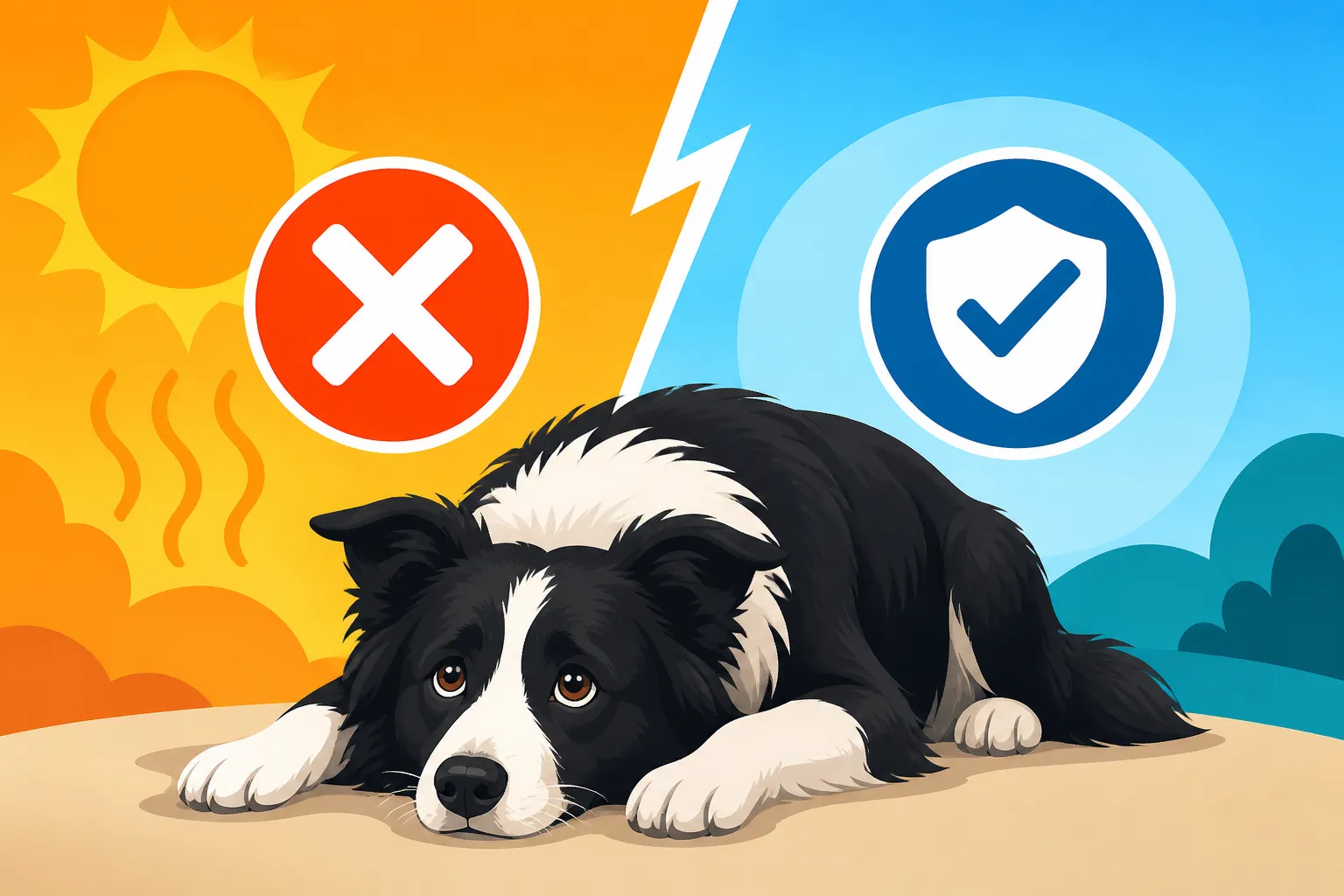
Why Overheating Does Not Explain Border Collie Collapse
It’s incredibly frustrating when your beloved Border Collie exhibits alarming symptoms, collapsing after exercise, only for someone to shrug and say, "Oh, they just overheated." This dismissive attitude completely misses the mark and can leave owners feeling unheard and helpless. This guide aims to thoroughly explain why Border Collie Collapse (BCC) is a distinct, complex neurological condition, not merely a case of your dog getting too warm, and what that means for understanding and managing it.
The Frustrating Misconception of "Just Overheating"
Let's be honest, it's easy for people, even well-meaning vets or fellow dog enthusiasts, to jump to conclusions when a dog, especially an active breed like a Border Collie, collapses. The symptoms can seem similar to heatstroke at first glance, leading to a pervasive and deeply unhelpful misconception that often delays proper diagnosis and treatment. For an owner watching their otherwise vibrant dog suddenly go weak, drag its hind legs, or become disoriented, being told it's "just" overheating can feel incredibly invalidating.
Why It's an Easy Assumption to Make
The immediate presentation of Border Collie Collapse can indeed mimic aspects of heatstroke. Both conditions often occur after physical exertion, especially in warm weather or during intense activity. Dogs with either condition might appear lethargic, weak, or uncoordinated. Panting might increase, and in severe heatstroke, dogs can collapse. This surface-level similarity makes it all too simple for an observer to equate the two, especially if they aren't familiar with the nuances of specific breed-related conditions. Many people, when they see a highly driven dog suddenly falter, immediately think the dog pushed itself too hard and simply got too hot. It's a common enough occurrence in any breed if they're over-exercised in unsuitable conditions, so why wouldn't it be the case for a Border Collie?
However, this assumption overlooks critical distinctions. While heat can certainly exacerbate a BCC episode, it is not the underlying cause. Border Collies are bred for endurance and often work in varying temperatures, a testament to their physiological capabilities. To assume every collapse is heat-related underestimates the breed's hardiness and, more importantly, misrepresents the serious, internal mechanism at play in BCC. It’s akin to saying a person with a seizure disorder just “fainted from exertion” because both involve a temporary loss of control, ignoring the vastly different physiological origins.
The Real-World Impact of This Misconception
The biggest problem with the "just overheating" myth is the severe delay it can cause in getting your dog the correct diagnosis and management. If an owner, or even a primary care vet, dismisses episodes as simple heat exhaustion, they might not pursue the specific testing or specialist consultation needed for Border Collie Collapse. This means your dog might continue to have episodes, potentially putting them at risk, and you remain in the dark, unable to effectively prevent or mitigate future incidents. It’s a frustrating cycle where a lack of understanding leads to ineffective solutions.
Imagine you're at a trial, and your dog has an episode. Someone tells you to just "cool them down" and offers ice packs and water. While these actions might be helpful in any situation involving an exerted dog, they don't address the core issue of BCC. You might diligently follow cooling protocols, only for your dog to collapse again the next time they work, even in cooler weather or after moderate exercise. This repeated failure to prevent episodes, despite your best efforts to "cool them," can lead to immense stress, confusion, and even guilt for owners who feel they're doing something wrong, when in reality, the fundamental problem hasn't been identified. This is why understanding "Border Collie Collapse and What Sets It Off" is so vital.
Diving Deep into Border Collie Collapse (BCC)
Border Collie Collapse is a perplexing condition, often leaving owners scratching their heads. Unlike a simple case of overheating, BCC is a specific, exercise-induced neurological syndrome. It’s not just about temperature; it’s about a complex interplay within the dog's central nervous system that malfunctions under certain physiological stresses, particularly intense excitement and sustained high-level activity.
What BCC Truly Looks Like vs. Heatstroke
When a Border Collie experiences a BCC episode, the symptoms are distinct from heatstroke, though some initial signs can overlap. Typically, BCC begins with a progressive weakness and uncoordination in the hind limbs, often after 5 to 15 minutes of intense activity like repeated ball retrieving or herding. The dog might start to drag its back legs, adopt a stiff, "wooden" gait, or even develop a characteristic "wobbling gait" as it tries to keep moving. They might appear confused or disoriented, but they usually remain conscious and aware of their surroundings. This is a crucial differentiator from severe heatstroke, where dogs can become unresponsive or lose consciousness.
Here's a comparison to highlight the differences:
| Symptom / Feature | Border Collie Collapse (BCC) | Heatstroke (Severe) |
|---|---|---|
| Onset | 5-15 min into intense exercise, often excitement-driven | During/after exertion in hot/humid conditions |
| Consciousness | Conscious, often disoriented but aware | Can be unresponsive, collapse, loss of consciousness |
| Gait | Hind limb weakness, wobbly, stiff, dragging legs | General weakness, collapse, may struggle to stand |
| Mentation | Confused, vacant stare, but responds to voice | Disoriented, stupor, seizures, coma |
| Rectal Temp. | Normal to slightly elevated (rarely above 106°F) | Very high, often 106°F or higher |
| Panting | Often present, but may not be extreme | Excessive, frantic, persistent |
| Mucous Membranes | Normal to slightly pale/gummy | Bright red, then pale/grey, dry |
| Recovery | Within 5-30 minutes, full recovery, no lasting effects | Can be prolonged, require intensive vet care, permanent organ damage possible |
| Triggers | High excitement, repeated retrieving, specific exercises | High ambient temp, high humidity, lack of shade/water, over-exertion |
As you can see from the table, while some elements like panting might be present in both, the quality of the collapse and recovery is quite different. With BCC, dogs usually recover relatively quickly and completely, often within 15 to 30 minutes, and return to normal behavior without any residual weakness or damage. Heatstroke, especially severe heatstroke, can lead to organ damage, prolonged recovery, and even death if not aggressively treated. It's vital for owners to understand "What a Border Collie Collapse Episode Looks Like" to differentiate it from other conditions.
The Neurological Basis of BCC
Current research strongly points to a neurological basis for Border Collie Collapse, distinguishing it definitively from simple overheating. It’s classified as an "exercise-induced collapse" (EIC) syndrome, similar to what's seen in other breeds, though the specific genetic markers can differ. In Border Collies, it's believed to be related to abnormalities in neurotransmitter function or energy metabolism within the brain and spinal cord, particularly during high-intensity exercise that combines physical exertion with intense excitement. The actual mechanism involves a transient dysfunction of the central nervous system, affecting the communication between the brain and the muscles, leading to the characteristic wobbly gait and hind-limb weakness.
This neurological glitch isn't about the dog's core body temperature reaching dangerous levels, but rather how its brain handles the physiological stress of intense work. Think of it less like a car engine overheating and more like a computer temporarily crashing under too much processing load. The dog's internal systems, particularly the nervous system, become overwhelmed, leading to a temporary "shutdown" of motor control, especially in the hindquarters. It's why dogs can collapse even on cool days or after relatively short bursts of activity, especially if that activity is highly stimulating or involves "Excitement as a Trigger for Border Collie Collapse". This is far more complex than just needing a fan or a cool drink.
Clinical Evidence and Research Separating BCC from Heatstroke
The scientific community has made significant strides in understanding Border Collie Collapse, moving beyond anecdotal observations to gather robust clinical data. This research unequivocally supports the distinction between BCC and heatstroke, providing owners and veterinarians with clearer diagnostic pathways.
The Role of Temperature in BCC Episodes
One of the most compelling pieces of evidence against the "overheating" theory is the dog's body temperature during and immediately after a BCC episode. While a dog experiencing BCC might have a slightly elevated temperature due to exertion, it rarely reaches the critical, life-threatening levels seen in heatstroke. Typically, a dog with BCC will have a rectal temperature of 103°F to 105°F (39.4°C to 40.5°C), which, while warm, is well below the 106°F (41.1°C) or higher often seen in heatstroke victims that require emergency intervention. Furthermore, their temperature usually returns to normal quite rapidly once activity ceases, often within minutes, even without aggressive cooling measures. This is a stark contrast to heatstroke, where hyperthermia is persistent and requires significant effort to bring down.
Studies have also shown that BCC episodes can occur in mild or even cold weather, further decoupling the condition from ambient temperature. A Border Collie can collapse in a snowfield just as readily as on a warm day, provided the intensity and excitement levels are high enough. This challenges the notion that external heat is the primary driver. It really underscores "Why Overheating Does Not Explain Border Collie Collapse" and points to an internal, physiological trigger. This is not to say that extreme heat can't worsen an episode or make a dog more susceptible, but it's not the root cause. Owners should always practice responsible exercise in any weather, but for BCC dogs, heat is merely another factor, not the factor.
Diagnostic Processes and Ruling Out Other Conditions
Diagnosing Border Collie Collapse involves a careful process of elimination and specific testing. Vets will first rule out other conditions that might present similarly, such as cardiac issues, orthopedic problems like hip or elbow dysplasia, metabolic disorders, or even certain types of seizures. This usually involves a thorough physical exam, blood work to check for electrolyte imbalances or organ damage (which are often normal in BCC), and potentially cardiac evaluations.
The definitive diagnosis often comes from a combination of characteristic clinical signs observed during or immediately after an episode, the rapid and complete recovery, and crucially, genetic testing. While the specific gene markers for BCC in all Border Collies are still being fully mapped out, researchers have identified certain genetic predispositions to exercise-induced collapse in some related breeds, and ongoing research is pinpointing these in Border Collies as well. Labs like OptiGen offer panels that screen for various genetic conditions, and while a direct BCC gene isn't always on every panel, ruling out conditions like Trapped Neutrophil Syndrome or Neuronal Ceroid Lipofuscinosis can be part of the broader diagnostic picture. Knowing about "The Border Collie Genetic Panel and What It Screens" can be incredibly helpful for owners and breeders alike. This targeted genetic testing helps to confirm the underlying susceptibility, giving owners a clear answer and a path forward.
Managing a Border Collie with BCC – Beyond Cooling
Once a Border Collie Collapse diagnosis is confirmed, the focus shifts from a simplistic "cool them down" approach to a more nuanced, individualized management strategy. This is where owners truly become advocates for their dogs, understanding their unique triggers and adjusting their lifestyle accordingly.
Tailoring Exercise and Avoiding Triggers
The cornerstone of managing BCC is identifying and avoiding the specific triggers that precipitate an episode. Since excitement and high-intensity, repetitive activities are often the culprits, tailoring your dog's exercise routine is paramount. This doesn't mean your Border Collie can't be active; it means being smart about how they're active. For some dogs, "Repeated Ball Retrieving and Border Collie Collapse" is the prime trigger, while for others, intense herding sessions or high-octane agility runs might be problematic.
Instead of endless fetch sessions, consider activities that engage their minds without pushing them into that high-arousal, repetitive physical state. Scent work, tracking, or even trick training can provide excellent mental stimulation. If they love herding, shorter, less intense sessions with plenty of breaks might be necessary. For agility dogs, adjusting routines to reduce back-to-back weaving or jumping sequences could help. It's a process of careful observation and experimentation to understand your individual dog's limits and the particular types of stress (both physical and mental) that lead to collapse. The goal is to keep them happy and engaged without crossing the line into an episode.
Proactive Steps and Living with BCC
Living with a Border Collie prone to collapse requires proactive planning and a deep understanding of the condition. Beyond managing exercise, ensuring a calm environment, especially before and after stimulating activities, can make a significant difference. Learning to recognize the early signs that your dog is approaching an episode can allow you to intervene, call a halt to the activity, and prevent a full collapse. This might look like a subtle change in their gait, a vacant stare, or a slight slowing before the more obvious hind-limb weakness sets in. Learning how to identify these early warning signs is crucial, and it takes time and keen observation.
For owners, having a solid support system and financial preparedness are also key. While BCC itself isn't life-threatening, the diagnostic journey and potential follow-up vet visits can add up. This is where reliable pet insurance like Healthy Paws can really step in and offer peace of mind. Knowing that you have coverage for unexpected vet bills related to diagnostics or ongoing management means you can focus on what's best for your dog, rather than worrying about the cost. It can be a huge relief, especially when facing conditions that might require specialist consultations or specific treatments, though thankfully BCC often requires management rather than medication. While medications aren't typically used to prevent BCC episodes, sometimes a vet might recommend supportive care or rule out other issues that may require treatment. Pet insurance, such as through Healthy Paws, can cover a significant portion of these diagnostic costs, including consultations and tests. It’s also worth considering how "Insuring a Border Collie Against Epilepsy and Joints" could also extend to other neurological conditions that might need expensive workups.
Ultimately, living with a Border Collie with BCC means accepting that they have a unique physiological quirk, not a flaw. It means educating others, including your family, dog walkers, and even your vet if they are unfamiliar with the condition, about the true nature of Border Collie Collapse. It’s about being your dog’s best advocate and adapting their world to ensure they can live a full, happy, and active life within their specific limitations. It’s definitely not about "just overheating."
Disclaimer
This article is for general informational purposes only and does not constitute professional advice. Laws, prices and regulations vary by location and change over time. Consult a qualified professional for guidance on your specific situation.